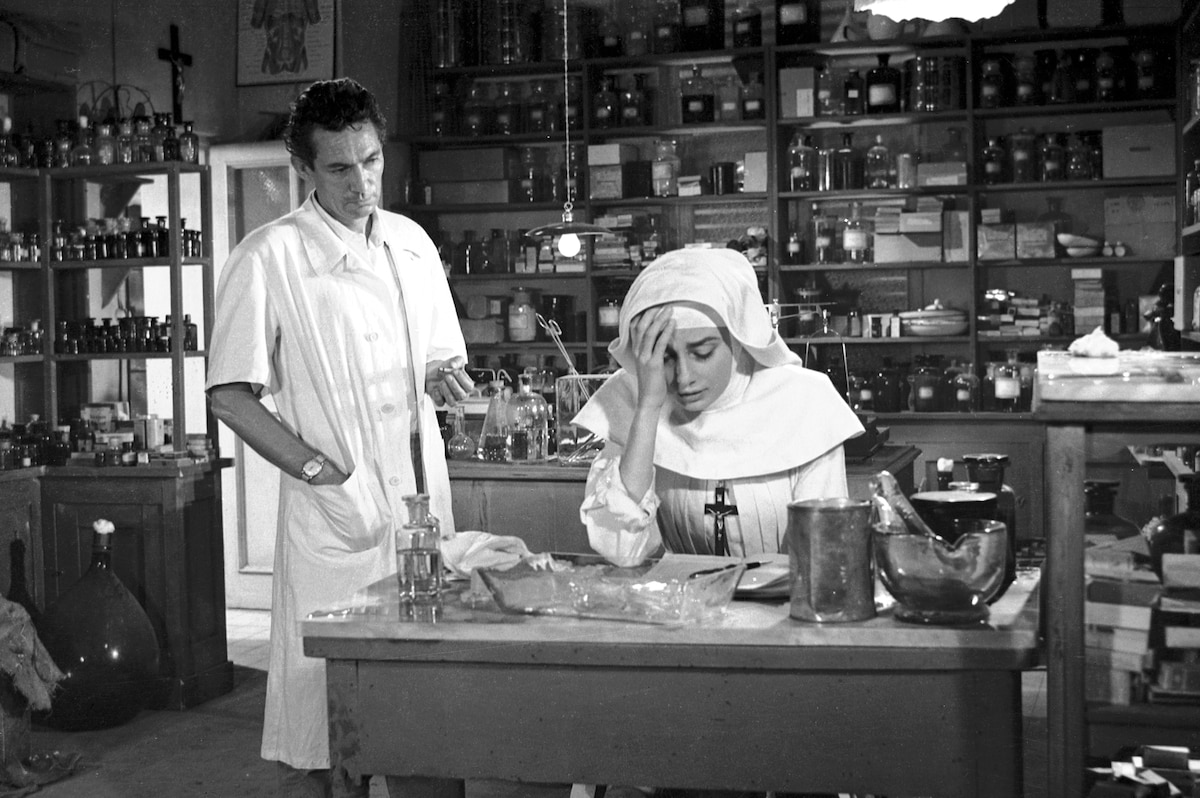
Films about the religious life have seldom been very realistic. Vintage Hollywood was prone to concocting feel-good movies about ministers and priests opening orphanages, perhaps singing as they convinced local misers to help fix the roof of the chapel. As attractive movie stars see playing priests and nuns as interesting career turns, the films often carry with them an odd uneasiness: when is the romance going to begin?
Fred Zinnemann's 1959 The Nun's Story was such an uncompromising change of pace that it seems a courageous project even by today's standards. Author Kathryn C. Hulme had served as a director of a United Nations Relief and Rehabilitation Administration (UNRRA) Camp in liberated Germany, helping displaced persons. She met the subject of her book, ex- nun Marie-Louise Habets, while both women were doing this work. Gary Cooper first sent Hulme's #1 bestseller to director Fred Zinnemann. One of his most celebrated movies, The Search (1948) is a touching humanist document about the efforts of the UNRRA. Zinnemann met Hepburn during preparations for the 1956 Italian production of War and Peace. Paramount turned down the Nuns project, and Jack Warner's initial opinion was that "no one wants to see a documentary on how to become a nun." The interest of the highly bankable Audrey Hepburn made the film possible.
The famed playwright Robert Anderson was engaged at an early date to write the screenplay. He thought of it as a perfect vehicle for Ingrid Bergman, but the actress knew she was too old for the part, and suggested Audrey Hepburn as well.
The highly independent Hepburn identified strongly with Habets, whose name in the book was changed to Gabrielle Van Der Mal. Both women had lost beloved fathers, and both had lost brothers in the war. Hepburn's popularity and reputation for integrity smoothed over many preproduction problems. The Catholic Church worried that the film's account of the hardships experienced by Hepburn's "Sister Luke" would be bad for recruiting. They questioned scenes in the Congo in which Sister Luke has a potentially romantic relationship with an Italian doctor. This made sense considering the romantic stars that where considered for the role. Gérard Philipe and Yves Montand wanted too much money, or thought the part of the doctor was too small. English actor Peter Finch had just turned forty, and had just played a rugged, romantic leading man in the war movie A Town Like Alice (1956). Like his character Dr. Fortunati, Finch had a reputation as a hell-raiser and womanizer. The business-oriented Hepburn was faithful to her actor-director husband Mel Ferrer.
A remarkable group of actresses was enlisted to play the nuns that train and supervise Hepburn's Sister Luke: Dame Edith Evans, Dame Peggy Ashcroft, Mildred Dunnock, Beatrice Straight, Patricia Collinge, Rosalie Crutchley, Ruth White and Barbara O'Neil. To prepare for their parts, the ladies were allowed to live in convents for a number of days. Zinnemann drove to see them every morning; the women would run out and tell him that they were fascinated and excited, even though it was freezing cold in the cloister. Of all the actresses playing nuns, the director was most impressed with Peggy Ashcroft. An agnostic, Ashcroft nevertheless projected an undeniable mystic quality.
Sister Luke's challenge is to become a selfless, sacrificing 'instrument,' for whom the love of God takes precedence over every mortal concern. In granting their approval, The Church objected to one line in which Edith Evans' Mother Superior says that a nun's life is "against nature." Director Zinnemann remembered reaching a compromise in which the words were changed to, "above nature." But in the final film the original reading prevails. A Nun's Story came through uncompromised.
Filming was split between Belgium, the Belgian Congo, and interiors in Rome. Hepburn had requested cameraman Jack Cardiff, a veteran of shoots in Africa. She was pleased with the choice of Franz Planer, who had filmed her hit Roman Holiday (1953) and would later be responsible for the stylish Breakfast at Tiffany's (1961). Most of the film's entire first hour took place in a convent during Sister Luke's training. Zinnemann proposed that this section be filmed in B&W, but the studio overruled the idea as being too arty. The makeup for the nuns required special thought. They had to look as though they weren't wearing any, but it was unthinkable to allow a glamorous star like Hepburn to go without. Her eye treatment was carefully minimized.
Audrey Hepburn loved working in the Congo with the cast and crew, but did ask for a few perks. Her tiny terrier dog was waived through the colonial quarantine rules, and she was granted an air conditioner for her room. But she also traveled to work in a small canoe, in rivers inhabited by herds of friendly but dangerous hippos. For one sequence the company moved upriver to a mission hospital caring for patients suffering from leprosy. Hepburn took a keen interest in the social work being done. The doctor assured Hepburn and actor Niall MacGuinness that there was little or no chance of visitors contracting the disease - but added that the incubation period was seventeen years. The African extras were confused when they saw actresses in nun's clothing smoking cigarettes; Hepburn even used a cigarette holder. Zinnemann recalled the Africans being satisfied with his explanation, "Oh, these are American nuns.
The crew was aware of political tensions during filming. The European government enforced a curfew for blacks that began at sunset. In 1960 the colonials were overthrown in a bloody revolution. Some of the real nuns that Zinnemann and Hepburn had worked with on location were killed.
Back in Rome, the company went to work on interior sets designed and built by the celebrated designer Alexandre Trauner. As The Church would not allow real nuns to serve as extras, the production hired trained dancers, who could be expected to gracefully mimic the group rituals and work for hours while wearing the confining garments. Fred Zinnemann cast his gallery of older, experienced nuns from the Roman social set. When Church officials visited to judge the film's recreation of a large chapel scene, at least one told Zinnemann that his nuns looked more devout than the real thing. The shooting was held up by almost a week when Audrey Hepburn came down with kidney stone trouble, which had reportedly begun when she was dehydrated in Africa. Production finished a little late, in June of 1958. Hepburn was well enough to rush back to Hollywood, where just four weeks later she began filming Green Mansions (1959) for her director-husband Mel Ferrer.
No American movie had examined a novice's struggle with the spiritual life as did The Nun's Story. As in the book, Sister Luke (Hepburn) has no difficulty fulfilling her vows of poverty and chastity, but the third vow of obedience became a grave obstacle. As he bids her farewell, her father (Dean Jagger) says that she is too independent and stubborn to conform to the role laid out for her by The Church. The first forty minutes of the film depict the 'boot camp' designed to mold the novices into a mold of utter selflessness, devotion and service. Telling details emphasize Sister Luke's innate individuality: told to cast off all possessions of her past life, she hangs onto a gold pen that her fiancé had given her. Lying prostrate on the floor, she sneaks a peek at the Mother Superior (Edith Evans). Although Sister Luke has experience in nursing and lab work and is the best of the students, a supervisor (Ruth White) notices the pride she takes in her personal accomplishments. Sister Luke is advised to prove her humility by purposely failing her exams.
Sister Luke is first assigned to a Church-run asylum, where she disobeys safety instructions and is attacked by a violent patient (Colleen Dewhurst, in a frightening performance). The Congo is in many ways an idyllic setting. But instead of doing her duty and maintaining a rigorous spiritual life as instructed by Mother Mathilde (Peggy Ashcroft), Sister Luke's competence and organizational reforms bring her into conflict with the somewhat arbitrary rules of her calling. The dedicated, slightly rakish Dr. Fortunati (Peter Finch) does not tempt her, but she is shaken by his continual criticism. Why should such a talented nurse be a nun? When an emergency arises, Sister Luke performs a difficult, demanding operation on her own. Yet she is expected to suppress her pride in the accomplishment.
A Nun's Story resolves Sister Luke's conflict of faith in a way that doesn't soften the pain of real-life decisions. Back in Belgium when war breaks out, she finds herself compelled to defy The Church's order to remain strictly neutral under the German occupation. The real-life nun's differences with The Church, unstated in the film, were more political, but the film does make clear that she leaves because she has lost her calling and wishes to become a nurse for the resistance. A quote from the real Marie-Louise Habets betrays no doubt: "I have given too many cups of water in His name and He knows I would go on doing it, whether working for Him as a nun or as a war nurse."
The final scene held audiences breathless, as Sister Luke returns to the secular world after seventeen years a nun. Director Zinnemann decided to end the film without curtain music, so as not to impose an opinion about Sister Luke's choice: audiences must decide for themselves. However, in addition to the bells on the soundtrack, we do hear a subtle note of organ music.
A Nun's Story is possibly Fred Zinnemann's most accomplished movie, especially given the difficulty of the subject. The cutting is remarkably fluid and his visuals are both elegant and austere. The overall style is quite modern for its year. Time jumps occur across cuts instead of dissolves; when a war montage is required Zinnemann handles it with simple voiceovers spoken over shots of trees under dark skies. There are no scenes of massed troops yet the occupation is firmly felt. Even at 2.5 hours, the studio did not request that cuts be made. The director's only regret was a minor detail. When Sister Luke's hair is revealed at the finish, it shows no signs of aging, not a single white hair.
Although Warners reportedly thought their show would be a flop, they gave it the full marketing push merited by Audrey Hepburn's star status. As it turned out, the Vatican reversed its position and approved of the picture whole-heartedly. The only real dissent was in connection with the book. Martin Quigley of the Catholic Legion of Decency objected to the depiction of a nun's life as inhumane forced labor. Nobody else had difficulty understanding that the film was a period piece; by 1959 conditions in most orders were much less rigorous.
The movie quickly became a notable, profitable success. Variety's notice praised it as a "soaring and luminous film," adding that it is Audrey Hepburn's "most demanding film role and (she) gives her finest performance." With her contracted ten percent of the gross receipts, A Nun's Story was Hepburn's most profitable film. Its prominence drew attention away from the recently-released Green Mansions, one of the actress's few flops. Although Ben-Hur swept the Oscars that year, Zinnemann's film garnered eight nominations, including one for Best Actress. Ms.Hepburn would later claim that the experience had a profound effect on her life. She would later dedicate much of her time and effort to the support and promotion of The United Nations Children's Fund (UNICEF). In 1989 she became a special UNICEF ambassador in Africa, Asia and Central and South America.
Playwright-screenwriter Robert Anderson wrote bicycle scenes for the movie because he saw that Audrey Hepburn liked bicycle riding. She rode bikes around film lots, but also on the streets of Beverly Hills.
The real-life Sister Luke left her order because of the Catholic Church's neutrality in the German occupation. Specifically, she cited The Church's failure to protest the treatment of Belgian Jews, and its support of King Leopold, who collaborated with the Nazis.
Both director Fred Zinnemann and Audrey Hepburn agreed that neither Sister Luke nor The Church should be fully responsible for her abandoning her vows, that the failure should be shared 'fifty-fifty.'
Hepburn's fee was $200,000 vs. ten percent of the gross receipts. When the film became a hit, she indeed did very well by it.
Fred Zinnemann remembered the film as a moving experience: "The strongest memory I retain is the total faith of so many nuns we met and the marvelous serenity with which they went about their duties and devotions."
By Glenn Erickson
