During the opening titles of The Hunters, the soundtrack roars with the whoosh of jets swooping through the sky. CinemaScope was five years old when this wide-screen war drama premiered in 1958, but Twentieth Century Fox still took great pleasure in showing off the stereophonic effects enabled by the process. This was the last of four theatrical features produced and directed by the (mostly) retired movie star Dick Powell in the 1950s, and he clearly designed the production for maximum impact on the senses. Assistance came from the United States Air Force and the Department of Defense, and from airfields in Arizona and Florida where the picture's aviation scenes were shot. The story isn't very original, but it looks and sounds terrific.
Wendell Mayes's screenplay is based on a novel by James Salter, a respected and successful author who served as an Air Force pilot and career officer until The Hunters, his first book, was published in 1956. Salter wrote a handful of movies, including Sidney Lumet's The Appointment and Michael Ritchie's Downhill Racer (both 1969), but he's best known for novels and stories, some of which draw directly on his military experiences. Like the main character of The Hunters, an Air Force officer named Cleve Saville (Robert Mitchum), he had boundless enthusiasm for flying, and also like Cleve he volunteered for combat duty in the Korean War, hunting down enemy MiGs as a hardworking fighter pilot. To make the best use of Mitchum's slow-burning ruggedness, the screen adaptation changes the story's emphasis from the downward spiral of a young flyer to the challenges faced by an older one, in combat and also in a love triangle. As usual, Mitchum rises fully to the occasion.
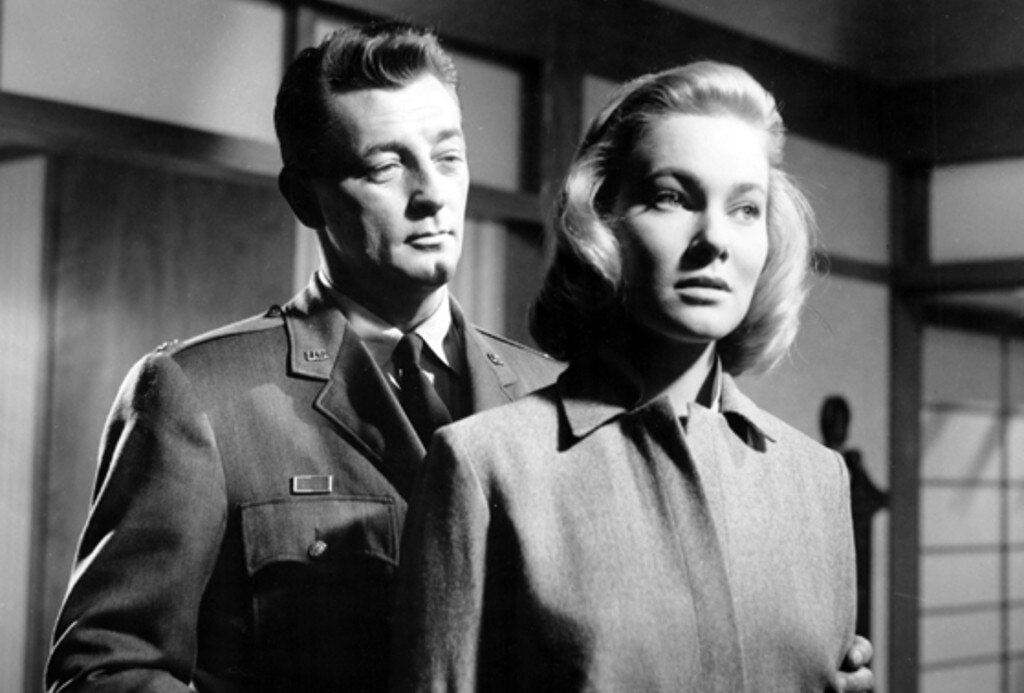
Cleve is a World War II veteran freshly stationed at the Itami Air Force Base in Japan, where he's assigned to a (fictional) fighter unit based on various actual groups. His colleagues include old friend Dutch Imil (Richard Egan), the colonel who commands the unit, and new acquaintance Karl Abbott (Lee Philips), a young lieutenant who never fails to fulfill a mission but drinks at other times to deaden his fears of getting shot down and killed. Karl's alcoholism has alienated him from his wife, Kris, a Norwegian woman played by the Swedish actress May Britt for some reason. Cleve meets Kris when he literally carries Karl home after a very boozed-up night, and it's clear from the get-go that the longtime bachelor and the unhappily married woman feel sparks of mutual attraction, if not flames of immediate love.
There's a war on, though, so Cleve travels to Seoul for a meeting with Dutch, which gives us more information about the rugged pilot. His cronies call him the Iceman, thanks to his unflappable demeanor and steely nerves. But he's a little on the old side - too old, technically speaking, for the missions he's volunteered to fly - and since time has passed since he last flew a fighter plane, Dutch wants to test his skills before sending him into combat. Cleve graciously agrees, and soon he's ready to join in the ongoing hunt for Russian planes flown by Chinese foes seeking to conquer the skies above Korean territory.
When he isn't flying, Cleve manages to spend more time with Kris, turning their friendship into a real romance. But the movie's main action is still in the sky, where likable Lt. Corona (John Gabriel) gets killed because arrogant Lt. Ed Pell (Robert Wagner) abruptly flies off to pursue an enemy on his own. Tensions escalate between Cleve and Karl, reaching a boiling point when Karl makes an outrageous proposition to Cleve, offering him a free hand with Kris in exchange for getting the first shot at a Chinese ace with the improbable name of Casey Jones, the most dangerous enemy pilot of all. Cleve eventually finds himself on the ground behind enemy lines with Karl, who's badly wounded, and Pell, who turns out to have a surprising streak of heroism. Since this is a highly traditional movie, the story's conflicts - professional, marital, and romantic - are all resolved in time for the final scene.
Like most Hollywood war pictures, The Hunters has no sympathy for individual enemy fighters, treating them as depersonalized figures with no recognizable traits except a penchant for cruelty - most visible in a tragic episode involving a family of Korean peasants - and a determination to shoot valiant Americans out of the sky. The movie also has little to say about the Korean War, mentioning only that American forces aren't allowed to cross the Yalu River and that seasoned warriors like Cleve regard the conflict as a disappointingly small-scale skirmish in comparison with their World War II adventures. Powell came to The Hunters after directing Mitchum in The Enemy Below (1957), a World War II film set on the high seas, but he gives the Korean hostilities the serious treatment they deserve. He also injects a fair amount of authenticity, using real F-86 Sabre fighters as well as F-84F Thunderstreak planes that stand in for MiG-15s flown by the enemy. The most graphic crash sequence uses documentary footage of an F-100 Super Sabre hitting the ground and exploding, obviously spliced in from another source but jolting and spectacular to see.
The Hunters didn't thrill many critics. New York Times reviewer Howard Thompson applauded Mitchum and Britt for their performances, praised "some strikingly pretty and picturesque settings of modern Kyoto, Japan," and commended "some of the cryptic dialogue exchanges back at the base." Calling those conversations "scorching reminders...from one small corner of a 'forgotten war,'" he accurately summed up the film's most interesting message: "Paradoxically, this picture is stating, with frank irony, that the Korean war, coming after the 'Big One,' seemed not to matter to a great many people." On a less positive note, Thompson found it puzzling that Mitchum's no-nonsense character "would 'protect' a selfish, whimpering and perennially hung-over neurotic" like Karl, risking his own life to save him. But the critic definitely loved the high-flying planes. "If Mr. Powell hasn't managed to raise his story to the same height," he concluded, "he certainly knew what to do after the take-off."
Director: Dick Powell
Producer: Dick Powell
Screenplay: Wendell Mayes, based on the novel by James Salter
Cinematographer: Charles G. Clarke
Film Editing: Stuart Gilmore
Art Direction: Lyle R. Wheeler, Maurice Ransford
Music: Paul Sawtell
With: Robert Mitchum (Maj. Cleve Saville), Robert Wagner (Lt. Ed Pell), Richard Egan (Col. Dutch Imil), May Britt (Kris Abbott), Lee Philips (Lt. Karl Abbott), John Gabriel (1st Lt. Corona), Stacy Harris (Col. Monk Moncavage), Victor Sen Yung (Korean farmer), Candace Lee (Korean girl)
Color-108m.
by David Sterritt
The Hunters
by David Sterritt | June 02, 2015
SIGN UP FOR OUR NEWSLETTERS

CONNECT WITH TCM