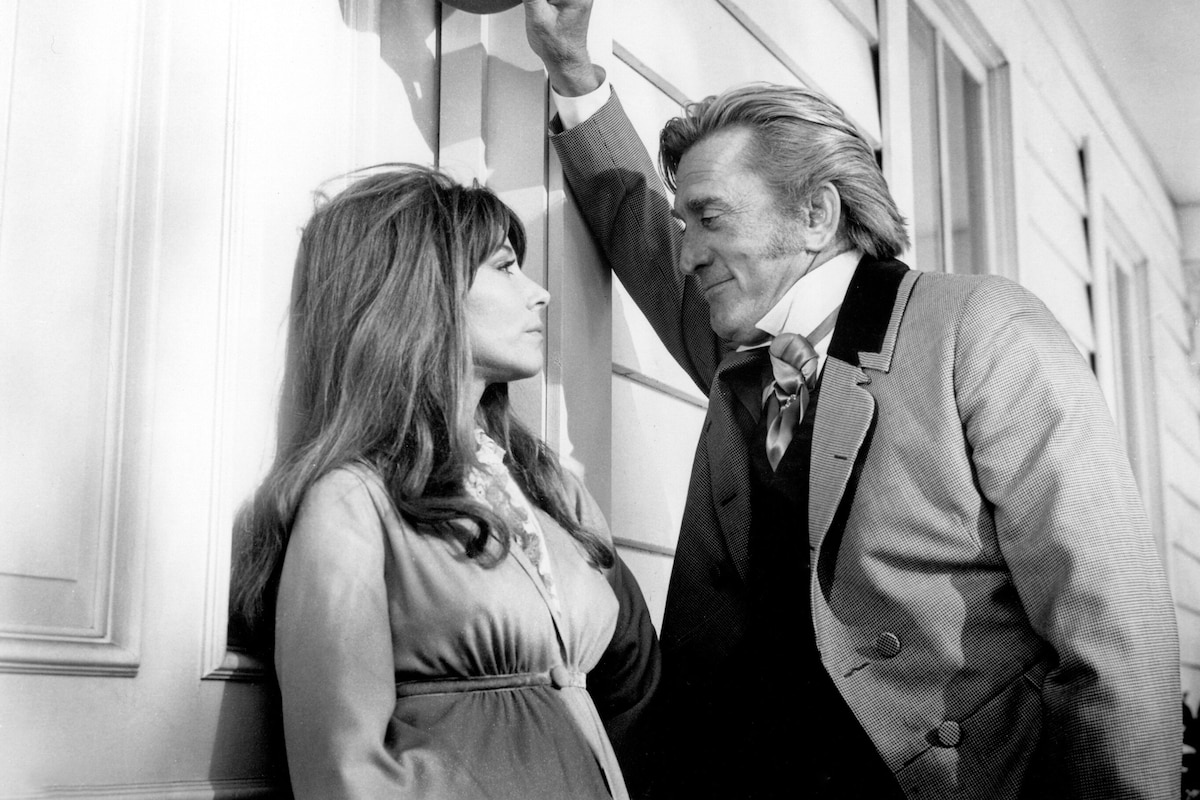
After overseeing two features made on foreign soil (Cleopatra [1963], The Honey Pot [1967]), director-producer Joseph Mankiewicz thought it would be nice to make a picture closer to home - specifically Palm Springs. Though the two-time Academy Award winner had written several westerns early in his Hollywood career (among them, early sound versions of The Virginian and The Three Godfathers) he had never directed a prairie tale and resolved to adjust that inequity with There Was a Crooked Man... (1970). One of many revisionist westerns that proliferated near the end of the 1960s with a mind to rewriting the history books on the specific details of the winning of the west, There Was a Crooked Man... found Mankiewicz in a playful mood, "crooking a snook" (as he described it to journalist Gordon Gow in 1970) or "having a little fun with the mythology of the Wild West." His collaborators were screenwriters Robert Benton and David Newman, relatively fresh from their success with Arthur Penn's Bonnie and Clyde (1967). For the cynical tale of a career criminal who rules the roost in an Arizona Territory penitentiary and manipulates the prison's reform-minded warden to his own crooked ends, Mankiewicz enlisted Kirk Douglas and Henry Fonda and filled his jailhouse with a motley crew of Hollywood veterans.
In signing on to play badlands rogue Paris Pitman, Jr., Kirk Douglas may have been exorcising his frustrations at having failed to transfer to the big screen his Broadway success as Randall Patrick Murphy in One Flew Over the Cuckoo's Nest. (The actor would cede the film rights to Dale Wasserman's stage play, adapted from the novel by Ken Kesey, to his son Michael, who spun the tale into Oscar gold in 1975.) Douglas' reputation as a Hollywood martinet preceded him to the Mojave Desert location, where the crew decorated his massive star trailer with an Astroturf yard, a white picket fence, a mailbox, flower beds, and a birdbath. A more sanguine Henry Fonda, having seen his own box office appeal eclipsed by his own children, Jane and Peter (Jane would win her first Oscar in 1972, an honor that would evade her father until 1982, just months before his death), spent his off-hours painting watercolors of the desert surroundings. Among the supporting cast were troupers Burgess Meredith (as an aging boy bandit), Hume Cronyn (who completed his work with the diagnosis of optic cancer, which would cost him an eye), Lee Grant (who had acted with Douglas in Detective Story [1951] twenty years earlier), and Warren Oates, then enjoying a career upswing after decades of journeyman work; having spent the night before shooting was to commence drinking to excess in The Raincheck Room, a West Hollywood haunt for out-of-work actors, Oates simply took a cab straight from the bar to the location.
The film's stellar cast notwithstanding, perhaps the biggest attraction of There Was a Crooked Man... was the film's desert prison set. Specially constructed by production designer Edward Carrere to withstand both the propeller wash of the helicopters used for aerial footage and the occasional sandstorms (such as the ones that destroyed two earlier attempts at set-building), the prison compound comprised fourteen buildings (among them a kitchen, mess hall, guard barracks, blacksmith shop, seven guard towers, and a gallows) spread out over four acres; the prison set was contained within 22 foot high walls that were four feet thick. The location dressing was capped by a massive pile of rocks that had been trucked in from the surrounding desert - 80 loads of them. Isolated from their Hollywood comfort zone at the distance of just over a hundred miles, the cast and crew of There Was a Crooked Man... blew off steam as best they could, with one crew member growing a marijuana garden on the balcony of his motel lodgings (the police raid netted Oates and his visiting bride-to-be Vickery Turner, though both were quietly released) and tenth-billed Michael Blodgett (the Beyond the Valley of the Dolls [1970] star was cast as a lure for the youth market) partying so hard that he woke up naked the next morning in Kirk Douglas' birdbath. Reviewing the film at the time of its Christmas 1970 release, Films and Filming remarked that There Was a Crooked Man... was "filled with more characters of variable eccentricity than Grand Hotel."
By Richard Harland Smith
Sources:
The Films of Kirk Douglas by Tony Thomas (Citadel Press, 1991)
Warren Oates: A Wild Life by Susan Compo (University Press of Kentucky, 2009)
Joseph Mankiewicz interview by Gordon Gow, Films and Filming (November 1970)
Henry Fonda: A Bio-Bibliography by Kevin Sweeney (Greenwood Publishing Co., 1992)
There Was a Crooked Man
by Richard Harland Smith | June 02, 2015
SIGN UP FOR OUR NEWSLETTERS

CONNECT WITH TCM