An actor of such commanding presence that he could play with equal persuasiveness an avuncular Almighty in one film (The Green Pastures, 1936) and the scheming scion of Satan in another (Cabin in the Sky, 1943), Rex Ingram was enjoying a brief tenure as one of Hollywood's preeminent black actors when he turned down the role of Uncle Remus in Disney's Song of the South (1946), feeling that its stereotyped depiction of Reconstruction era Negroes would be a set-back for contemporary African-Americans; little could Ingram have expected in that moment of professional conscience that he would be scrambling for film roles - any roles - within a few short years.
The son of a riverboat fireman whose family urged him to achieve greatness, Ingram was pursuing a medical degree at Northwestern University when a trip to Hollywood had unexpected consequences. Spotted on a street corner by a casting agent for the silent Tarzan of the Apes (1918), Ingram wound up with a role in the first motion picture devoted to Edgar Rice Burroughs' immortal treeswinger. Though filmed in Louisiana (where the swamps surrounding Morgan City stood in for the African bush), the production gave Ingram cause to stick around Tinsel Town, where he turned up in uncredited bits in William Fox's Salomé (1918), starring Theda Bara, and Cecil B. DeMille's The Ten Commandments (1923).
Through the Thirties, Ingram worked on Broadway and in Hollywood. In 1939, he rebranded the role of Nigger Jim in MGM's adaptation of The Adventures of Huckleberry Finn with an empowering masculinity and the following year appeared as the mystical Djinn in producer Alexander Korda's Technicolor The Thief of Bagdad (1940). Ingram's career trajectory was furthered by parts in Korda's Sahara (1943) and Frank Borzege's Moonrise (1948), whose October 1948 release came just weeks after he was arrested in Manhattan in the company of a 15 year-old Salina, Kansas, high school girl. That Ingram's companion, Jeanette Ann Hughes, was white may likely have influenced the charge of "white slavery" levied against the 52-year-old actor (who was, more formally, found guilty of violating the Mann Act). The prosecutors' discovery of a steamy love letter written by Ingram to Hughes led to the further charge of "using the mails to transmit obscene literature."
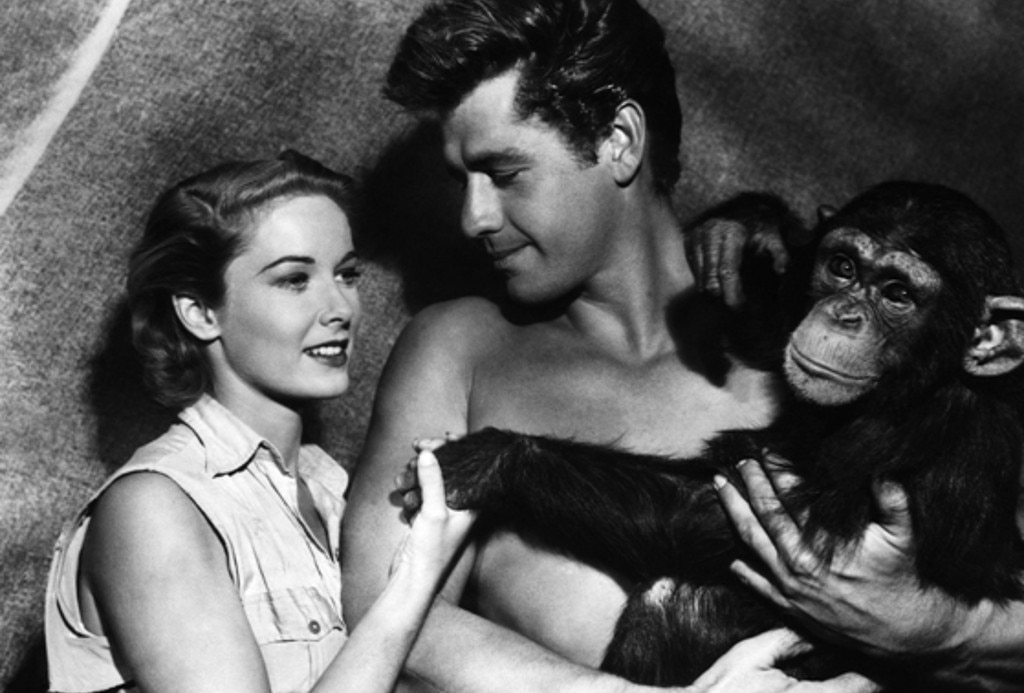
Though he had been slated to begin rehearsals on Broadway for Martin Ritt's staging of the Dorothy Heyward drama Set My People Free, Ingram instead spent ten months in a federal penitentiary and the effect on his career was no less than devastating. After several years of inactivity, Ingram accepted an uncredited role as an African tribal chieftain in Tarzan's Hidden Jungle (1955). This penny-pinching jungle adventure represented the sagging fortunes of the character of Tarzan, who had enjoyed a highly-funded film series at MGM starring Olympic gold medalist Johnny Weissmuller in the title role, which shifted to RKO in 1942. After headlining twelve films in the series, Weissmuller traded his Tarzan loincloth for the safari kit of Columbia's Jungle Jim (1948) and bequeathed the series to Lex Barker. Barker played Tarzan in five films before moving on as well, his abdication leaving producer Sol Lesser with the task of finding a replacement.
After auditioning 200 candidates, Lesser settled on 6'3 Las Vegas lifeguard Gordon Werschkul, whom he rechristened Gordon Scott. Production of Tarzan's Hidden Jungle commenced in mid-August 1954 on the grounds of the 170-acre World Animal Jungle Compound in Thousand Oaks. (The theme park would soon undergo a name change to Jungleland in a bid to compete with the newly-opened Disneyland). Scott's leading lady was former Miss America hopeful Vera June Ralston, whom an early marriage had left with the professional name Vera Miles. The newly-divorced mother of two took a shine to Scott, whom she married in 1956. The union was short-lived. While Scott swung from one Tarzan programmer to another, Miles enjoyed key roles in John Ford's The Searchers (1956) and Alfred Hitchcock's The Wrong Man (1956) and only lost out on the Kim Novak role in Vertigo (1958) when she became pregnant with her son, Michael. Following their 1959 divorce, Scott and Miles went their separate ways: Scott to bare-chested cult immortality in a number of Italian sword-and-sandal films and Miles to prominent roles in Hitchcock's Psycho (1960) and Ford's The Man Who Shot Liberty Valance (1962).
Rex Ingram enjoyed a modest uptake in his fortunes, with character parts in God's Little Acre (1958) and Anna Lucasta (1958), an unbilled bit as a preacher in Elmer Gantry (1960), and a return to Broadway in an all-black revival of Samuel Beckett's Waiting for Godot alongside his Cabin in the Sky costar Mantan Moreland. The first African-American to earn a Phi Beta Kappa pin from Northwestern University, Ingram made history again in August 1962 when he became the first black actor awarded a contract role on a daytime drama, The Brighter Day. He had precious little time to enjoy his recurring character, clergyman Victor Graham, as the soap opera was cancelled two weeks after he shot his first episode. Rex Ingram died in Hollywood in 1969, at the age of 74.
By Richard Harland Smith
Sources:
Toms, Coons, Mulattoes, Mammies, & Bucks: An Interpretive History of Blacks in American Films by Donald Bogle (Continuum International Publishing Group, 2001)
Becoming Somebody: The Story of Canada Lee by Mona Z. Smith (Macmillan, 2005)
Cosby: His Life and Times by Mark Whittaker (Simon & Schuster, 2014)
Making Movies Black: The Hollywood Message Movie from World War II to the Civil Rights Era by Thomas Cripps (Oxford University Press, 1993)
Tarzan's Hidden Jungle
by Richard Harland Smith | June 02, 2015
SIGN UP FOR OUR NEWSLETTERS

CONNECT WITH TCM