Douglas Fairbanks Jr.'s famous name was enough to get him a Hollywood studio contract in 1923, at the tender of 13, to his father's chagrin. But the younger Fairbanks had to work hard to achieve success in his own right, and honed his craft by working in the theater. Thanks to his stage experience and excellent diction, he successfully made the transition to talking films in 1928, and was signed to a contract by First National Pictures. After the company was taken over by Warner Bros., he was promoted to major supporting roles in prestige films such as the war drama The Dawn Patrol (1930) and Little Caesar (1931), and the studio's head of production Darryl Zanuck began grooming him for stardom.
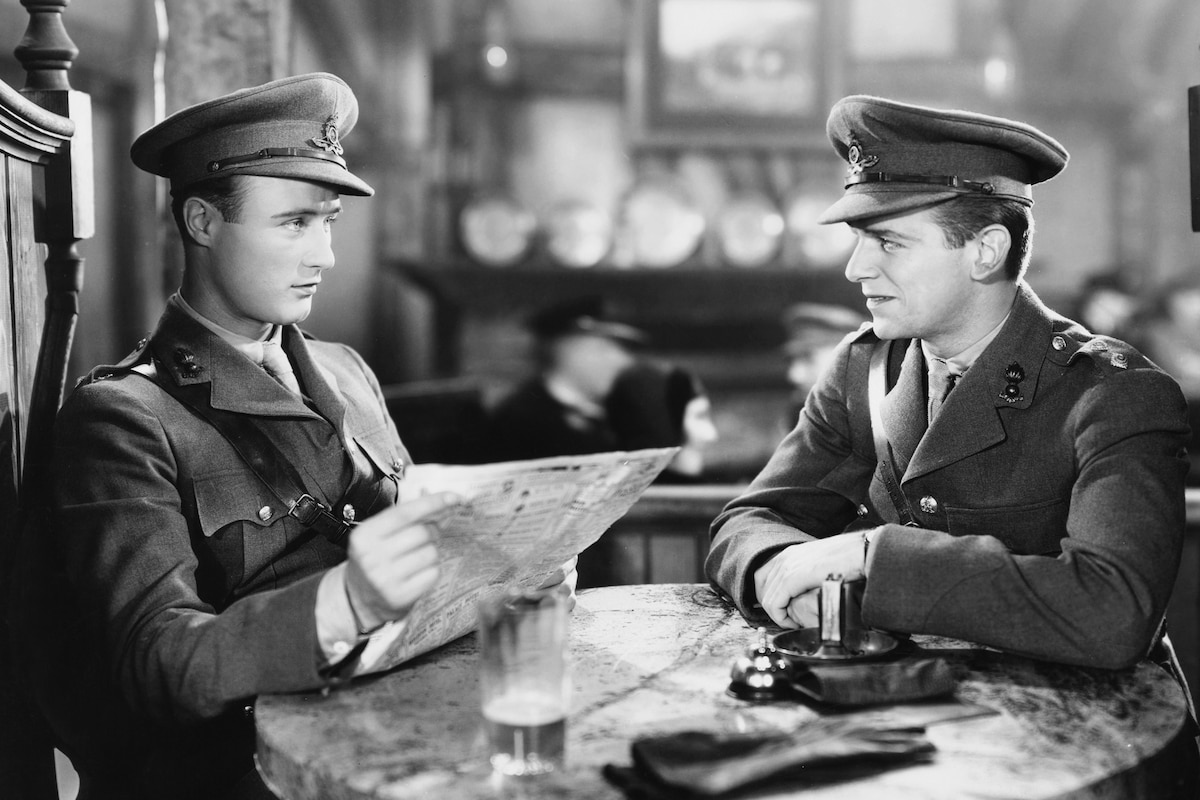
Fairbanks's first starring role at the studio was another World War I film, Chances (1931). Fairbanks and Anthony Bushell play British soldier brothers in love with the same woman, played by Rose Hobart. Howard Hawks, who had directed The Dawn Patrol, was assigned to direct, but he thought the best-selling novel upon which the film was based was "lousy," and refused. Veteran director Allan Dwan, who had helmed many of the senior Fairbanks's silent films, including one of his best, Robin Hood (1922), stepped in, to the delight of Fairbanks Junior, who remembered Dwan in his memoirs as a "marvelous old boy."
Two seaside scenes in Chances, supposedly taking place in Cornwall and in France, were shot in Santa Barbara. For one of the war scenes, a battlefield was built on ten acres at the Warner Brothers/First National ranch. But the film's most elaborate set -- and the largest interior set ever built at First National -- was the interior, exterior, and garden of an English country home.
Critics at the time found the film impressive. "It is a thoroughly human story of war and love....It rings true in every episode, nothing being overdone, for which director Allan Dwan, the director, deserves much credit," according to Mordaunt Hall of the New York Times. More than 50 years later, Fairbanks was less effusive, writing "The picture, in spite of dear Allan's patient and paternal guidance and the expensive production given it, did not have a story of a power and sweep to match its background," he wrote. "It was good, but not good enough. Today it is still affecting, though a little dated." Seen another 20 years after that was written, the film remains "affecting," and the years have only given it more poignancy.
In the decades after making Chances, Fairbanks found his footing in films, and had some of his biggest successes with the same kind of roles at which his father had excelled, in swashbucklers and adventure stories such as The Prisoner of Zenda (1937), Gunga Din (1939) and Sinbad the Sailor (1947). As a naval officer during World War II, his real-life heroics earned him decorations from the American, French, Italian and British governments. He continued to act in films, television and theater until the 1980s. When Fairbanks died in 2000, the New York Times obituary noted, "The son was not the gymnast that his father was, but he was a versatile actor who easily played a wide variety of roles."
Director: Allan Dwan
Screenplay: A. Hamilton Gibbs, Waldemar Young
Cinematography:
Art Direction: Esdras Hartley
Principal Cast: Douglas Fairbanks, Jr. (Jack Ingleside), Rose Hobart (Molly Prescott), Anthony Bushell (Tom Ingleside), Holmes Herbert (Major Bradford), Mary Forbes (Mrs. Ingleside), Edmond Breon (The General), Harry Allen (Private Jones), Florence Britton (Sylvia)
72 minutes
by Margarita Landazuri
Chances
by Margarita Landazuri | June 02, 2015
SIGN UP FOR OUR NEWSLETTERS

CONNECT WITH TCM