To hear Victor Mature tell it, he could "make with the holy look." That was his explanation for why he did so well in Biblical epics and certainly, from the start, his looks were a big part of it. In his first big starring role, as a caveman in One Million B.C., Mature had the right brawny look for the part but guys with a brawny look were, and will always be, a dime a dozen in Hollywood. Mature had something more, a natural star quality charisma that leapt from the screen. It was a stoic charisma, the kind usually associated with the big, strong, silent type. Once he'd acquired the nickname, "The Hunk," it was a no-brainer to cast him as Samson in Samson and Delilah (literally a no-brainer, since the character is known for his brawn, not his brains) and from that point forward, the Biblical roles started flooding in. One movie after another outfitted Mature in tunics and, four times running, cast him opposite Jean Simmons, including Adrocles and the Lion, The Robe, and, finally, The Egyptian, their last film together, though Gene Tierney gets the hunk in the end.
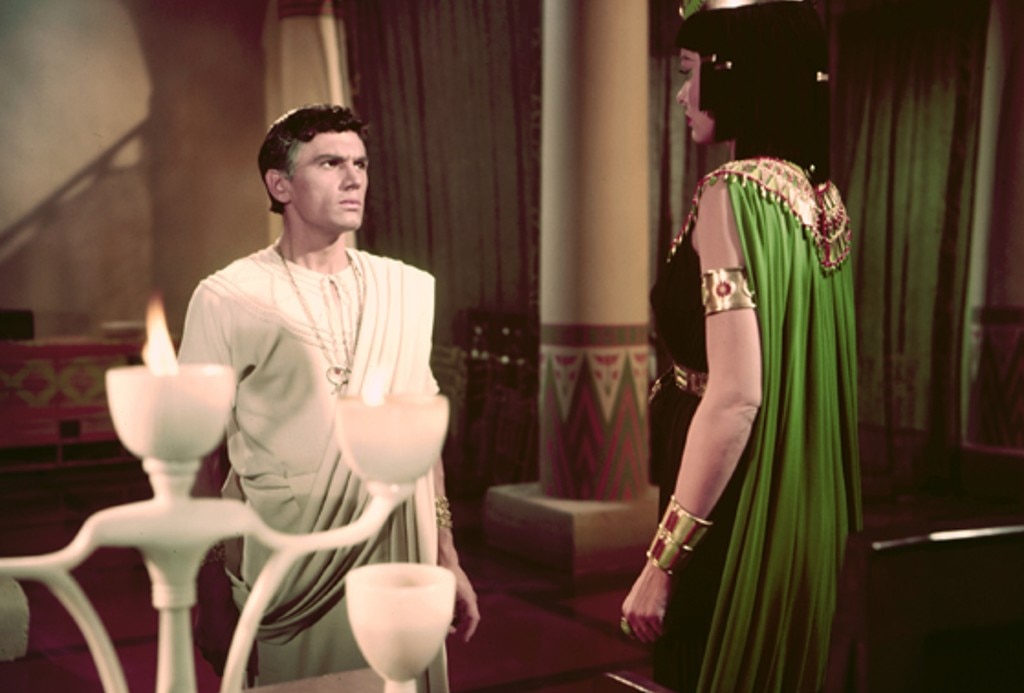
The story of The Egyptian has nothing to actually do with the Bible but uses the same solemnity and time period as many an Old Testament epic. Taking place 14 centuries before the birth of Christ, the tale begins with the titular character, now an old man, writing his memoirs in hieroglyphs on papyrus, while stranded in exile awaiting his eventual death from old age. That character, Sinuhe (Edmund Purdom), is a former physician who was sent down the river in a basket made of reeds (sound familiar?) only to be rescued by a physician who, despite his talents, works only for the poor. Sinuhe grows up with the medical expertise he has learned from his father and also vows to help only the poor, with the help of his one-eyed assistant, Kaptah, played by the great Peter Ustinov. Eventually, Sinuhhe befriends the loud and, yes, brawny, son of a cheesemaker, Horemheb (Victor Mature) and the two become an unlikely team. Horemheb gets Sinuhe drunk on a regular basis, to the chagrin of a beautiful serving wench, Merit (Jean Simmons), who loves Sinuhe and thinks Horemheb a tactless oaf, which of course he is.
One day, Horemheb takes Sinuhe hunting lions and while pursuing a male lion in their path, spy a man kneeling in prayer to Aten, the sun, giver of all life. The man doesn't seem to notice the lion approaching, nor does he seem to care about anything other than worshipping the sun, when Horemheb kills the lion with his arrow. When Sinuhe asks if the man is okay, he falls into a seizure and the two men put him on their chariot whereupon they are instantly beset by the Pharaoh's guards and arrested. The man, it turns out, is the Pharaoh (Michael Wilding) and now the two men fear they will be killed for laying hand upon him. When the Pharaoh grants them audience later, he instead thanks them for their efforts and makes Sinuhe the court's official physician. As Sinuhe's life become more rarefied in the company of the court, he loses sight of his original principals.
The part of Sinuhe was originally offered to Marlon Brando who found the script unsatisfying and backed out. He chose On the Waterfront instead, won an Oscar and made movie history. Next up was Farley Granger who, also unimpressed, turned it down. Third on the list was Dirk Bogarde who, like Brando and Granger before him, gave the movie the pass. At this point, with Victor Mature and Jean Simmons already signed and providing more than enough star power for the marketing department, 20th Century Fox got Edmund Pardom on loan from MGM. Pardom does a fine job but never took off as a star in his own right.
Directing was the great Michael Curtiz, a director who never found a script he couldn't make skip along in the editing room. No matter what the story, Curtiz always found a way to make his movies, well, move. Eleven years after his all-time Hollywood triumph, Casablanca, Curtiz wasn't getting the scripts he'd gotten in the thirties and forties but still made the best with what he had. Pardom didn't have the charisma of a Bogart or Cagney, certainly, so there wasn't a lot that even Curtiz could do with the many dramatic scenes between Pardom and Bella Darvi, playing his ill-fated lover, but the scenes with Pardom and Mature are a lot of fun, enough to make one wish the whole thing had just been an extended buddy movie, Biblical epic style.
Gene Tierney, in a small role opposite Mature, was nearing her final year in Hollywood before making a comeback in the early sixties. Suffering from bouts of depression and finding it hard to concentrate on the set, Tierney's roles got smaller and smaller until, after one more movie the following year, The Left Hand of God, with Humphrey Bogart, she dropped out of the movies until her comeback performance in Advise and Consent, in 1962.
Jean Simmons was making her fourth and final movie alongside Victor Mature with The Egyptian and though she stayed in movies for years to come, preferred the stage and spent more time before an audience than before a camera. She had become a respected actress, and an Oscar nominated one, for her performance in Laurence Olivier's Hamlet in 1948 but found most of the roles she received unsatisfying. By the mid-seventies, she found steady work on television and remained active in acting straight into the 21st century.
The Egyptian didn't break the box office in 1954 nor did it win a slew of awards. It did, however, prove two things. One, Michael Curtiz was a great director no matter what the genre or period. And two, Victor Mature, despite his own constant self-deprecation, could keep an audience's attention and make a movie hum. It's no small talent to "make with the holy look," and Mature had it in spades.
By Greg Ferrara
The Egyptian
by Greg Ferrara | June 02, 2015
SIGN UP FOR OUR NEWSLETTERS

CONNECT WITH TCM