A lightweight romantic melodrama, Men Call It Love (1931) is less interesting as a viewing experience and more fascinating as a historical marker and as a turning point in the career of star Adolphe Menjou.
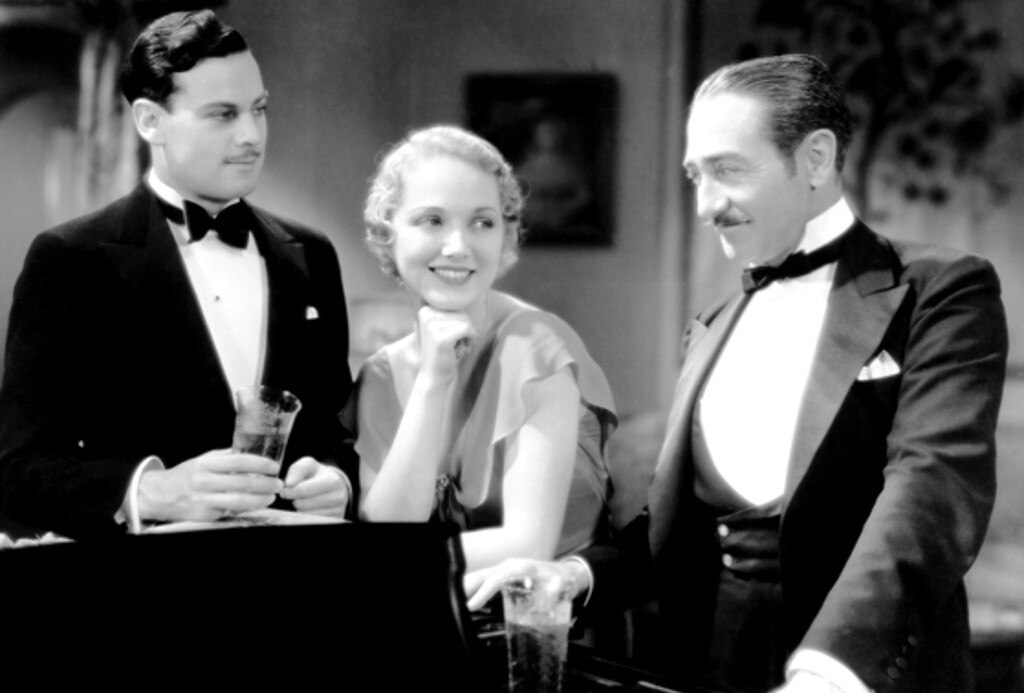
The film was released in the pre-Code era, which is readily apparent from the first sequence. Casual jokes about infidelity, rampant adultery, and double entendres abound. Men Call It Love opens at a party among the country-club set, who care more about their golf game than they do about their marriages. Though the setting is nondescript, Mordaunt Hall, the reviewer for The New York Times, likened it to Westchester or Long Island. Menjou stars as wealthy playboy Tony Minot who prefers his romantic conquests to be married. A professional golfer, Tony is described as having two "occupations"--the other being "jumping out of bedroom windows." At the party, the very married Helen, played by Mary Duncan, breaks off her romance with Tony, because he has lost interest in her. Tony has turned his attention to Connie, a naïve young wife who loves her husband, Jack, played by Norman Foster. The purpose of the party was for Callie, played by Hedda Hopper, and her husband Henry to announce their divorce in such a flippant manner that they joke about each other's infidelities. The lack of respect for the vows of marriage bothers Connie, who believes in the sanctity of the institution. When Connie discovers that Jack has been unfaithful with Helen, she throws herself at Tony, who is all too willing to catch her.
Men Call It Love violated the Production Code, or censorship code, in its flagrant use of adultery, particularly because the multiple infidelities suggested that breaking wedding vows was an accepted practice, even fashionable. Aside from Tony and Helen, Helen and Jack, and Connie and Tony, Henry has committed adultery so many times that Callie nonchalantly jokes about it in their divorce announcement. Later, in the locker room of the country club, Callie tells Connie that if Jack is busy on the night of her next party, "Bring someone else's husband." And, she knowingly tells Helen, "You will grab someone else's husband the minute you get there." The double entendres in the dialogue also violated the Code: After Connie receives an impromptu golf lesson from Tony to improve her swing, she announces, "Tony has made me loose." Men Call It Love features many scenes with drinking, though it was still Prohibition. The characters drink at parties, at home, and at clubs, suggesting it was common practice. Even Tony's car is fitted with a hidden receptacle large enough for two or three cocktail shakers. The frequent use of alcohol consumption violated the Code because it was not plot related. Paramount received a warning about the unsuitable material from the Production Code Administration, but because the Code was not mandatory in 1931, the studio ignored the PCA's suggestions.
More than a pre-Code romance, Men Call It Love serves as a kind of commentary on the state of marriage at the end of the Jazz Age. It was adapted from the play Among the Married by Vincent Lawrence, written in the late 1920s and staged in 1929--the tail end of the Roaring 20s and the beginning of the Great Depression. The setting, characters, drinking, and devil-may-care approach to sex are in keeping with the attitudes of the Jazz Age. Following the ratification of the 19th Amendment in 1920, which gave women the right to vote, the decade witnessed a loosening of social conventions, social mores, and gender roles. These changes were also due to Prohibition, in which generally law-abiding citizens flaunted the law, as well as the increased urbanization of America in which the young flocked to the cities for employment and recreation. A consequence of these social changes was the skyrocketing rate of divorce (the number of divorces divided by the number of marriages in any given year). By 1920, the rate had risen to 13.4 % from about 8% in 1910. The rate came down briefly in the early 1920s but then steadily rose throughout the decade, according to numbers found in the Statistical Abstract of the United States, part of the U.S. Census Bureau. By the late 1920s, America was gripped by a panic about the future of marriage. Contemporary newspaper and magazine articles speculated on the viability of marriage, lamenting its destruction and predicting its demise by the late 20th century. In his book Sex in Civilization, published in 1929, sociologist Samuel Schmalhausen summed up the crisis succinctly: ''The old values are gone. Irrevocably . . . We live in a state of molten confusion. Instability rides modernity like a crazy sportsman. Civilization is caught in a cluster of contradictions that threaten to strangle it.''
Lawrence's play reflected the Jazz Age's contradictory ideas toward marriage. While the fashionable infidelities of the main characters titillated viewers, Connie's sincere beliefs in the value of marriage supported traditional values. Her integrity and innocence not only shamed Jack after he was caught with Helen but also influenced Tony to change his ways. Near the end, Jack calls marriage "the most sacred agreement" and laments that "with marriage, a few drinks . . . you forget every promise you ever made."
Though playing something of a cad, Adolphe Menjou manages to remain attractive and appealing throughout the film, partly because his character is redeemed and partly because of Menjou's star image. During the silent era, Menjou was under contract to Paramount, which had taken advantage of his debonair manner and continental look to construct an image for him as the dapper, urbane gent. His route to stardom began with recognition for his performance as the arrogant French playboy in Charlie Chaplin's A Woman of Paris (1923) and continued with starring roles in Ernst Lubitsch's Forbidden Paradise (1924) and Frank Tuttle's A Kiss in the Dark (1925). While many silent-era actors worried about their voices when submitting to the dreaded sound test, Menjou's smooth, cultured vocal style guaranteed him a place in talking films. Despite this, Paramount released him in the early 1930s. He was quickly signed by MGM who took advantage of his multi-lingual abilities and his distinguished persona. Menjou's unique spin on the dapper gentleman archetype included his reputation for sartorial splendor. Columnists repeatedly referred to his impeccable wardrobe, and he was named the Best Dressed Man in America more than once. Menjou understood that his debonair star image depended to a large degree on his wardrobe. In his 1947 autobiography, It Took Nine Tailors, he wrote, "On the screen the slightest flaw in the cut of a suit is exaggerated. Sometimes as many as eight or ten fittings and alterations are necessary to get a satisfactory fit. . . . I took my new job so seriously that eventually I had clothes made by most of the great tailors in the world. That was why my wardrobe grew to such tremendous proportions."
While at MGM, Menjou began to move from leading man material to showy secondary or supporting roles. His pre-Code films represent his last efforts at playing the leading man. A week after the premiere of Men Call It Love, The Front Page was released, starring Menjou as Walter Burns. He was nominated for an Academy Award for his highly praised performance, which revealed his comic timing and talent for verbal interplay. However, shortly thereafter, leading roles began to elude him, and by Stage Door (1937), he was appearing in supporting and secondary roles. Though still a charismatic scene-stealer, Adolphe Menjou's career had entered a different phase.
By Susan Doll
Production Management: B.P. Fineman for Paramount Pictures
Director: Edgar Selwyn
Screenplay: Doris Anderson (credited with dialogue continuity), from the play Among the Married by Vincent Lawrence
Cinematography: Harold Rosson
Editor: Frank Sullivan
Art Direction: Cedric Gibbons
Costumes: Rene Hubert
Cast: Tony Minot (Adolphe Menjou), Connie (Leila Hyams), Jack (Norman Foster), Helen (Mary Duncan), Callie (Hedda Hopper), Joe (Robert Emmett Keane), Brandt (Harry Northrup), Henry (Cosmo Kyrle Bellew)
Men Call it Love
by Susan Doll | June 02, 2015
SIGN UP FOR OUR NEWSLETTERS

CONNECT WITH TCM