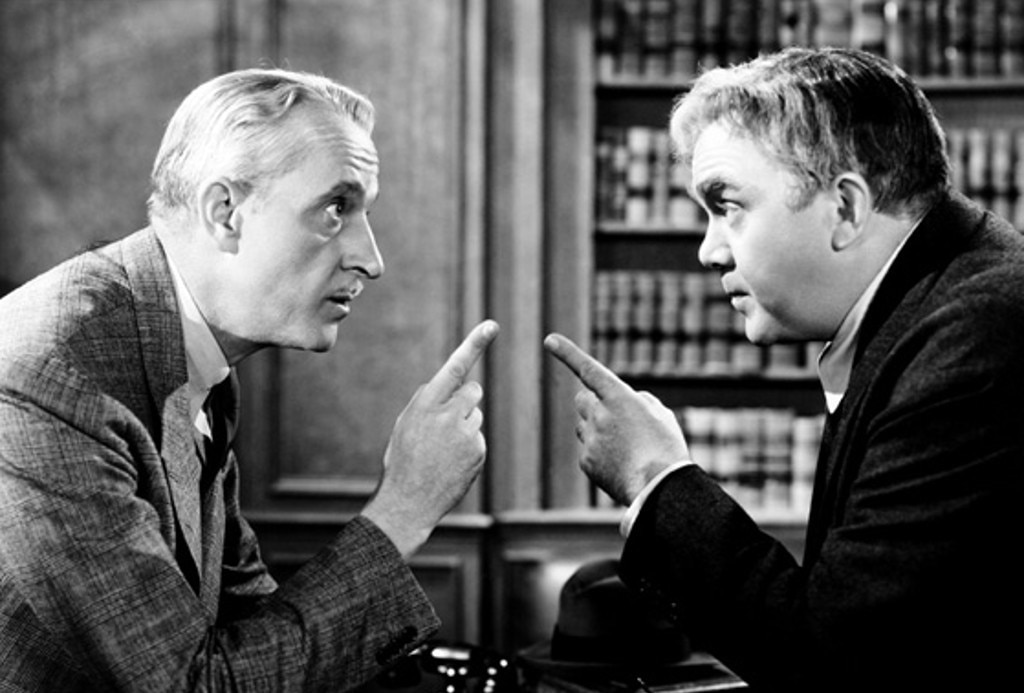
British crime writer Anthony Berkeley Cox (who published under the nom de plume "Frances Iles") had a good year in Hollywood in 1941, when Alfred Hitchcock adapted his 1932 novel Before the Fact as Suspicion and Vincent Sherman brought his 1937 book Trial and Error to the big screen as Flight from Destiny (1941). Fresh from his 1940 Academy Award win as Best Supporting Actor for Stagecoach (1939), Thomas Mitchell stars as a professor of philosophy who, upon learning that he has only six months to live, decides to commit "a social murder," one that would benefit society... and finds a just cause in the plight of young lovers (Geraldine Fitzgerald and Jeffrey Lynn) who have become pawns of a criminal gang. Scripted by Barry Trivers (with an uncredited assist from Robert Rossen and Charles Kenyon), Flight from Destiny sits intriguingly at the midway point between Edmund Goulding's classic weepy Dark Victory (1939) and Rudolph Maté's film noir cornerstone D.O.A. (1950), both of which featured terminally ill but proactive protagonists making the most of their allotted time. In its own complex resolution, Flight from Destiny also anticipates a key plot point of Hitchcock's Rope (1948, based on a 1929 stage play), with Mitchell coming to appreciate all too late that his ideology has had unforeseen repercussions. Flight from Destiny provided Hollywood newcomer Alexis Smith with an early (uncredited) role; later that year, Warner Bros. would promote her to leading lady status opposite Errol Flynn in Dive Bomber (1941).
By Richard Harland Smith
Flight from Destiny
by Richard Harland Smith | June 02, 2015
SIGN UP FOR OUR NEWSLETTERS

CONNECT WITH TCM