It was likely the controversy - the equivalent of success in the eyes of an exploitation filmmaker - attending the release of Elia Kazan's Baby Doll (1956) that prompted Mobile, Alabama-based independent film producer Meyer "Mike" Ripps to bankroll Bayou (1957). Based on a Tennessee Williams one-act play and set in the steamy Mississippi Delta, Baby Doll was branded as morally repellent from the pulpit of St. Patrick's Cathedral by Archbishop of New York Francis Spellman, condemned by the Catholic Legion of Decency and Time magazine, and banned from exhibition in several states (and foreign markets) for its depiction of a middle-aged man's seduction of a business rival's 19 year-old "child bride." (Even more troubling than the salacious logline was Warner Bros.' lurid promotional campaign, the artwork for which foregrounded the image of star Carroll Baker curled fetal in a crib-like daybed, blithely sucking her thumb and staring boldly forward with a seductive vacuity that evokes a broad spectrum of emotions, from fear to wanton longing.) With the Catholic Church forbidding parishioners to see the film, and in fact encouraging congregants to boycott the very cinemas offering such filth for viewing, Baby Doll became a cause célebrè and the movie to see while not being seen - which made the drive-in the perfect vantage point.
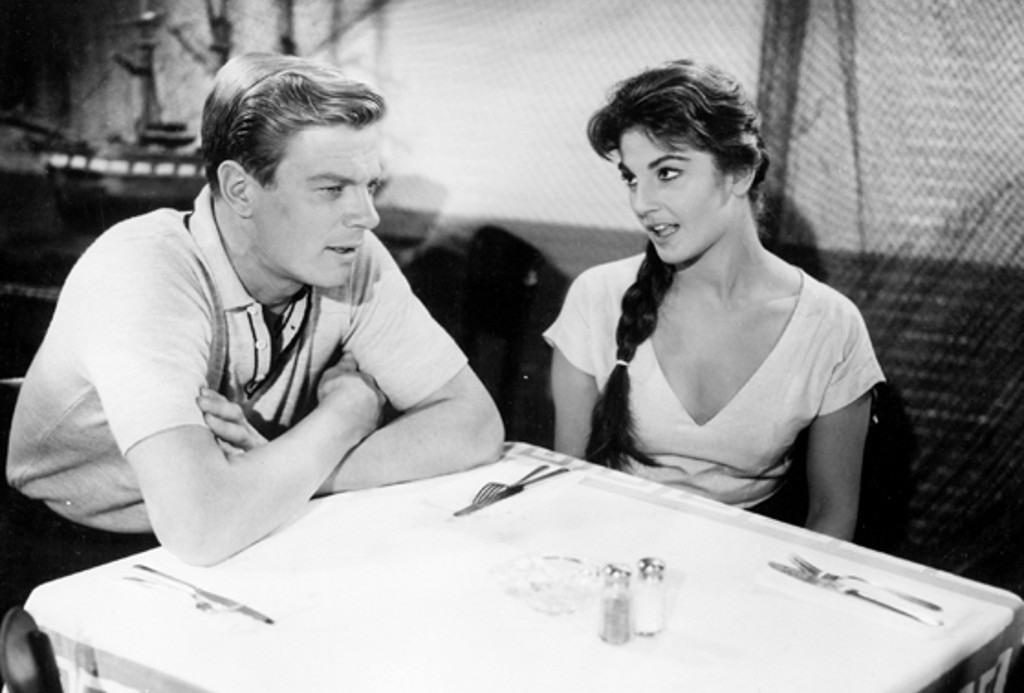
With a like-minded script banged out by Alabama associate Edward I. Fessler, which focused on the blooming love of a Yankee architect for an under-aged Cajun girl, Ripps shopped Bayou around Hollywood with the hope of picking up spares. For his leading man he tapped Peter Graves, a classically handsome, Pasadena Playhouse-trained actor whose career was balanced between character parts in such prestigious films as Billy Wilder's Stalag 17 (1953) and Charles Laughton's The Night of the Hunter (1955) and starring roles in such popcorn munchers as Roger Corman's It Conquered the World (1956) and Bert I. Gordon's Beginning of the End (1957); secondary roles were doled out to Hollywood veteran Douglas Fowley, Corman troupers Ed Nelson and Jonathan Haze, oddball actor Timothy Carey (who had made strong, albeit eccentric impressions in Kazan's East of Eden [1955] and Stanley Kubrick's The Killing [1956]) and Brooklyn-born Lita Milan, a former WAMPAS Baby Star, who at age 23 was not too deep into her years to portray a teenager on the delicate cusp of womanhood. Ripps also picked up a bargain in cheap script revisions from HUAC-damaged screenwriter Paul Jarrico, and brokered a distribution deal with United Artists.
Filmed on location in and around Barataria Bay, Louisiana, by actor-turned-director Harold Daniels (who had helmed the 1951 RKO film noir Roadblock, starring Charles McGraw, and a couple of low budget programmers for Jack Pollexfen and Audrey Wisberg's American Pictures), Bayou disappointed moviegoers and drive-in-goers alike by falling appreciably short of its promise to be "Bold! Brutal! Barbaric!" Shot for $200,000, the film sank without a trace and would have been lost for all time but for the indomitable soul and business acumen of huckster Mike Ripps. When United Artist's rights to Bayou lapsed after 1960, Ripps reacquired the property and sank $50,000 into new footage (mostly focusing on peekaboo nudity and stand-ins for his long-departed leading players), releasing it on the Southern drive-in circuit as Poor White Trash (1961). Playing the ozoner circuit for the next several years, paired with such similar redneck romper stompers as Roger Corman's The Intruder (aka I Hate Your Guts, 1962) and Joseph Mawra's Shanty Tramp (1967), Poor White Trash earned back an estimated $10,000,000 in rentals - due in large part to Ripps' ambiguous ad campaign, which refused to show or tell as a double-dog-dare to the curious . When the film opened in Los Angeles, Ripps employed the old Kroger Babb trick of posting armed guards at the box office, ostensibly to discourage trampling from the capacity crowd that queued up around the block.
Emboldened by his success with the rebooted Bayou, Ripps returned to the exploitation bait-and-switch in subsequent years, retitling Texas filmmaker S. F. Brownrigg's failed Scum of the Earth (1974) as Poor White Trash, Part 2 (1976) -- a rebranding that evoked (or hoped to) the better-heeled sequels The Godfather: Part II (1974) and Walking Tall Part II (1975). Ripps' ad campaign, which offered very little evidence as to what the film was about, crowed "Due to the abnormal subject matter of this movie, no children allowed!" The track seemed to work a charm, with Ripps taking out full-page trade paper space to brag about how well the release performed over the course of a single weekend in various Michigan drive-ins. Having bought himself the Do Drive-In in Pritchard, Alabama, Ripps also put his money behind the occasional original feature, such as the Eastmancolor voodoo romp Macumba Love (1960) - starring June Wilkinson (dubbed "The Bosom" by Playboy, Wilkinson's measurements often crept into the ad campaigns for her movies) -- Common Law Wife (aka Swamp Rose, 1963), and All the Young Wives (aka Naked Rider, 1973). Ripps also fronted seed money to first-time filmmaker Timothy Carey, resulting in the cult classic The World's Greatest Sinner (1962).
by Richard Harland Smith
Sources:
Drive-In Theatres: A History from Their Inception in 1933 by Kerry Segrave (McFarland & Company, Inc., 1992)
Beyond Ballyhoo: Motion Picture Promotion and Gimmicks by Mark Thomas McGee (McFarland & Company, Inc., 2001)
The Marxist and the Movies: A Biography of Paul Jarrico by Larry Ceplair (University of Kentucky Press, 2007)
RKO Radio Pictures Horror, Science Fiction and Fantasy Films, 1929-1956 by Michael R. Pitts (McFarland & Company, Inc., 2015)
Regional Horror Films, 1958-1990: A State-by-State Guide with Interviews by Brian Albright (McFarland & Company, Inc., 2012)
The New Poverty Row: Independent Filmmakers as Distributors by Fred Olen Ray (McFarland & Company, 1991)
"Let's Not Hate Anyone: Timothy Carey and the World's Greatest Sinner" by Marissa Young, Cashiers du Cinemart issue 18, 2014
Bayou
by Richard Harland Smith | June 02, 2015
SIGN UP FOR OUR NEWSLETTERS

CONNECT WITH TCM