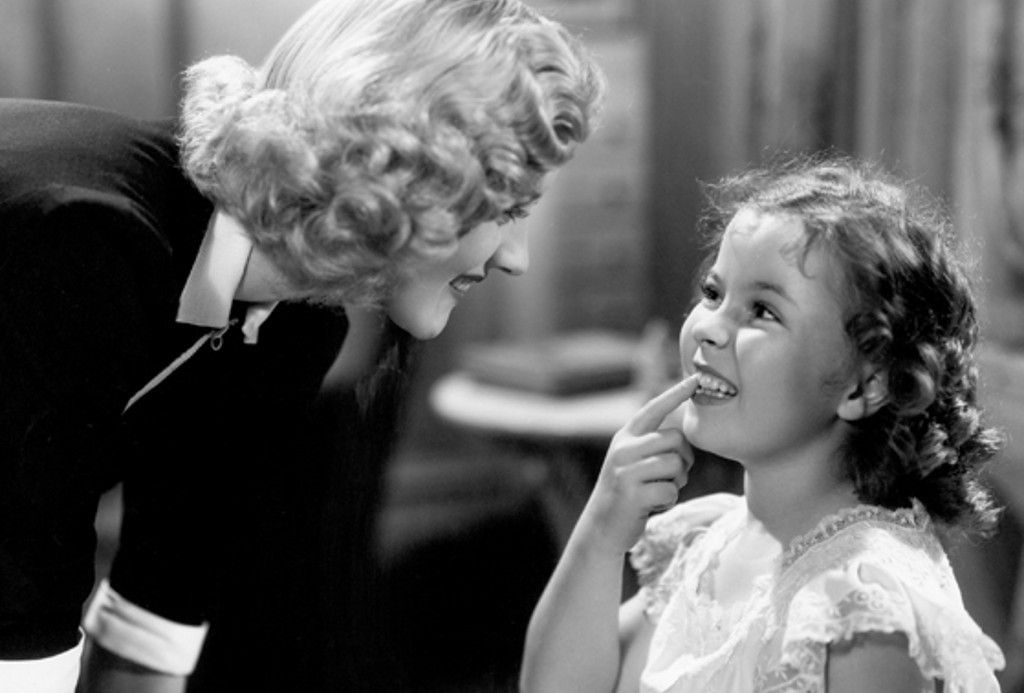
Shirley Temple was ten years old, had been a child star for four years, was about to hit puberty and the beginning of a downward career slide when she made Little Miss Broadway (1938). In it, Temple plays her usual role of an orphan. This time, she goes to live with a family friend in a theatrical boarding house. Next door lives a mean old lady (Edna May Oliver) who owns the house. She hates theatrical people and the noise they make. To get rid of them, she demands $2,500 in back rent. Mixed up in the plot is a Romeo and Juliet affair with George Murphy and Phyllis Brooks, a court case, and a predictable ending. Also in the cast were Jimmy Durante, Donald Meek, The Brian Sisters, and Jane Darwell.
Originally titled Little Lady of Broadway, the film was directed by Irving Cummings with the screenplay by Harry Tugend and lyricist-turned-screenwriter Jack Yellen (who wrote the lyrics for classics like Happy Days are Here Again and Ain't She Sweet?), although studio chief and executive producer Darryl F. Zanuck is said to have personally rewritten the final draft of the script. Little Miss Broadway was shot on the 20th Century-Fox lot between February 7th and late March 1938.
George Murphy, who would later become a California state senator, began his career as a song and dance man. He was not satisfied with the choreography of the film's closing number, We Should Be Together and asked Fox management to have it restaged. According to those on the set, while Temple's mother (who was always present during filming) was not happy about it, Shirley herself was all for the idea, and after the number was filmed Murphy and Temple repeated the routine just for fun. Murphy's involvement in this film would later benefit him in a way he could not have predicted in 1938. While running for senator, Murphy would later say, "Those old pictures showing me dancing with Shirley Temple that keep turning up on the late night TV movies are getting me votes." Another musical number, which took place during the courtroom scene, featured Temple with Jimmy Durante. While the studio released publicity shots from this number, it was cut out from the final film.
According to a website devoted to the Brian Sisters, the sisters were missing their youngest member, Gwen, who was not only the same age as Temple, but prettier and a better singer, causing Temple's mother to think Gwen would show up her daughter. Gwen was cut from the film, which angered her sisters Betty and Doris, but they agreed to appear when Gwen was paid her salary, anyway. They were also not happy with having to change their style in order to sing with Temple. According to Doris Brian, "Betty and I had to sing with Shirley. She was a good actress and a great little dancer, but not much of a singer. At the recording session, Betty and I were singing as we usually did, but Shirley could not blend with us. The musical director cautioned us to '...sing it the way Shirley does'."
The critics were mixed when Little Miss Broadway was released in July 1938. Frank S. Nugent of The New York Times felt that Temple's films had devolved into "poses." "Pose No. 1 has her singing a song of optimism to the other little girls, including the Brian sisters, at the home. Attitude No. 2 has her round little chin quivering as she says good-bye to all her tiny playmates. [...] In No. 3 she is making friends with Jimmy Durante, the midgets, the mind-reading act and the ventriloquist of the theatrical hotel. Plate 4 involves the mean old lady next door who owns the hotel and Slide No. 5 deals with the old lady's nice young nephew, George Murphy, and Pop Shea's pretty daughter, Phyllis Brooks." Despite its plot growing old and Temple growing older, Little Miss Broadway turned out to be the eighth biggest box-office draw of 1938.
By Lorraine LoBianco
SOURCES:
Bakish, David Jimmy Durante: His Show Business Career, with an Annotated Filmography and Discography
http://www.bidnessetc.com/business/shirley-temple-the-little-girl-that-saved-20-th-century-fox/
http://www.brian-sisters.org/LittleMissBroadway.shtml
The Internet Movie Database
Nancy, Peter John Garfield - Unabridged Guide
Nugent, Frank "The Screen; Shirley Temple Forces a Dimple in Her New Picture 'Little Miss Broadway' at the Roxy" The New York Times 23 July 38
Ross, Stephen J. Hollywood Left and Right: How Movie Stars Shaped American Politics
http://www.tcm.com/tcmdb/title/81551/Little-Miss-Broadway/full-synopsis.html
Little Miss Broadway
by Lorraine LoBianco | June 02, 2015
SIGN UP FOR OUR NEWSLETTERS

CONNECT WITH TCM