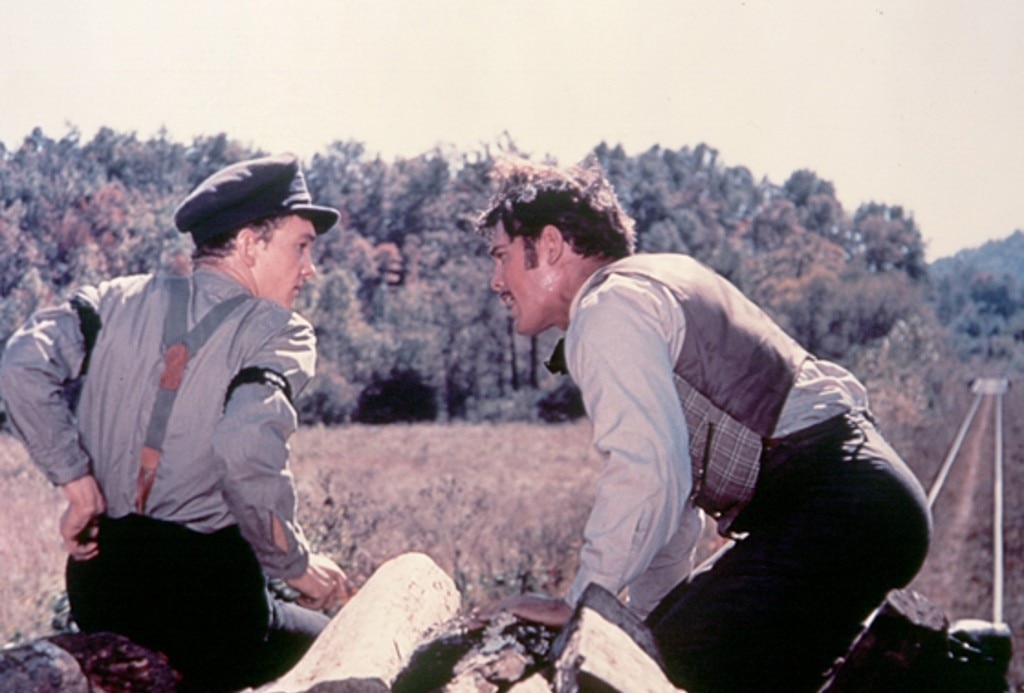
Disney's live-action movie The Great Locomotive Chase (1956) details a fascinating episode of the American Civil War. On April 12, 1862, a Union spy named James. J. Andrews led a group of volunteer Union soldiers to seize control of a Confederate passenger train in Big Shanty (now Kennesaw), Georgia. The northerners had infiltrated the territory in the days prior by traveling there in small groups and in civilian clothes, on the pretext that they were joining the Confederate army. When the train -- whose locomotive was named the General -- stopped at Big Shanty for a breakfast break, Andrews' men took control of the locomotive and the first car, leaving the rest of the train and the passengers behind. Their plan was to drive north to Chattanooga, destroying sections of track, bridges and telegraph wire behind them along the way. The intended result was chaos and delay in a vital Confederate supply chain as a separate Union regiment would meanwhile attack Chattanooga.
However, Andrews hadn't counted on the determination of the General's conductor, William Fuller, to get his train back. When Fuller saw that the General had been seized, he took chase -- by foot, by handcar, and eventually by another locomotive. The General was slowed down by the fact that the track was a single line for north- and southbound trains, and it had to keep making station stops in order to keep to the schedule and not arouse suspicions. Andrews had prepared for this with a series of bluffs to station masters.
Eventually, Fuller had to abandon his locomotive, run through destroyed track, and commandeer another train, and then another, until finally he was chasing the General in a locomotive called the Texas, running in reverse. Andrews' train ran out of fuel some 18 miles south of Chattanooga, and his men scattered into the fields. All were captured in the days ahead. Several, including Andrews, were executed by hanging; others were imprisoned. Of those, some escaped, and others were returned to the north through prisoner exchanges. Most of the Andrews Raiders, as they were known, ultimately received the first-ever Congressional Medals of Honor for their actions. (Andrews himself did not, because he was a civilian and thus ineligible.)
The Andrews Raid had loosely inspired Buster Keaton's classic film The General (1926), but now, thirty years later, Walt Disney wished to make a dramatic film out of the tale. The result is still considered one of his better live-action pictures.
Disney assigned the project to screenwriter Lawrence Watkin (Treasure Island [1950]) and also made Watkin producer, even though Watkin had zero experience as such. To direct, Disney hired Francis D. Lyon, a former film editor who had transitioned to directing a few years earlier. Despite their limited combined experience, Lyon later said that Disney "did not interfere in any way during the shooting," adding that Disney had his hands full with the then-ongoing construction of Disneyland. Actor Fess Parker, however, said that Disney "wanted the last word... he didn't want anybody to challenge him," and so made sure not to employ a strong, assertive producer or director to the film.
Parker, at this point in the middle of a star-making run as Davey Crockett in a series of Disney TV shows and movies, was cast as Andrews. Fuller, the southern train conductor, was played by Jeffrey Hunter, who had just completed an important turn in John Ford's The Searchers (1956), which would be released three months before The Great Locomotive Chase. Another John Ford regular, Harry Carey, Jr., was cast in a supporting role here. Carey later recounted, "I was nothing but a glorified extra, just standing on that train. I went out of my mind!" He added that he and his fellow castmates (except Parker) passed the time by drinking, which proved a challenge since their shooting location -- Georgia -- was a dry state. Jeffrey Hunter would drive across the state line to buy their liquor and bring it back, Carey said.
Fess Parker was unhappy with Walt Disney around this time because he felt Disney was not giving him enough opportunities to stretch his acting wings in other, more grown-up movies. While traveling to the Georgia location with Disney and Jeffrey Hunter, for instance, conversation turned to Hunter's just-completed job on The Searchers -- and Disney casually mentioned that Warner Brothers had inquired about Parker for that very Searchers role. Disney had turned them away without even consulting Parker. Soon thereafter, Parker told Disney he wanted to play the lead role in Bus Stop (1956), but Disney wouldn't loan him out for that one, either. Either film could conceivably have marked a major turning point in Parker's career and screen persona.
So it was likely with some personal consternation toward Disney that Parker later called this film "dull," and said "there was more tender loving care of the locomotives than of their live asset." It's true that Disney, a major train enthusiast, spared little expense on historical accuracy on this movie, starting with the trains themselves. The actual General and Texas locomotives were in museums and it was prohibitively complicated to re-activate them to a fully operational state, so Disney found two other period engines. One, the William Mason, was brought in from the Baltimore and Ohio railroad line to play the General, and another, the Inyo, was rented from Paramount studios to play the Texas. Both were almost exactly identical to the real engines. They had interesting histories themselves: the William Mason had transported Union troops around Harpers Ferry and had previously been used on screen in Wells Fargo (1937) and Stand Up and Fight (1939). The Inyo, built in 1875, had appeared in Dodge City (1939), The Harvey Girls (1946), Duel in the Sun (1946), and So Dear to My Heart (1948), among other films. Both locomotives currently reside in railroad museums and are still driven on special occasions.
The actual Georgia rail line on which the Andrews Raid occurred was by 1955 too modernized to be usable for a period film, but Disney found another line in Georgia, the Tallulah Falls Railway, about fifty miles away. It still existed in the crude standard of 1860s railroad construction and was thus perfect. Much of the movie filmed in and around the town of Clayton, Georgia, and a number of Clayton townspeople were hired for bit parts, including the mayor, the chief of police and a local Baptist minister.
The film was well-received by moviegoers, and critics praised it as a rousing adventure story and de facto history lesson. "Jeffrey Hunter is positively staggering as the valiant Confederate conductor who leads the chase," declared The New York Times. "Francis D. Lyon...has enacted a peach of a locomotive chase in which the old engines rattle across the country and the actors have a heck of a good time... Great entertainment for youngsters and for anybody who ever had a yen for trains."
By Jeremy Arnold
SOURCES:
Michael Barrier, interview with Fess Parker in Walt's People: Talking Disney with the Artists Who Knew Him (Vol. 5), edited by Didier Ghez
Rosemary Entringer, "The Great Locomotive Chase," article in May 1956 issue of Trains magazine
Leonard Maltin, The Disney Films
Charles Tranberg, Walt Disney and Recollections of the Disney Studios: 1955-1980
The Great Locomotive Chase
by Jeremy Arnold | June 02, 2015
SIGN UP FOR OUR NEWSLETTERS

CONNECT WITH TCM