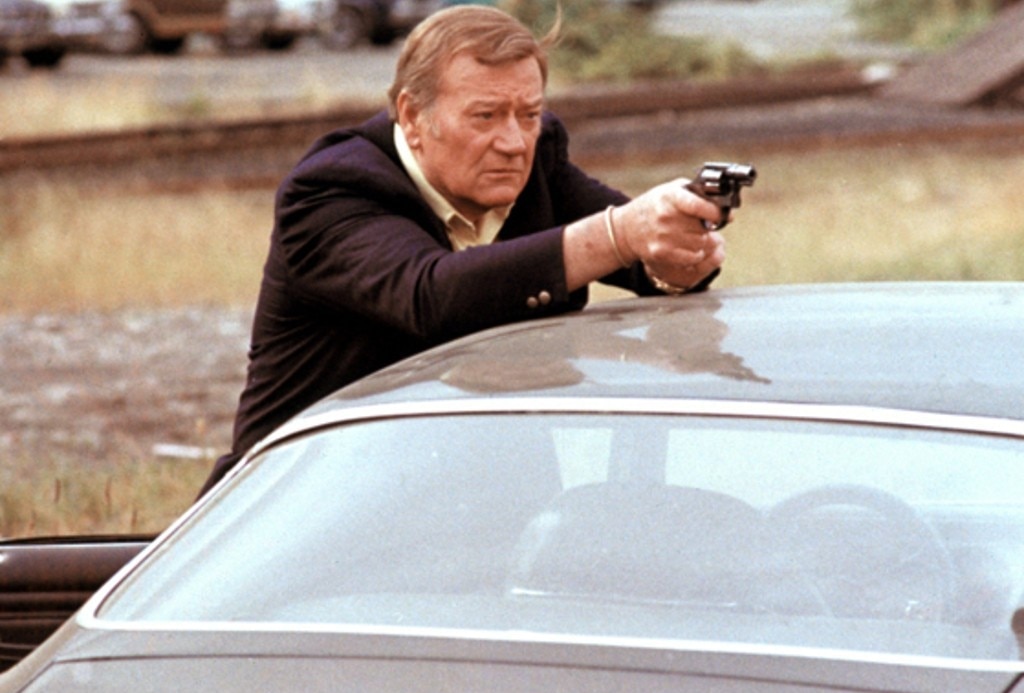
In a career that spanned over 45 years, John Wayne played sheriffs, marshals, Texas Rangers, soldiers, military officers, outlaws with a sense of justice, even a federal agent, but he never played an actual cop until McQ (1974). He had been offered Dirty Harry in 1970 but turned it down for a slate of westerns, a decision he regretted when he saw the film, which became a huge hit as directed by Don Siegel with Clint Eastwood in the title role. So when the screenplay of McQ came his way, he had his production company Batjac take on the maverick cop drama for himself with his son Michael as executive producer.
Lt. Lon McHugh, aka McQ, is a veteran cop in the Seattle Police Department. He's divorced, lives on a boat, and drives a flashy 1973 Pontiac Trans Am nicknamed "the Green Hornet." The boat was Wayne's own craft, "Wild Goose," and the actor bunked there during production, but the car looks more like something Steve McQueen would drive and the big, bulky, aging Wayne seemed to have difficulty climbing in and out of the tiny cab.
The film opens with the systematic murder of three policeman and Wayne makes his entrance by ducking an attempt on his life and coolly shooting the hitman as he runs off. When McQ discovers that his partner and best friend is one of the victims, he beats up the local crime kingpin (Al Lettieri) and then quits the force after his commander (Eddie Albert) disciplines him with desk duty. This one is personal for McQ and he goes rogue with the help of a private eye buddy (David Huddleston), information from a reluctant informant (Roger E. Mosley), and a MAC-10 submachine gun he "borrows" from a local gun dealer (a new piece of weapons technology, the gun received its own "special weapon" credit). This was clearly a cop film made in the wake of Bullitt (1968), The French Connection (1971), and Magnum Force (1973), with roaring car chases through city streets, alleys, packed freeways, and hills almost as steep as San Francisco, a police force riddled with corruption, and a culture where loyalty and trust is in short supply.
Eddie Albert co-stars as McQ's superior officer, whose immediate reaction to a spate of cop killings is to round up the militants and "freaks"--this was 1973, after all--and Diana Muldaur is the widow of McQ's partner. A dignified Julie Adams made the most of a single scene as McQ's ex-wife. "We rehearsed several times, and I felt we caught the undercurrent--two people who were both being polite, but who were in an awkward situation, conscious of all that they had felt for each other," recalled the actress to Wayne biographer Scott Eyman, who noted the parallels to Wayne's real life. Wayne's own marriage was undergoing strains and he separated from his wife, Pilar, shortly after returning home from the location shoot. Colleen Dewhurst is even more memorable in a touching turn as an aging, lonely cocktail waitress and informant with a drug habit and a crush on McQ. There's a melancholy beauty to her performance and Wayne matches her with a tenderness rarely seen in his roles. Clu Gulager, David Huddleston, Al Lettieri, and Roger E. Mosely fill out the supporting cast.
Not only was it Wayne's first urban cop role, it was his first collaboration with director John Sturges, a filmmaker who earned his stripes on such westerns as Bad Day at Black Rock (1955) and Gunfight at the O.K. Corral (1957), made his reputation with The Magnificent Seven (1960), and directed such big, brawny action films like The Great Escape (1963) and Ice Station Zebra (1968). Given their propensity for muscular genres and their similar ages--Sturges was just two years younger than Duke--it was surprising they had never worked together before.
The film was shot on location in Seattle and on the Olympic Peninsula of Washington State in the summer of 1973. The climactic chase and shoot-out was filmed at Ocean Shores on the Quinault Indian reservation. As Sturges remembers it, "When I got up there on the Olympic Peninsula, I looked at the beach and noticed a guy driving up it. 'Jeez,' I thought, 'that would be a terrific place to stage a chase..." The car chases and stunt driving scenes were designed and overseen by legendary stuntman and future director Hal Needham, who created a driving stunt never before attempted in a film. Previously, ramps were used to send cars flipping over. Needham used a "cannon" with a black powder charge which was placed in the car behind the driver's seat and fired downward to send the car into the air. While testing the stunt, Needham used too much powder and sent the car flying 25 feet straight up. He broke his back and punctured a lung in the impact. Gary McLarty, another stunt driver, was called in to perform the stunt for the cameras in place of the hospitalized Needham. It was a success and the car was sent flipping six times before coming to rest. The driver survived without injury.
After a sneak preview in Seattle in early 1974, Wayne took the film to Cambridge to meet a tongue-in-cheek dare by the staff of the Harvard Lampoon to "have it out, head-on, with the young whelps here who would call the supposedly unbeatable John Wayne the biggest fraud in history." He followed the preview screening with an impromptu press conference, where he matched the irreverent questions of the students with witty responses, matching them quip for quip with a sense of humor none of them expected from the reactionary icon of old Hollywood. "I had the best damn day of my life," he told his secretary and companion Pat Stacy, and the Lampoon sent him their Brass Balls sculpture in tribute.
If Wayne was a hit with the college crowd, the film did little better than break even. At 66 he was a little old for the role of a maverick cop. He suffered from gout, which limited his mobility, and a life making rugged movies and smoking and drinking to excess was taking its toll on his body. After another attempt at a tough urban cop drama, Brannigan (1975), Wayne returned to the genre in which he was most comfortable--the western--and made his final films back in the saddle.
By Sean Axmaker
Sources:
John Wayne: The Life and Legend, Scott Eyman. Simon and Schuster, 2014.
Escape Artist: The Life and Films of John Sturges, Glenn Lovell. University of Wisconsin Press, 2008.
John Wayne: American, Randy Roberts and James S. Olson. Free Press, 1995.
"Wayne, Off the Range, Stars as a Policeman in Warners' McQ," Nora Sayre. The New York Times, February 7, 1974.
AFI Catalog of Feature Films
IMDb
McQ
by Sean Axmaker | May 18, 2015
SIGN UP FOR OUR NEWSLETTERS

CONNECT WITH TCM