The so-called "blaxploitation" genre exploded in the late 1960s and 1970s as independent producers tried to cash in on African-American audiences who were being ignored by the major studios. The films were largely low-budget productions from small studios. They were often reduced to glamorizing hoodlums and drug dealers and the films were usually rife with violence and nudity and unfortunate stereotypes, but the niche also offered African-American actors and actresses opportunities to play action heroes and other leading roles unavailable to them in major Hollywood pictures and gave opportunities for black filmmakers to get a start. After a few years of macho stud heroes, the movies also started to feature female heroes, beginning in 1973 with two hit movies: Coffy, which elevated Pam Grier to leading lady status, and Cleopatra Jones. The character was, in the words of Yvonne D. Sims, one of the "tough, no-nonsense women who were capable of holding their own among men and using justifiable violence to achieve their ultimate objective." But where Grier played a streetwise character in the inner city, the heroine of Cleopatra Jones is a glamorous international agent working for the American government (her badge simply reads "Special Agent to the President"). Made in the wake of Shaft (1971) and Super Fly (1972), the film was produced by Warner Bros., which was looking for its own black-themed hit, and the studio gave the film a bigger budget than any of Grier's films of the era.
The film was co-written and co-produced by Max Julien, a classically-trained actor who starred in the blaxploitation classic The Mack (1973) and was looking to expand his horizons. "Max was a very insightful man," observed actor Glynn Turman, who starred opposite Julien in Thomasine and Bushrod (1974), in an interview years later. "Very business savvy and very courageous." Julien wrote the part for his girlfriend at the time, actress Vonetta McGee, but she lost out to Tamara Dobson, a tall, statuesque fashion model featured in such magazine as Vogue, Essence, Mademoiselle, and Ebony.
The film opens on special agent Cleopatra Jones (Dobson), clad in layers of runway chic fashions in bright rainbow colors, strolling up a sand dune in a faraway locale to order airstrikes on a Turkish poppy field. That means war, as far as a Los Angeles drug lord named "Mommy" (Shelley Winters hamming it up under garish wigs) is concerned, and she lures Cleopatra back to L.A. by shutting down the rehab clinic run by Cleo's lover (Bernie Casey, a role model of dignity and action as a neighborhood activist). It's a mix of James Bond glamour and urban action, with the sleek Dobson as a tough, martial-arts-trained heroine taking on an exaggerated cartoon of a villain.
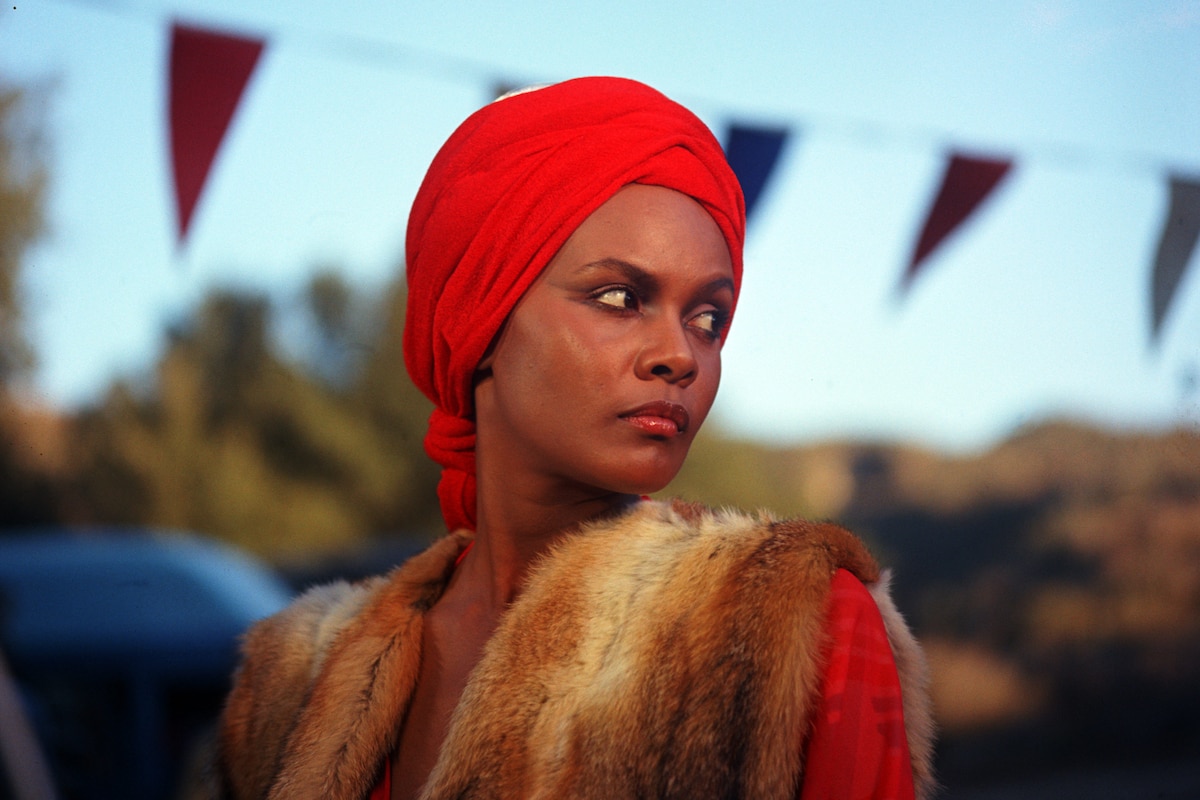
According to the film's press release, Tamara Dobson was chosen from 2,500 contenders tested in a "nation-wide talent search." She had appeared in numerous TV commercials and had minor roles in Come Back, Charleston Blue (1972) and Fuzz (1972) but Cleopatra Jones was her first leading role in a film. The Guinness Book of World Records lists the 6'2" actress as the tallest leading lady ever in a Hollywood and film director Jack Starrett makes the most of her physical presence. Dobson wears a stylish new high-fashion outfit for every scene--furs, pant-suits, ponchos, turbans--and a perfectly-coiffed afro that makes her look even taller. Her sleek black-and-silver Corvette has a personalized license plate that reads "CLEO" and a T-bar above the driver's seat that automatically opens with door to accommodate her afro.
Antonio Fargas, who trained at the Negro Ensemble Company in New York, co-stars as Doodlebug, Mommy's garishly overdressed pusher, a role he later parodied in the Keenan Ivory Wayans's 1988 spoof of the blaxploitation genre, I'm Gonna Git You Sucka. He made his film debut at 14 in The Cool World (1963) and appeared in Putney Swope (1969) and Shaft, but to a certain generation he's known for playing Huggy Bear, the streetwise informant on the hit TV cop show Starsky and Hutch.
Cleopatra Jones was a hit and Dobson returned for a sequel, Cleopatra Jones and the Casino of Gold (1975), but by then the genre was oversaturated and running out of energy. Dobson only made a few more films and TV appearances (including a role in Jason of Star Command, a low-budget Saturday morning cult sci-fi series that has since earned a small cult following) before returning to modeling full time. She was diagnosed with multiple sclerosis in 2000 and died in 2006 from pneumonia.
By Sean Axmaker
Sources:
Blaxploitation Films, Mikel J. Kloven. Oldcastle Books, 2010.
Women of Blaxploitation: How the Black Action Film Heroine Changed American Culture, Yvonne D. Sims. McFarland & Company, Inc., 2006.
Reflections on Blaxploitation, David Walker, Andrew J. Rausch, Chris Watson. Scarecrow Press, 2009.
AFI Catalog of Feature Films
IMDb
Cleopatra Jones
by Sean Axmaker | May 18, 2015
SIGN UP FOR OUR NEWSLETTERS

CONNECT WITH TCM