This is a good time for the publication of Tony Earnshaw's book on the making of Night of the Demon (1957), known to American audiences as Curse of the Demon. First of all, it's Halloween season - perfect for delving into the story of one of the finest horror films ever made. Second, Warner Home Video has just issued its Val Lewton Collection on DVD, comprised of the nine mostly excellent RKO chillers produced by Lewton in the 1940s. Three of those films were directed by Jacques Tourneur, including his personal favorite I Walked With a Zombie (1943). ("The best film I've ever done in my life," he later said. "Except that title.") Lewton taught Tourneur the power of suggestion over explicit explanation. He proved that intelligent films which make viewers imagine the worst, rather than subject them to cheap effects, can unnerve even the toughest souls.
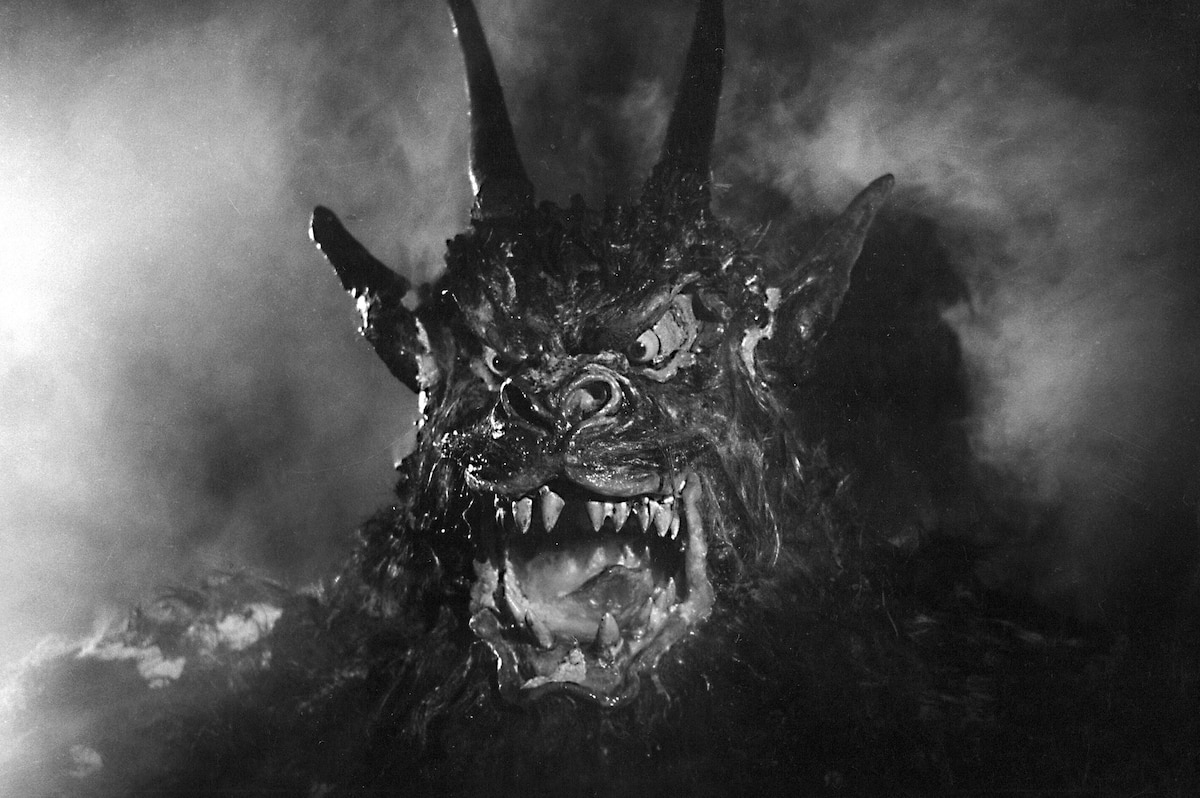
And so, when Tourneur in 1956 was offered Night of the Demon, he saw a ripe opportunity to make a throwback to the Lewton films of old. The screenplay by Charles Bennett was certainly appropriate. Based on English writer M.R. James's 1911 supernatural story Casting the Runes, updated to a modern setting, it was a creepy tale of an American psychologist (Dana Andrews) who arrives in London to expose what he believes to be a phony devil-cult led by one Julian Karswell (Niall MacGinnis). But as the evidence mounts that MacGinnis is not a phony and that Andrews himself will be horribly killed by an otherworldly demon, Andrews must learn to let go of his skepticism. The movie famously and controversially features shots of a demon monster in its opening and closing scenes - a monster which has probably appeared on the cover of more horror film books (this one included) than any other Hollywood creature.
A superb script from a famous writer, however, even when matched with a talented director, unfortunately did not lead to the smooth creation of a well-received film. Far from it. While the movie's reputation did grow in the years after its release, to the point where it is now considered a supreme achievement of its genre, its initial reception was indifferent and its making was so contentious that it long ago entered movie lore.
Most fans who are casually acquainted with Night of the Demon believe that Tourneur never wanted to show the demon in the film, and that producer Hal E. Chester ruined it by inserting the monster into two scenes. In his book, author Tony Earnshaw painstakingly (but readably) explains that it wasn't this simple. The demon was always in the script. The question was how much of it to show, and how explicitly to show it. Certainly Chester made the monster's presence more gratuitous by rewriting the script and by hiring blacklisted Cy Endfield to shoot monster inserts, and Chester did so over Tourneur's and Bennett's objections. (Neither of the two ever got over it. Earnshaw quotes Bennett as saying in 1986 that if Hal Chester "walked up my driveway right now, I'd shoot him dead.")
Earnshaw is a film journalist, broadcaster and programmer in England, and in Beating the Devil he has compiled information and interviews from just about every previous source about this picture, and he has conducted a few new interviews as well. Actual quotes from cast and crew are liberally sprinkled through the text. The demon controversy aside, Earnshaw also relates tales of Andrews' drunkenness during production and Chester's abrasive, meddlesome ways which annoyed just about everyone. There are further interesting tidbits such as the claim that the story's villain, Karswell, was likely inspired by Aleister Crowley, the notorious British occultist, black magician, drug addict, and bisexual hedonist who was dubbed "the wickedest man in the world" in the early 1900s. Earnshaw additionally includes rare production design sketches by Ken Adam (this was one of his earliest films), many stills from the movie and from behind the scenes, photos of locations as they appear today, reproductions of poster art, and well-written biographies of principal cast and crew members.
At 119 pages the book is slim, and sizable chunks are devoted to the biographies and a story synopsis, which if you've seen the movie you won't want to read. More would have been welcome on, for instance, Tourneur's own belief in the supernatural and his extensive research on witchcraft in England prior to filming. It is also surprising that basic information like the film's exact budget and box-office numbers are nowhere to be found. And there is far too much on the British censors' criticisms of the screenplay, criticisms which Alex Cox in his foreword labels outrageously pompous and intrusive. They are, but we don't need ten pages detailing every last censor's note.
These flaws do not ruin the book, however. Fans of the movie will devour it with interest, and those who haven't seen the movie will want to once they read it. However, the far better option is to rent or buy the DVD first. It's been available from Sony Home Entertainment since 2002 and is well worth watching. And Earnshaw's book, while not as extensive as it might have been, is well worth a read.
To order Beating the Devil: The Making of Night of the Demon, use this link to Barnes and Noble.
by Jeremy Arnold
Beating the Devil: The Making of Night of the Demon
by Jeremy Arnold | October 26, 2005
SIGN UP FOR OUR NEWSLETTERS

CONNECT WITH TCM