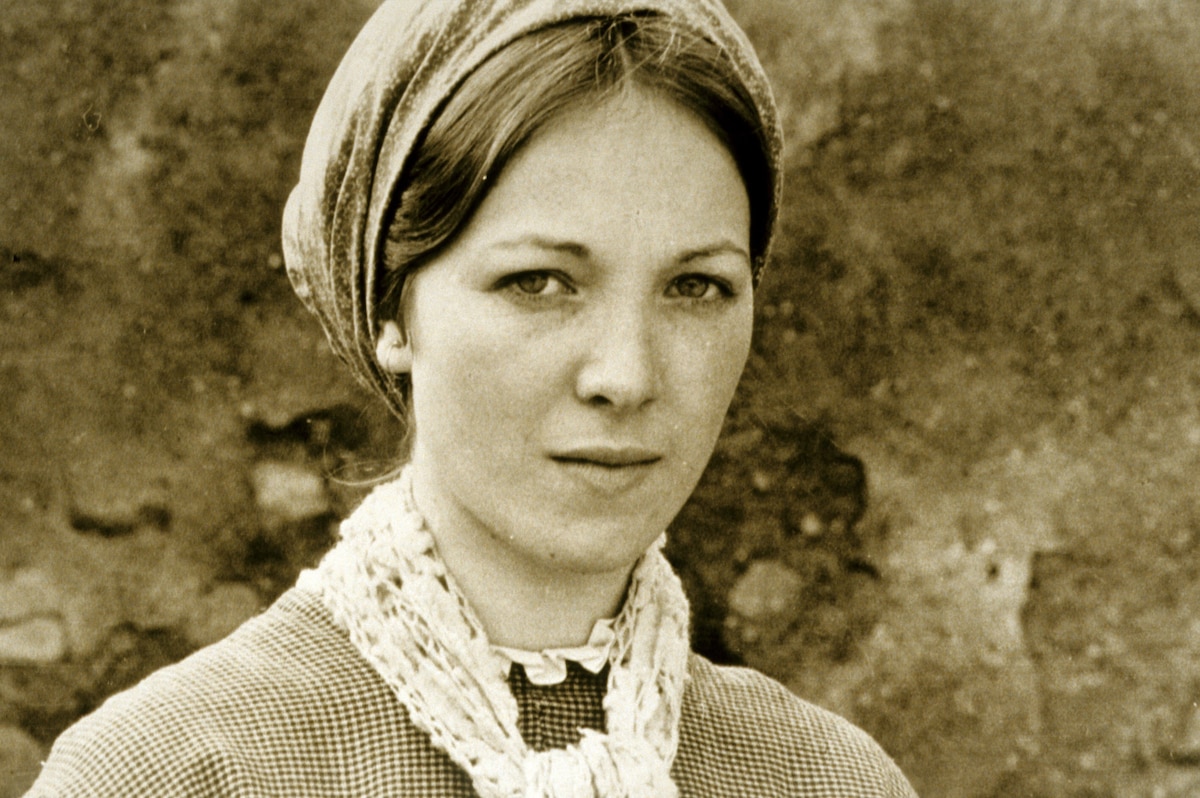
The work of Italian director Ermanno Olmi is like no other, and the film that many consider his masterpiece, The Tree of Wooden Clogs, is a prime example. Originally made as a three-part television series, it is the very essence of "slice of life" filmmaking, focusing on a year in the lives of several peasant families working as tenant farmers in northern Italy's rural Lombardy region at the end of the 19th century. The title refers to a peasant father who chops a tree down to make clogs for his son so he can go to school, and the consequences of his actions. The film won the Palme d'Or as best film at the Cannes Film Festival -- one of the few winners to be selected unanimously by a festival jury.
Olmi, who was born in the Lombardian city of Bergamo, based The Tree of Wooden Clogs on stories his grandmother told him, and his characters speak in the Bergamasque dialect. (There was also a version dubbed into regular Italian which was shown in some other parts of Italy.) Olmi, a Catholic, a Marxist, and a peasant, knew the region and the people intimately, and the story was close to his heart and to his own history: the feudal system which forced peasants to beg for what should be basic rights. Olmi began his career making documentaries, and as British critic Derek Malcolm notes, The Tree of Wooden Clogs "is a documentary that isn't a documentary, perhaps a trifle nostalgic for times past but never averse to pointing out the viciousness of the old system and the bleak fight that has to be fought against the natural world."
As was his custom, Olmi wrote, shot and edited the film himself, working with a handheld 35-millemeter camera and direct sound. The characters were played not by actors, but by real people who lived in the area. Throughout his career, Olmi has worked this way, and has described his method in interviews. He begins by making detailed notes for a subject or story, adding or subtracting or ideas as he scouts locations and casts his films. Once shooting begins, he outlines the story for the cast, but as he told film scholar Bert Cardullo, he never works with a completed script. "Shooting freely, never selecting anything in advance, I find that everything happens almost spontaneously. It doesn't happen by design, by planning...It is important that the operative technical moment be enveloped in the many emotions that are in the air at the moment one lives in the scene." On The Tree of Wooden Clogs, Olmi spent an entire year editing the film. "The editing is the moment when all the emotions I felt when I began to think about the film, to conceive it, to choose the locations, the faces--all these things--the editing is the moment when everything comes together," he told Cardullo.
Both at the time, and in the decades since, critics have extolled the timeless impact of The Tree of Wooden Clogs. Derek Malcolm listed it in The Guardian as one his hundred best films, writing that "Its strength lies not just in its ravishing depiction of the changing seasons in a stunning part of Lombardy nor in its human sympathies, which are never patronising to the ordinary people he finds so unordinary, but in its measured, cumulative approach to the hard life of those close to penury and exploited by the powerful."
Roger Ebert's review in the Chicago Sun Times suggested that "It is a film to experience in an almost apolitical way: we are introduced to a community of peasants, we observe their lives and strivings. Olmi has brought an astonishing wealth of detail, accuracy and beauty to this record of their story, and that is enough."
Deborah Young writes in Film Comment, "The illusion of recapturing lost time--here, the misery, hard labor, simple joys, and natural rhythms of the peasant, world--has rarely been more convincing. We watch the opening hour for the sheer beauty of the shots, its simplicity, humility, and quietude."And Vincent Canby of the New York Times concluded, "The Tree of Wooden Clogs is a profoundly serious film that stands outside time and fashion."
Director: Ermanno Olmi
Screenplay: Ermanno Olmi
Cinematography: Ermanno Olmi
Editor: Ermanno Olmi
Costume Design: Francesca Zucchelli
Production Design: Enrico Tovaglieri
Principal Cast: Luigi Ornaghi (Batisti), Francesca Moriggi (Batistina), Omar Brignoli (Minec), Antonio Ferrari (Tuni), Teresa Brescianini (Widow Runk), Giuseppe Brignoli (Anselmo), Carlo Rota (Peppino), Pasqualina Brolis (Teresina), Massimo Fratus (Pierino)
Minutes
by Margarita Landazuri
The Tree of Wooden Clogs
by Margarita Landazuri | April 22, 2015
SIGN UP FOR OUR NEWSLETTERS

CONNECT WITH TCM