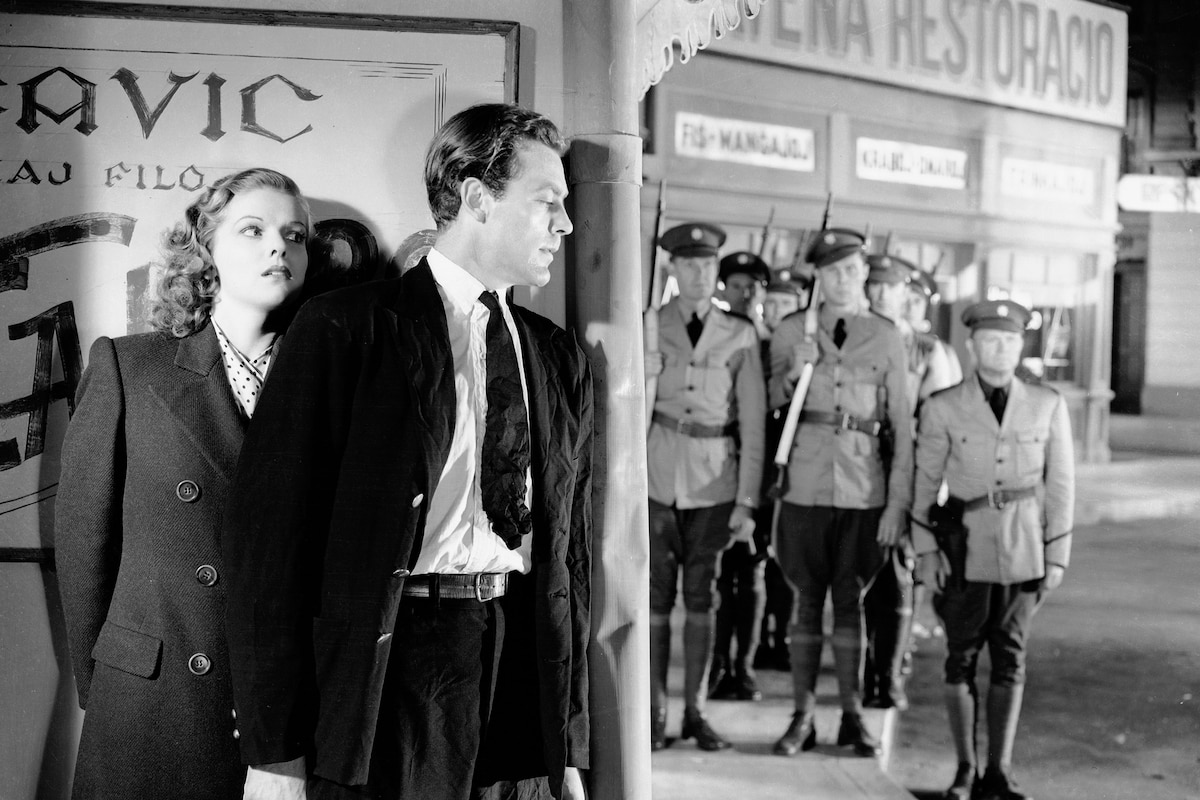
Before the attack on Pearl Harbor, isolationists in Congress lobbied Hollywood not to advocate for American participation in World War II. Alfred Hitchcock's anti-Fascist espionage thriller Foreign Correspondent (1940) was exceptional in its flaunting of those government edicts, but similar movies were vetted for 'interventionist' content. RKO's adventure thriller Conspiracy (1939) thrusts an unsuspecting American sailor into the middle of a Central American revolution. Discovering that his ship is transporting contraband weaponry, radio operator Steve (Allan Lane) must go on the run to evade the country's sinister secret police. He almost immediately meets young Nedra (Linda Hayes), a secret agent for the rebels. She hides Steve at the dance hall owned by her American friend Tío (Robert Barrat). If Steve can escape, will Nedra come to America with him? Conspiracy obscures its specific locale. In his New York Times review, Frank Nugent noted that "The natives seemed to be Teutons, the atmosphere Central American, the language Esperanto and the street signs a blend of Russian and Polish, except that the word-endings were either Spanish or Italian." Local native Nedra's last name is Carlson, which may account for at least one contemporary reviewer identifying the locale as Scandinavian. Other critics noted only the emphasis on action over credible drama. Hayes' exotic rebel agent Nedra performs in a public nightclub, singing the Sammy Fain-Lew Brown ballad "Take the World Off My Shoulders." Variety opined that the picture "at times looks like screen test for Linda Hayes and Allan Lane." The contraband cargo in question is poison gas, which the Geneva Protocol of 1925 had prohibited as a weapon of war. The supposedly neutral thriller surely touched on American war nerves, as a significant percentage of WW1 casualties had been caused by poison mustard gas.
By Glenn Erickson
Conspiracy (1938)
by Glenn Erickson | April 03, 2015
SIGN UP FOR OUR NEWSLETTERS

CONNECT WITH TCM