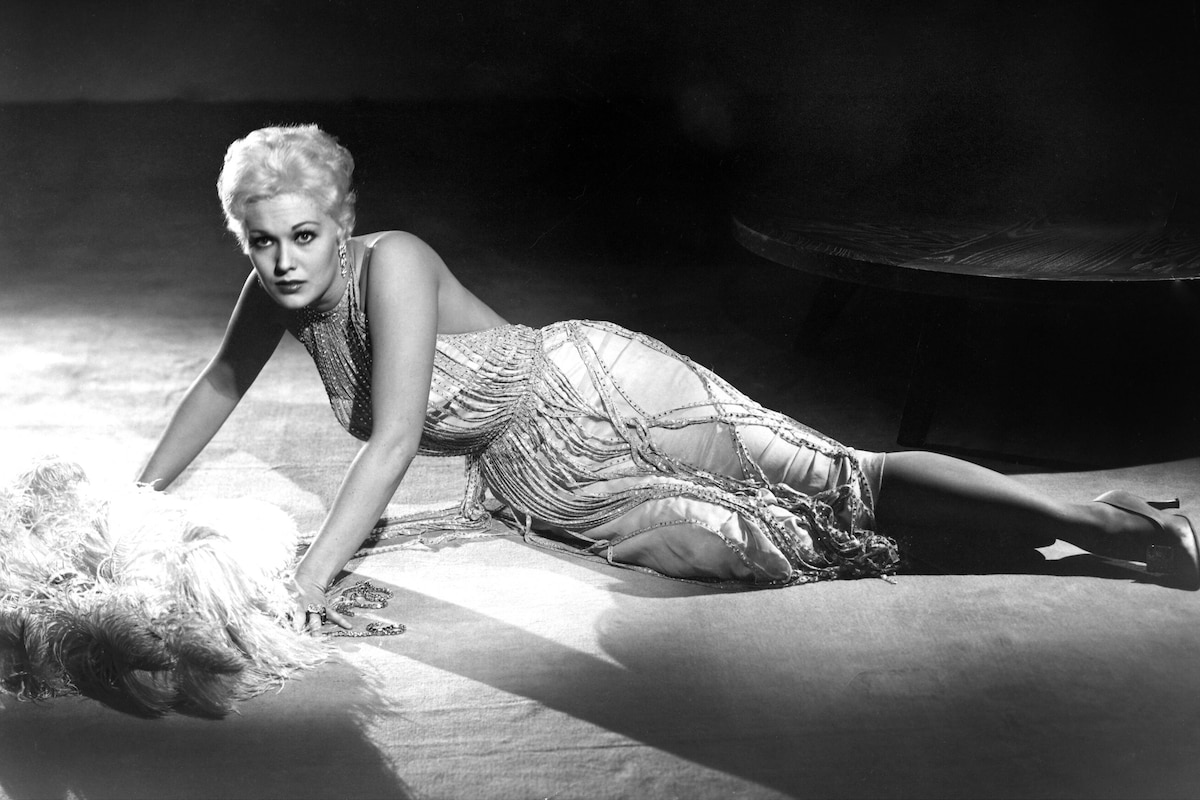
Kim Novak, with her soft morning breeze of a voice and bombshell figure, may have been a strange choice to portray Jeanne Eagels, the audacious Broadway and film actress who died in 1929, with alcohol, heroin, and sedatives found in her blood stream. As Samuel Fuller wrote in his 2002 autobiography A Third Face, Eagels - whose death Fuller covered as a cub reporter for the New York Evening Graphic -- "had an appetite for spectacular risks, both personal and professional." He went on to note that "her talent was like a shimmering diamond." Joseph Mankiewicz had told Fuller that Eagels had inspired the fiery Margo Channing, played by Bette Davis in All About Eve (1950, though Davis would ultimately put her own spin on the character).
Novak was hardly a Jeanne Eagels "type," but to notoriously controlling Columbia studio boss Harry Cohn, that didn't matter. In 1957, the year the sort-of biopic Jeanne Eagels was made, Novak had already been in Hollywood for four years. Cohn had signed her upon her arrival there, in 1953, hoping to groom her in the mold of Marilyn Monroe. She'd already received notice for supporting roles in three pictures - Picnic and The Man with the Golden Arm (both 1955), and The Eddy Duchin Story (1956); Jeanne Eagels was to be her first starring vehicle. There was no stopping Cohn.
But ultimately, the film - one of three consecutive pictures the actress would make with director George Sidney -- was so heavily fictionalized that Novak's suitability, or lack thereof, is hardly an issue. (One of Eagels' family members even sued the studio upon the movie's release, claiming it portrayed the actress as a "dissolute and immoral person;" the suit was settled out of court.) If Novak sometimes seems awkward or out of place in Jeanne Eagels, she is also at times deeply touching, foreshadowing some of the dreamy fragility she would show just a year later in her finest role, as Madeleine/Judy in Vertigo. Jeanne Eagels opens with Jeanne, fresh-faced and starry-eyed, arriving at a carny show, intent on winning a bathing-beauty contest that, she believes, has been fixed in her favor. But the carnival's owner, Jeff Chandler's Sal Satori, refuses to go along with the fix. Jeanne is upset, but not discouraged: She begs Sal to take her with him on the road. He agrees, at first reluctantly. Though she puts her estimable assets to work as a "cooch" dancer (even, at one point, being arrested for indecent exposure), she dreams of being a serious actress, a goal she eventually achieves with the help of acting coach Nellie Neilson (Agnes Moorehead), who ends up guiding her toward a sensational Broadway debut.
The movie handles the inevitable slide into alcohol and drug use delicately - at one point Jeanne alludes to the rumor that she uses heroin, though we never, of course, see her doing so. Novak may not be particularly good at playing drunken or drugged-out, but here and there, she shines: Early in the picture, when she begs Sal to take her with him, she manages to strike a balance between fierce, unspoken ambition and schoolgirl innocence - Novak is wonderful at conveying eagerness and optimism, untinged with anxiety or foreboding that things may not go according to plan. As Jeanne, she simply plunges forward; her innocence gives her a radiant, pearly glow.
Later, after Jeanne has rebuffed Sal's repeated and sincere marriage proposals - she's too ambitious to slow her career down for him - she realizes that the man she has married, ex-college football star John Donahue (Charles Drake), is all wrong for her. The two share a final, drunken New Year's Eve; Novak conveys a woozy unhappiness in this scene that's slightly awkward, though it's perhaps all the more affecting for that - there's something unpolished and raw about it.
Through the years, Novak would earn a reputation as a beautiful but stiff actress, a creature to be looked at and admired but not necessarily respected. But even her weakest performances show fascinating moments of fragility balanced with determination. In real life, upon her arrival in Hollywood, Novak fought to hang onto her sense of self: Cohn had wanted to change her name from her given one, Marilyn Pauline Novak, to Kim Marlowe. Novak, having grown up in a working-class Chicago neighborhood, was proud of her Czech heritage, and stood firm: She would change her first name, but not her last. As film critic Dave Kehr wrote in The New York Times in 2010, "Her hybrid stage name already seemed to contain the contradiction that would shape her career: part manufactured Hollywood glamour, part Midwestern authenticity. Elusive and ethereal at one moment, she could be frankly, thrillingly carnal the next."
Novak's gifts as a performer are easier, of course, to appreciate in retrospect. At the time of its release, Jeanne Eagels was savaged by critics. The (unnamed) critic for the New York Times wrote, "The kindest way to appraise 'Jeanne Eagels' is simply to call it embarrassing." Naming Novak specifically, the critic goes on: "Whatever possessed Columbia to cast this comparative fledgling, with her nice light comedy flair as one of Broadway's immortals, remains a studio secret."
But perhaps part of what we're seeing in Novak's sometimes awkward performance is a woman's resistance to being groomed as a Hollywood goddess. Cohn insisted on having Novak's hair dyed white-blonde, later tweaked to be blonde with a lavender tinge - it didn't matter that Novak reportedly loathed the color. But Novak was certainly no fool when it came to money: She raised a stink after learning that Chandler had been paid $200,000 for Jeanne Eagels, in contrast to the measly $13,000 she received, prompting Cohn to grumble, in a 1957 Time magazine cover story on the actress, "They all believe their publicity after a while. I have never met a grateful performer in the picture business."
Still, Novak would have the last laugh. In the year or so after Jeanne Eagels, she not only made Vertigo, the movie that would preserve her beauty forever in the minds of moviegoers; she fell head over heels for Sammy Davis, Jr. (Chandler was instrumental in introducing the couple.) Reportedly, Cohn was so appalled and distraught by the affair that he suffered a mild heart attack; he recovered from that one, but died from another later that year. His creation, defiantly, has long outlived him.
SOURCES:
IMDb
The New York Times
Samuel Fuller, A Third Face: My Tale of Writing, Fighting, and Filmmaking, Knopf, 2002
Sam Kashner, "The Color of Love," Vanity Fair, September 2013
Producer: George Sidney
Director: George Sidney
Screenplay: John Fante, Daniel Fuchs, Sonya Levien, from a story by Daniel Fuchs
Cinematography: Robert H. Planck
Music: George Duning
Film Editing: Viola Lawrence and Jerome Thoms
Cast: Kim Novak (Jeanne Eagels), Jeff Chandler (Sal Satori), Charles Drake (John Donahue), Agnes Moorehead (Nellie Neilson), Larry Gates (Al Brooks), Virginia Grey (Elsie Desmond), Murray Hamilton (Chick O'Hara)
[Black-and-white, 108 minutes]
By Stephanie Zacharek
Jeanne Eagles (1957)
by Stephanie Zacharek | April 03, 2015
SIGN UP FOR OUR NEWSLETTERS

CONNECT WITH TCM