A global relaxation of censorious standards related to nudity, profanity, and sexual situations in art led to, by the early 1960s, an increasing frankness about eroticism in literature, drama, fine art - even comic strips. Signifiers of the so-called "sexual revolution" were female comic strip heroines whose sensual escapades were meant to encourage a sloughing off of age-old inhibitions. Leading this emancipated pack were Guido Crepax's Valentina from Italy, Peter O'Donnell and Jim Holdaway's Modesty Blaise from Great Britain, Forrest J. Ackerman and Trina Robbins' Vampirella from the United States, and Jean-Claude Forest's Barbarella from France. A deep space voyager who often found herself seduced by her interstellar acquaintances or bound, gagged, and tortured by them, Barbarella debuted in 1962, the year that American astronaut John Glenn became the first man to orbit the Earth and that NASA launched the communications satellite Telstar. The Barbarella strips were collected into a single volume in 1964, which acquired the reputation (however inaccurate) of being the first adult comic book. Film rights to the series were acquired by maverick Italian producer Dino De Laurentiis, who assigned the adaptation to French filmmaker Roger Vadim. De Laurentiis envisioned Sophia Loren in the title role but when Loren turned him down (then in her mid-thirties, the Italian actress was admittedly too old to play a zero gravity naïf), he offered the part to Vadim's ex-wife, Brigitte Bardot. When Bardot demurred and Virna Lisi terminated her United Artists contract rather than accept the part, Vadim turned to the next actress on his short list: his then-current wife, Jane Fonda.
Vadim had married Fonda in 1965, on the rebound from a love affair with Catherine Deneuve. Less a marriage of equals than a Svengali-Trilby partnership (Vadim discouraged his new bride from taking roles in Bonnie & Clyde [1967] and Rosemary's Baby [1968]), the union found Mrs. Vadim eager to please her older and presumably wiser husband, even to the extent of paying off his gambling debts and assuming the cost of refurbishing his country farmhouse. In her 2006 memoir, My Life So Far, Fonda recalled that "the tensions and insecurities that haunted me during the making of that film almost did me in. There I was, a young woman who hated her body and suffered from terrible bulimia, playing a scantily clad - sometimes naked - sexual heroine. Every morning I was sure that Vadim would wake up and realize he had made a terrible mistake - 'Oh my god! She's not Bardot!' At the same time, unwilling to let anyone know my real feelings and wanting, Girl Scoutishly, to do my best, I would pop a Dexadrine and plow onward." The international press carried the news item of how Fonda fell ill during production, necessitating a halt in shooting, but the true story was that Vadim had no finished script, despite input from a dozen screenwriters (among them Terry Southern and Roger Corman collaborator Charles B. Griffith). When progress stalled for lack of authorial foresight, Fonda played sick so Vadim's insurers would cover the cost of the shut-down.
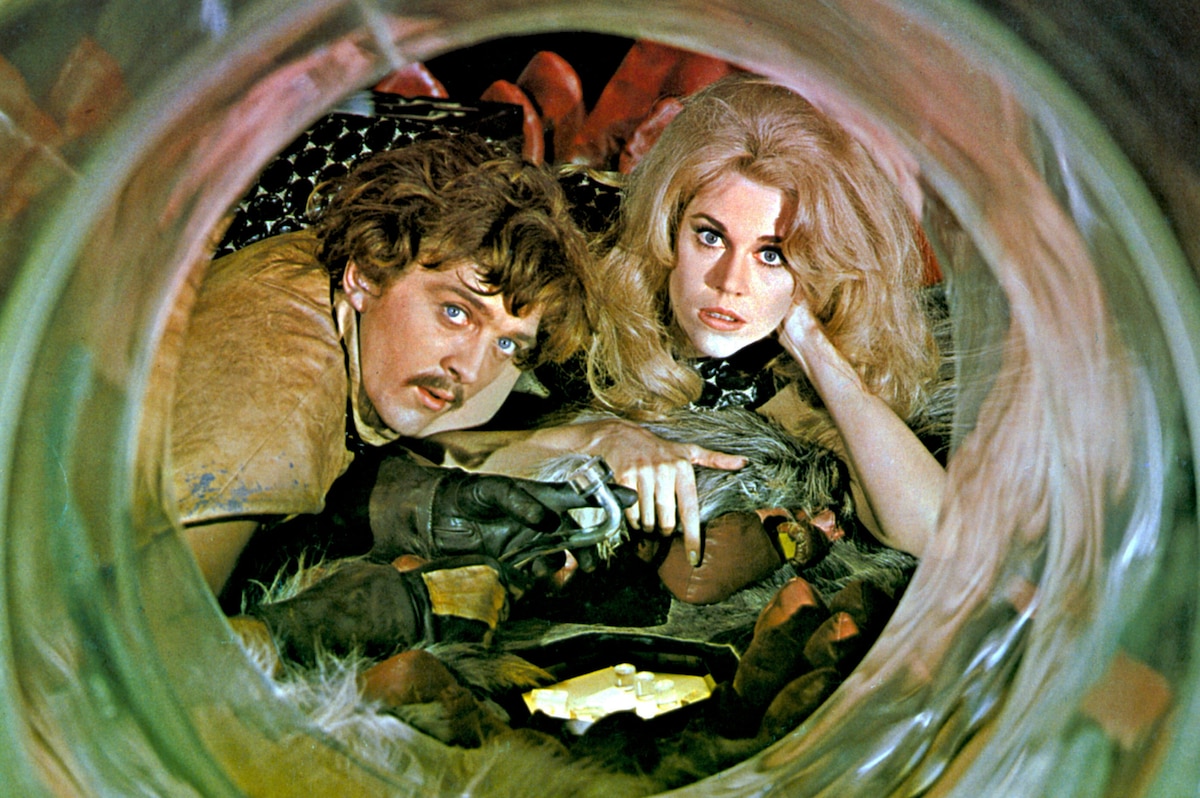
Despite being a compromised production, Barbarella remains forty-odd years on an amusing, eye-catching Pop Art diversion. Clad in bespoke Paco Rabanne costumes, Fonda is an apt embodiment of the free-spirited Barbarella and a sympathetic heroine even given the obvious misogyny underpinning the characterization. The actress is also well-served by an eclectic international supporting cast that includes David Hemmings, Milo O'Shea, Ugo Tognazzi, Claude Dauphin (in a role once considered for Jane Fonda's father, Henry Fonda), Anita Pallenberg (dubbed by Joan Greenwood), and Marcel Marceau (speaking on film for the first time as the beneficent Professor Ping, a mash-up of Albert Einstein and Harpo Marx). Fonda's leading man was American actor John Phillip Law, who had played a small role opposite her in Otto Preminger's Southern melodrama Hurry Sundown (1967); visiting Fonda at the Baton Rouge location during preproduction for Barbarella, Roger Vadim glimpsed the 6'5," blue-eyed Law climbing out of a hotel swimming pool and knew he had found the actor to play the blind angel Pygar. Shot decades before the advent of CGI, Barbarella's scenes of Pygar flying were accomplished practically, via the use of body harnesses that suspended the actors in front of a cyclorama for hours at a time. Fonda suffered additional abuse during a setpiece in which Barbarella is trapped inside a cage filled with ravenous birds, who scratched, pecked, and defecated on their already insecure leading lady.
Barbarella's disappointing box office mooted a proposed sequel, which producer Robert Evans had thought to title Barbarella Goes Down. Dino De Laurentiis considered resurrecting the character a decade later, and hired Terry Southern to bang out a treatment, but development was stillborn. Prior to his death in 2000, Roger Vadim announced a remake to star, alternatively, Sherilyn Fenn and Drew Barrymore, while more recently Robert Rodriguez attempted to cast Rose McGowan in the title role of a reboot until development funds from Universal Pictures were withdrawn. Edited for nudity to appeal to general audiences, the film was re-released in 1977 as Barbarella, Queen of the Galaxy to profit from the success of Star Wars. Relegated to the status of career punchline in the wake of Fonda's Academy Award wins for Klute (1971) and Coming Home (1978), Barbarella nonetheless exerted a certain influence. The pop group Duran Duran took its name (or thought it did) from the film's chief villain, Durand-Durand, and Barbarella's shadow can be felt as well in the costuming for the ITV series UFO and such feature films as Galaxina (1980), The Fifth Element (1997) and CQ (2001) - which featured John Phillip Law in a small role. In January 2011, Jane Fonda told The Los Angeles Times that she was, at age 73, game to return to the character of Barbarella. "Not a remake, a sequel. Look, I get shtupped by a blind angel, okay? Let's take it from there!"
By Richard Harland Smith
Sources:
Jane Fonda: My Life So Far by Jane Fonda (Random House, 2006)
Space Oddities: Women and Outer Space in Popular Films and Culture by Marie Lathers (A&C Black, 2012)
"Jane Fonda: I Want to Star in a Barbarella Sequel," by Deborah Vankin and Geoff Boucher, herocomplex.latimes.com
Barbarella
by Richard Harland Smith | April 03, 2015
SIGN UP FOR OUR NEWSLETTERS

CONNECT WITH TCM