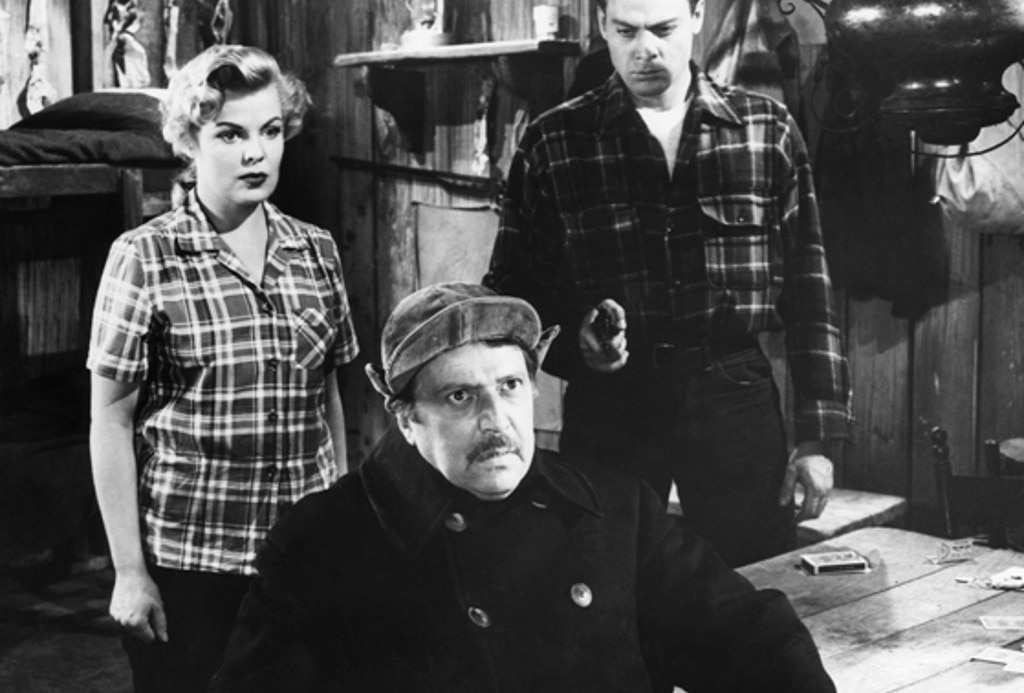
The poster for Bait (1954) lured its audience with "...The Door's Open...Come on In! She's the BAIT in a man-trap!" Cleo Moore was the "bait" of the title, with director/producer/actor Hugo Haas, John Agar, and Sir Cedric Hardwicke rounding out the cast. This was a decidedly "B" picture, and a decidedly odd film, with Hardwicke introducing himself as an autograph-signing Devil who sets the scene, goes into a projection booth and starts the film.
Hugo Haas had been a comedy star in Czechoslovakia but was forced to flee when the Nazis invaded. After the war, he became a character actor and used his own money to finance his films, each with the similar theme of the middle-aged man tempted by the blonde bombshell. None of the films was very well received, and Haas was later dubbed "the foreign Ed Wood." Like Haas' other films, Bait is quasi-morality tale about a middle-aged man's fatal attraction for a blonde temptress. In it, Haas stars as Marko, a former miner who wants to locate the gold mine he and his late partner found, but did not put on a map. A young man named Ray (Agar) goes along with Haas to find the mine, despite warnings from people in town who believe Marko killed his partner. On route, the two stop at Foley's supply store and meet Peggy (Moore), a single mother with a bad reputation. Ray is attracted to Peggy, but Marko tells him that she's bad news. When the men discover the gold, the greedy Marko begins to regret offering to split it with Ray, and comes up with a plan to get rid of him for good, using Peggy as the bait.
The story for Bait was by Samuel W. Taylor, with Haas credited for additional dialogue. As it was a low-budget film, production only lasted from early to mid-June, 1953. Location work was done in Bronson Canyon, located in Griffith Park, just north of Hollywood. Haas and Moore had worked together in One Girl's Confession (1953) and Thy Neighbor's Wife (1953) under Haas' own production company, and distributed by Columbia Pictures, where Moore had been under contract since 1952. She had been brought to the studio in the hopes of becoming another Marilyn Monroe or another Rita Hayworth, who had been Columbia's brightest star of the 1940s. Moore's career lasted a few years without making much of an impact, beyond her turn as a gun moll in Nicholas Ray's On Dangerous Ground (1951). When the studio signed Kim Novak as their "Great Blonde Hope", Moore found herself stuck making "B" pictures, and her contract was dropped in 1956.
When Bait was released in February 1954, it was trashed by the critics. "B.C." (likely veteran film critic Bosley Crowther) of The New York Times wrote a very short review of the film, in which he eviscerated it. "The brevity of the title of Bait [...] is a fair indication of the brevity of everything else in this film." The story was "pitifully meager", and the acting "leanly and laughingly done by Hugo Haas, who produced and directed, John Agar, and Cleo Moore. And it is charitably completed by the comparative brevity of the film, which is the one shining virtue of it. We return the favor with this review."
Cleo Moore ended up retiring from films in 1957 and became a successful businesswoman and mother before her untimely death from a heart attack at the age of only 48 in 1973. Hugo Haas returned to character acting until a few years before his death in 1968.
By Lorraine LoBianco
SOURCES:
B.C. "Bait: The Screen in Review" The New York Times 24 Feb 55
The Internet Movie Database
http://www.afi.com/members/catalog/DetailView.aspx?s=&Movie=51125
http://www.glamourgirlsofthesilverscreen.com/show/196/Cleo+Moore/index.html
Lyons, Arthur, Lyons, Eugene Death On The Cheap: The Lost B Movies
Pitts, Michael R. Columbia Pictures Horror, Science Fiction and Fantasy Films, 1928-1982
Smith, Emily The Jayne Mansfield Handbook - Everything you need to know about Jayne Mansfield
Bait
by Lorraine LoBianco | April 03, 2015
SIGN UP FOR OUR NEWSLETTERS

CONNECT WITH TCM