Dick Powell will forever be known to fans as the light crooner and likable leading man of thirties musicals who remade himself as a sardonic tough guy in a series of private eye and crime dramas of the forties and fifties. He took charge of his career by developing and producing films (usually uncredited) to showcase his new image, taking his private eye persona to radio and TV, forming the production company Four Star Television, and finally stepping behind the camera to direct. The Enemy Below (1957) is his fourth directorial feature and the first of two World War II pictures he made with Robert Mitchum and screenwriter Wendell Mayes.
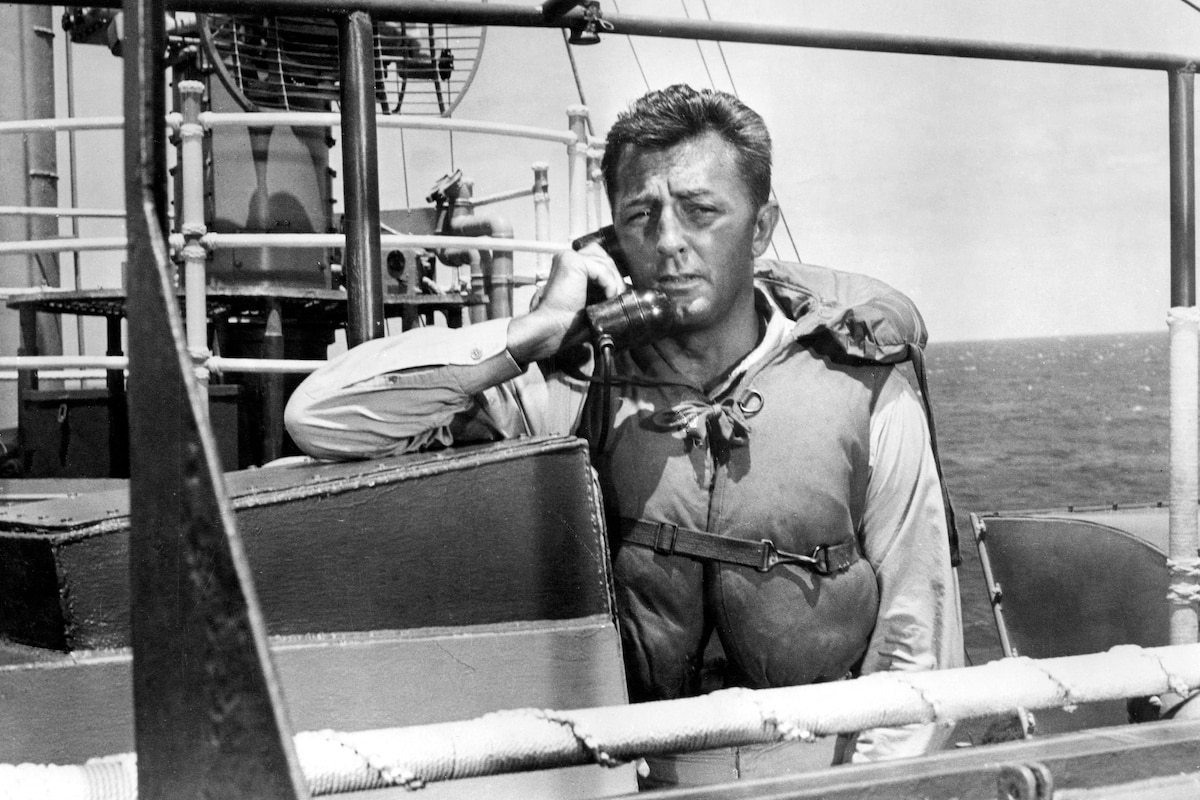
Based on the novel of the same name by Commander D. A. Rayner, the film stars Robert Mitchum as Captain Murrell, the newly-appointed commander of an American Destroyer in the South Atlantic, and German star Curd Jürgens as Commander Von Stolberg, a German submarine commander whose mission is imperiled when the American warship gives chase. The film offers its share of war movie action but the focus is on the battle of wits, a kind of chess game played with torpedoes and depth charges, with the two captains attempting to outwit the other by anticipating one another's movies.
The Enemy Below is set entirely at sea and it was shot largely on location, with the warm Pacific waters off the Hawaiian Islands standing in for the South Atlantic. The American destroyer escort U.S.S. Whitehurst, a World War II survivor stationed at Pearl Harbor, played the fictional U.S.S. Haynes. Lt. Cmdr. Walter Smith, the skipper of the Whitehurst, served as a technical advisor on the film. Powell made use of the ship for many of the interiors as well, to give the film an added element of authenticity. The submarine interior, however, was created entirely in the studio, and the battle scenes recreated through miniatures in a special effects tank.
It was Mitchum's first film after completing the World War II drama Heaven Knows, Mr. Allison (1957) and it put him back in uniform. Captain Murrell is still an enigma to his crew, newly assigned after surviving weeks alone at sea, and there are whispers among the crew that he's a "feather merchant," referring to his past as a merchant seaman before the war. "Like every civilian, I had to learn a new way of thinking," he explains to one of his officers. His unconventional tactics have the crew questioning his experience at first, and then rallying under his command as he pulls the untested crew together and they rise to the challenge of their first major enemy action. Mitchum's apparent ease and unforced sense of command defines the character of Murrell.
German star Curd Jürgens (whose name was Americanized as Curt Jurgens for the credits) made his American film debut as Mitchum's nemesis, a World War I veteran who never questions his duty but has no love for "the new Germany" of Hitler. "This was an important picture for me because it was the first film after the war in which a German officer was not interpreted as a freak," Jürgens recalled in an interview with New York Times in 1977. Powell presents the German crew as simply soldiers doing their duty. The sole Nazi officer among the battle-tested men is a joke to the rest of them, spouting Nazi rhetoric but lacking the fortitude to follow through on his grand proclamations. It was a far cry from the patriotic portraits of the 1940s war movies, and it looks forward to the presentation of the submarine crew in the award-winning 1981 German war drama Das Boot.
The film also marked the respective feature debuts of David Hedison (who was credited as Al Hedison), playing Mitchum's executive officer, and a very young Doug McClure in an uncredited role as a blond ensign manning the communications console on deck. Hedison went on to play a similar role in the TV series Voyage to the Bottom of the Sea, where the second season episode "Killers of the Deep" played out a similar battle with an enemy submarine and even used footage from the film. The film also inspired the 1966 Star Trek episode "Balance of Terror," with the Starship Enterprise recreating the role of the American Destroyer and a Romulan warship playing the submarine.
The film changed a few details of the novel, notably the nationality of the ship (it was British in the novel) and the bleak climax. It was shot as written but Powell, who was producer as well as director, hedged his bets with a second, more rousing finale, and they previewed the film with both endings, choosing the most popular.
The film, which opened on Christmas day in 1957, was a box office disappointment but it won an Oscar for its special effects and was voted one of the ten best films of the year by the National Board of Review. The Time reviewer called it "the best game of poker a man could ever hope to kibbitz" and the industry magazine Variety praised it as "well-made, with solid action" and "an engrossing tale."
Sources:
Robert Mitchum on the Screen, Alvin H. Marill. A.S. Barnes and Co., 1978.
Robert Mitchum: A Biography, George Eells. Franklin Watts, 1984.
Robert Mitchum: "Baby, I Don't Care", Lee Server. St. Martin's Press, 2001.
AFI Catalog of Feature Films
IMDb
By Sean Axmaker
The Enemy Below
by Sean Axmaker | April 03, 2015
SIGN UP FOR OUR NEWSLETTERS

CONNECT WITH TCM