Twentieth Century-Fox's submarine combat movie The Enemy Below was such a big hit in 1957 that the studio immediately assigned the film's producer-director, Dick Powell, to another war movie: The Hunters (1958). Powell, of course, was also a big movie star, but his feature acting days were already behind him. In 1953, he had transitioned to a new career as a director and producer -- though he would still occasionally act for television -- with the fine suspense drama Split Second. The Hunters was his fifth and final big-screen directing effort.
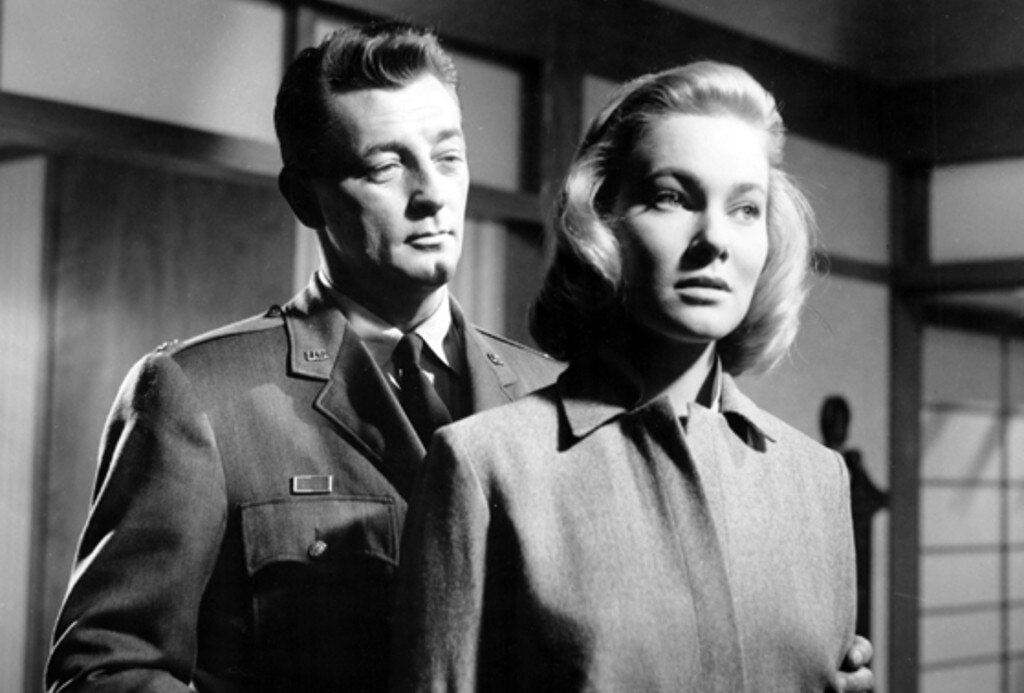
It stars Robert Mitchum as a veteran World War II pilot returning to active duty for the Korean War. He falls for the wife (May Britt) of one of his fellow Air Force pilots (Lee Philips), and ultimately must try, with the help of a third pilot (Robert Wagner), to escape enemy territory with the injured Philips on his back. The result is a film that mixes scenes of exciting aerial combat and those of decidedly soapy melodrama. The critical consensus in 1958 was that there was too much of the latter and not enough of the former. (The New York Times mused that the film "somehow only matters when aloft.") Still, the film's excellent production values and beautiful CinemaScope photography by Charles G. Clarke made the film quite watchable, and the aerial scenes still impress.
The Hunters was based on an acclaimed novel by James Salter. Screenwriter Wendell Mayes, who had adapted another novel into the screenplay for The Enemy Below, returned to adapt Salter's book. He later said, "While we used the title, what I wrote was from start to finish an original screenplay. There wasn't anything else to do, because the novel could not be adapted. It was too internal." Mayes created the entire romantic-triangle plotline of the film, changing the thrust of the novel considerably. This was not appreciated by Salter, who later said, "I only saw the film once, and I was sickened by it." (In 1999, an article in The Hollywood Reporter indicated that Salter was then writing a new, more faithful screenplay from his novel, but a film never came to fruition.)
In any case, Dick Powell sent Mayes's script to Robert Mitchum, whom he had just directed in The Enemy Below -- or, as Mitchum later recounted, Powell sent part of the script. Speaking to the London Sunday Express in 1978, Mitchum said, "Powell sent me 30 pages,...saying how good it was. And it seemed fine to me. I got to fly a fighter plane and spend a lot of time in the officers club in Japan. 'And you can go to Japan and scout it out for a couple of weeks,' he said. That sounded good, so I said 'Yes.' Then he sent me page 31. And I found out my plane crashed and I spent the rest of the film carrying some fellow through Korea on my back. 'You ought to cast the part by the pound,' I said. 'Find some wisp. What's Sinatra doing?' But of course they saddled me with some hulk [Lee Philips] who got heavier by the minute and we did the whole thing on the Fox ranch and I never got near Japan."
Mitchum was available to do The Hunters because he had just been booted from Douglas Sirk's planned production of Battle Hymn (1957), another Korean War movie. Universal wanted Mitchum for the lead role of Col. Dean Hess, a WWII and Korean War fighter pilot who had previously been a clergyman, but the real-life Hess vetoed the plan because, as he put it, "I cannot possibly allow a man who has been jailed for taking drugs to play me on screen." Rock Hudson took the part instead, and Mitchum signed on to The Hunters.
For the role of a young hotshot pilot named Lt. Ed Pell, Fox cast 27-year-old Robert Wagner, who reported to work on The Hunters immediately following his honeymoon with Natalie Wood. In his memoir, Wagner wrote that he "adored both [Powell and Mitchum]. Powell was one of the great guys of all time, and Mitchum and I became fast friends. He insisted that I call him 'Mother Mitchum'.... [He] wasn't drinking at the time, although he did smoke a little grass. His marijuana bust in the 1940s hadn't fazed him in the least."
Wagner received a good notice from The New York Times, but in the end, the airplanes drew the biggest raves: "Mr. Wagner, in the role of a jive-talking killer ace, steals the picture from everybody, excluding the jet planes. The sight of these silver-bellied beauties streaking across the sky, or barking away in counter-attack, may be reward enough for many customers."
By Jeremy Arnold
SOURCES:
Alvin H. Marill, Robert Mitchum on the Screen
Jerry Roberts, editor, Mitchum in His Own Words
Lee Server, Robert Mitchum: Baby, I Don't Care
Robert J. Wagner with Scott Eyman, Pieces of My Heart
The Hunters (1958)
by Jeremy Arnold | April 03, 2015
SIGN UP FOR OUR NEWSLETTERS

CONNECT WITH TCM