Perhaps more so than any other actor employed during Hollywood's Golden Age, Anthony Quinn was called upon to personify nearly every ethnicity in the diversity index; a veritable one man United Nations, Quinn portrayed Greeks, Frenchmen, Italians, Hawaiians, Spaniards, Cubans, Filipinos, Inuits, and Arabs. Mexican-Irish by birth, the actor also played his fair share of Native Americans, beginning with a bit as a Cheyenne brave in The Plainsman (1936) - directed by future father-in-law Cecil B. DeMille) - and sixth-billed as Lakota legend Crazy Horse in Raoul Walsh's They Died with Their Boots On. Elevated to the A-list by Academy Awards for supporting roles in Viva Zapata! (1952) and Lust for Life (1956) and Best Actor nominations for Wild is the Wind (1957) and Zorba the Greek (1964), Quinn matured into elder statesman roles by the mid-60s, becoming the face of The Establishment in such films as Elliot Silverstein's The Happening (1967) and Stanley Kramer's R.P.M. (1970). Carol Reed's Flap (1970) represented a change of pace for the 55 year-old Quinn, while simultaneously returning him to the Native American milieu for the first time since Budd Boetticher's Seminole (1953).
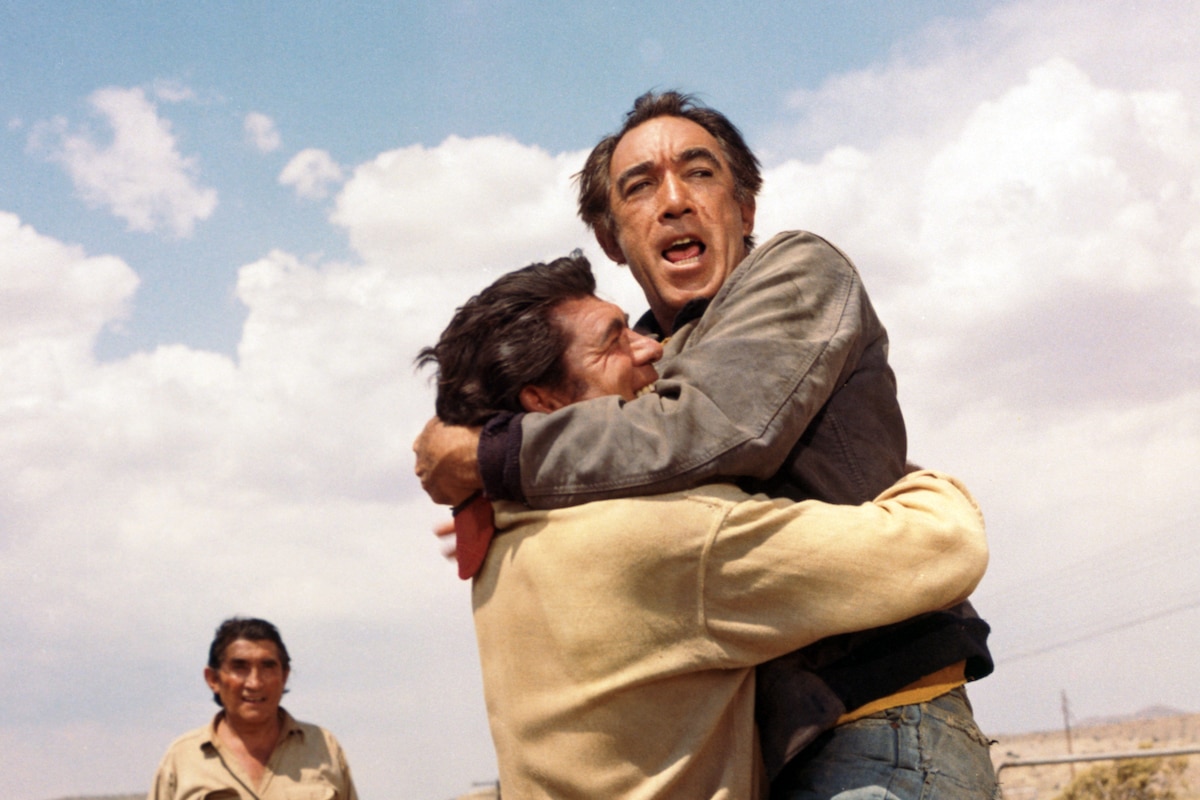
While R.P.M. had cast Quinn as a middle-aged college professor who becomes a reluctant arbiter between campus revolutionaries and university dons, Flap called upon the actor to play the revolutionary, albeit an atypical one. Based on the 1967 novel Nobody Loves a Drunken Indian, by western writer Clair Huffaker, Flap is the story of Flapping Eagle, a reservation lout whose drunken escapades are construed by others as activism and who ultimately becomes a martyr to the cause of Native American rights. The film was British producer-director Carol Reed's penultimate production and his follow-up to Oliver! (1968), his Academy Award-winning big screen adaptation of the long-running Broadway musical. As had Oliver!, Flap attends the plight of the disadvantaged - namely, the residents of a downtrodden New Mexico reservation - with a focus that is both comical and tragic but ultimately. The film had gone into production under a handful of alternate titles, among them Nobody Loves a Drunken Indian and Nobody Loves Flapping Eagle, with principal photography commencing in and around New Mexico's Santa Clara Pueblo and the ancient Puye Cliffs. Flap's supporting cast included two-time Oscar winner Shelley Winters and Tony Bill, who would soon trade acting for producer credits on such films as The Sting (1973), Hearts of the West (1975), and Going in Style (1979).
Warner Bros.' ad campaign for Flap contained the tagline "The Indians have already claimed Alcatraz... City Hall may be next!" However nonsensical the reference may be to contemporary eyes, the Warners publicity mill was referring to an event that had gained national attention. As production commenced in late 1969, members of the Native American activist group Red Power had begun what would be an almost two-year occupation of Alcatraz Island in San Francisco Bay. The siege of the declassified penitentiary was an attempt to reclaim the land for indigenous peoples, based on a stipulation in the 1868 Treaty of Fort Laramie that relinquished retired government land to the Sioux nation. Though the occupation ended ignominiously with the activists forcibly removed, the protest played a decisive role in legitimizing Native American self-determination. Flap was a box office failure for Warner Bros. but the studio fared better when it acquired Tom Laughlin's Billy Jack (1971), another chronicle of the struggle for Native American rights that went on to become one of the most successful independent films of all time.
By Richard Harland Smith
Sources:
The Films of Carol Reed by Robert F. Moss (Columbia University Press, 1987)
British Film Makers: Carol Reed by Peter William Evans (Manchester University Press, 2005)
Flap
by Richard Harland Smith | March 18, 2015
SIGN UP FOR OUR NEWSLETTERS

CONNECT WITH TCM