Jean Renoir, like many great directors, had a career filled with masterpieces overshadowed by one movie. Orson Welles, a giant who made one great film after another, had all of them overshadowed by Citizen Kane throughout his career and beyond. For Buster Keaton, it was The General. For Ozu, Tokyo Story. For Kubrick, 2001: A Space Odyssey. And Jean Renoir had The Rules of the Game. If another of his movies makes it onto a list of cinema's greatest, it will almost assuredly be Grand Illusion, another masterpiece. And yet he did so many more. In fact, many would argue, as Andrew Sarris did, that his greatest works came in the fifties, during his Technicolor era. One of those works cast his longtime collaborator, Jean Gabin, in the lead and celebrated France, the theater, love, and life. It was French Cancan, filmed in glorious Technicolor and lovingly shot, frame by frame, as if the whole world was a stage.
The story begins as impresario Henri Danglard (Jean Gabin) and his star and mistress, La Belle Abbesse, who goes by Lola (Maria Felix), all retreat from a successful night onstage by heading to the White Queen, a dive bar in the poorer quarter to, as one observer in the bar puts it, "slum" for the evening. There Danglard sees local women, and one in particular, dancing the cancan joyously and has an idea: Revive the cancan and pull his struggling act out of bankruptcy. The owner of the White Queen thinks it's a great idea and assures Danglard's manager that there's money to be made right there in his bar. Meanwhile, Danglard, taken with that one dancer in particular, Nini (Françoise Arnoul), asks her to waltz, much to the chagrin, and ire, of Lola and Paolo (Franco Pastorino), Nini's boyfriend. Later, on the way home, he tells Lola not to worry, as he will never see Nini again. Of course, we know he will.
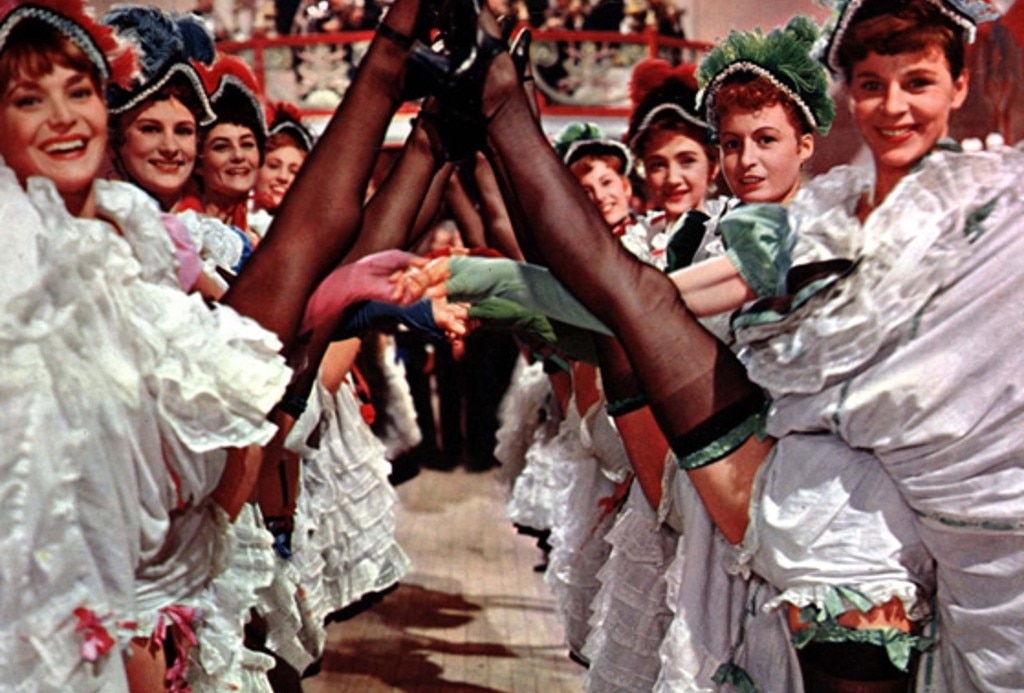
The opening of French Cancan is quite extraordinary and possibly one of the most joyous extended sequences that Renoir ever filmed. Taking up almost the entire first reel, the characters dance and laugh and drink and then dance some more. It doesn't do much to advance the plot except, it does, for it's in Danglard's joy that we come to understand how he makes his way through life. Playing the scene out in five minutes would rob the audience of a deeper understanding of Danglard for we can only understand him through the way he experiences the joy of the dance.
For movie fans associated with only Renoir's two most famous films, The Rules of the Game and Grand Illusion, both of which featured on location shooting, the artifice of French Cancan may be a little surprising but absolutely necessary. The entire film used sets, even for exterior scenes, and it seems fitting that a movie about a life on the stage should take place entirely on one. Even the famous Moulin Rouge, where naturally Danglard premieres his triumphant production, is recreated onstage, windmill and all. It's as if all of it, from the dancers to the customers, are just performers in a fantasy inside Danglard's head. As he sits in his chair at the end, smiling in absolute satisfaction at the success of his show, it may well just be. At least, that's how it could be, for the success of a new production is all the happiness a man like Danglard needs.
Jean Gabin, the great French star, was the perfect choice to play Danglard even if most of his other roles would argue against it. Gabin, who had worked with Renoir three times in the thirties, was accustomed by 1954 to playing tougher, edgier roles than that of impresario Danglard, and yet he brings to the role a sense of release, as if all the years of playing tough guys had bottled up all the joy and he finally had to let it out. Working perfectly with Gabin are Françoise Arnoul and Maria Felix, two other stars of international cinema that Hollywood just couldn't figure out. Both Gabin and Felix made attempts at Hollywood stardom but sabotaged their own efforts (Gabin famously demanded that Marlene Dietrich costar with him in an RKO film until they finally fired him and Felix turned down practically every good offer that came her way) as neither actually wanted to make movies in Hollywood. Gabin spent much of his time on the stage and the rest of his career as a legend of the French screen.
Jean Renoir, son of painter Auguste Renoir, was born in the Montmartre district of Paris where much of the action takes place (and which is depicted in his father's famous work, Bal du moulin de la Galette, and it must have felt like a journey back home for him. Today, it is considered one of his finest films, and one of the greatest triumphs of fifties cinema. There have been many movies taking on the Belle Epoque in general and the cabaret life of the Montmartre district in particular, from the original Moulin Rouge in 1952 and Can-Can in 1960 to the updated Moulin Rouge in 2001, but none have successfully captured the energy and joy that Renoir's French Cancan provides with seamless ease.
By
Greg Ferrara
French Cancan
by Greg Ferrara | March 18, 2015
SIGN UP FOR OUR NEWSLETTERS

CONNECT WITH TCM