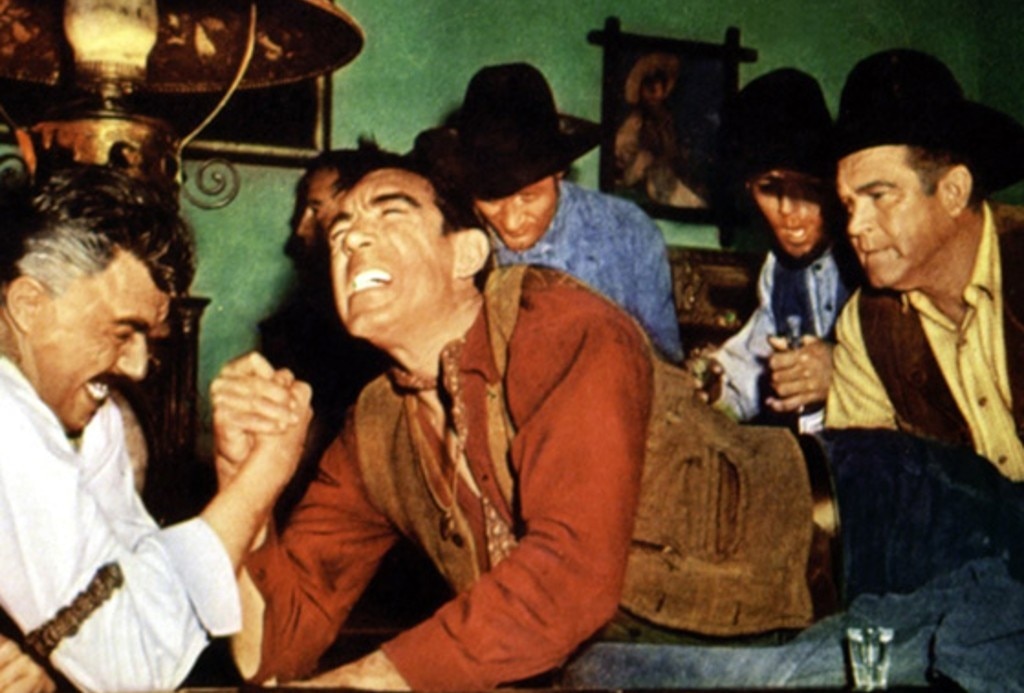
Anthony Quinn played practically every ethnicity known to Hollywood at one time or another in his long career. He was Zorba the Greek (1964), an Inuit hunter in The Savage Innocents (1960), an Arab warrior in Lawrence of Arabia (1962), and any number of American Indians and Italian / Italian-American gangsters and peasants among the more than 150 films of his career. For the low-budget western Man from Del Rio (1956), the Mexican-born star represented his own nationality as Dave Robles, a Mexican-American gunslinger who comes to the town of Mesa to take his revenge on the outlaws who terrorized his town of Del Rio.
The film rests on the sturdy shoulders of Quinn, who plays a simple man with no ulterior motives apart from his idea of justice. He takes their offer to be the town's new sheriff in part as a step up to respectability but also as a way to romance Estella (Katy Jurado), the Mexican housekeeper of the town doctor (Douglas Fowley). His dignity is short-lived when he realizes that the white townsfolk consider him nothing more than a paid servant, good enough to clean up their streets but beneath their social station. The working title of the film was The Lonely Gun, which fits the sense of isolation that Dave feels in this town. Race and class and an unearned sense of moral superiority simmer under the surface of a plot heading to an inevitable showdown between Dave and the town's would-be crime boss.
The great Mexican actress Katy Jurado, memorable in such American classics as Bullfighter and the Lady (1951), High Noon (1952), and Pat Garrett and Billy the Kid (1973), took second billing in the credits. Though a leading lady in Mexico, this was her first star billing in an American film. Douglas Fowley played Doc Holliday on the TV series The Life and Times of Wyatt Earp and provides a measure of moral authority in a town rife with hypocrisy as a more traditional town doctor here and prolific character actors Whit Bissell (the not-so-good doctors of I Was a Teenage Frankenstein and I Was a Teenage Werewolf, both 1957) and Douglas Spencer (the sardonic reporter in the original The Thing From Another World, 1951) lend their able support in small roles.
Anthony Quinn squeezed this modest western in between a couple of major productions that took him to France. He had just returned from the hills of Provence, where he played Paul Gauguin in Vincent Minnelli's Lust For Life (1956), a performance that would earn him his second Academy Award for Best Supporting Actor, and was soon to fly back to Paris to play Quasimodo in a French remake of The Hunchback of Notre Dame (1956). Man from Del Rio took him back to Hollywood, or rather to a "movie ranch" in Placerita Canyon just outside the moviemaking capitol.
If this particular dusty little frontier town looks familiar, it's likely because the busy Melody Ranch, formerly known as Placerita Ranch and Monogram Ranch, had been the location for scores of films and TV shows since old west street sets were constructed in 1936. Gene Autry renamed it Melody Ranch when he purchased it in 1953 and continued leasing it to film productions as well as to television shows in the TV western explosion. You can see the ranch's street sets in such films as The Gunfighter (1950) and Wichita (1955) and the TV shows Gunsmoke and Have Gun, Will Travel among its productions. The sets have since been rebuilt and the ranch continues to serve as a location for film productions and even has its own Melody Ranch Studio Museum.
Director of photography Stanley Cortez moved from B-movies to major studio productions, such as The Magnificent Ambersons (1942) and Since You Went Away (1944), and back again throughout his career. Before starting on Man from Del Rio, Cortez shot The Night of the Hunter (1955) for director Charles Laughton, helping to create one of the most expressionist films made by an American studio in the sound era. Though Man from Del Rio is far less stylized, Cortez creates an uneasy atmosphere in the way he transforms the town from an empty, seemingly desolate place deserted by the townsfolk as the outlaws run the streets into a main street teeming with ghoulishly curious citizens awaiting a gunfight.
European-born filmmaker Harry Horner had a relatively brief career as a director--his best known films are a pair of minor film noirs, Beware, My Lovely (1952) and Vicki (1953)--but he was also a successful production designer who earned two Academy Awards (for The Heiress, 1949, and The Hustler, 1961). Though he retired after the remake of The Jazz Singer (1980), he left behind a major legacy: two sons who kept the family name in Hollywood. Christopher Horner followed in his father's footsteps as a production designer and art director while James Horner became one of the busiest composers in Hollywood, matching his father's tally with two Oscars of his own, both for the blockbuster hit Titanic (1997).
By Sean Axmaker
Sources:
One Man Tango, Anthony Quinn with Daniel Paisner. HarperCollins, 1995.
Melody Ranch Motion Picture Studio website
AFI Catalog
IMDb
Man from Del Rio
by Sean Axmaker | March 18, 2015
SIGN UP FOR OUR NEWSLETTERS

CONNECT WITH TCM