Now, Voyager was Bette Davis' biggest box office hit of the '40s, marking the pinnacle of her career at Warner Bros. as a romantic leading lady. The picture also marked the first of four collaborations between Davis and director Irving Rapper, who would reteam for The Corn Is Green (1945), Deception (1946) and Another Man's Poison (1951). Although not as much of an artistic influence on her as director William Wyler, Rapper played an important role in shaping her film career in the forties.
For many historians, Now, Voyager is the ultimate "women's picture" - a romance deftly constructed to delight female viewers by appealing to their romantic fantasies. Others have pointed to the way Charlotte's growing independence paralleled the plight of American women during World War II, who were forced to draw on inner reserves to raise families and take on factory jobs vacated by men off serving in the military. In recent years, feminist critics like Jeanne Allen, who edited the published screenplay, have praised Now, Voyager for its depiction of a woman's move into adulthood and independence.
Those factors have also made the film a favorite among gay audiences who feel an identification with both leads, the repressed Charlotte and Jerry, who is trapped in a loveless marriage.
Now, Voyager was the third novel in a tetralogy about the upper crust Vale family of Boston. Olive Higgins Prouty, also the author of the hit romance Stella Dallas (1925, 1937), had started the series in 1936. In the third novel, released in 1941, she followed the progress of the unattractive, neurotic Charlotte Vale, who blossoms under psychiatric care, goes through a diet and a major makeover, and falls in love on a European cruise. The psychiatric elements were drawn from Prouty's own life; following the death of her fourth child, she had suffered a nervous breakdown.
Prouty took her title from Walt Whitman's "The Untold Want" in Songs of Parting: "The Untold Want, By Life and Land Ne'er Granted,/Now, Voyager, Sail Thou Forth, to Seek and Find."Former Warner Bros. production head Hal Wallis had just signed a contract to start his own production company at the studio. For his first independent production, he decided to bring Prouty's novel to the screen. He hoped the picture would contain the same elements of shipboard romance that had made Love Affair (1939), with Irene Dunne and Charles Boyer, such a box office hit.
When the studio bought the film rights, Prouty sent them a lengthy letter suggesting how she thought the book should be filmed. Among other ideas, she thought the picture should be shot in Technicolor, with the flashbacks to Charlotte's first shipboard romance done as a silent film in black and white. Wallis did not follow her suggestions.The first director assigned to Now, Voyager was Edmund Goulding. When he grew ill, the film was re-assigned to Michael Curtiz.
Originally, Wallis wanted to cast Irene Dunne in the lead to capitalize on her success in Love Affair. Then he learned Norma Shearer was interested. Both actresses had the same manager, however, and while he tried to balance their needs, Shearer lost interest, and Dunne moved on to another project. Wallis then considered casting Ginger Rogers, who had just won an Oscar® for another popular romantic drama, Kitty Foyle (1940).
Meanwhile, Bette Davis was on vacation in New Hampshire following a series of blow-ups with studio head Jack Warner. They had quarreled over her last completed picture, In This Our Life (1942), which she considered a travesty. Then he had tried to force her to leave the lot when she showed up at the start of her vacation for a pre-arranged publicity shoot. He was afraid she would charge him with overtime; she was insulted he would even have thought that. She slammed into his office, accused him of treating her like a chorus girl, then took off on vacation and refused to take his calls.
When Davis' friend at the studio, director Irving Rapper, told her that Warner Bros. had picked up the rights to Prouty's novel, she began lobbying for the role, arguing that as a native Bostonian she would understand the role much better than an actress not raised in New England. Warner, however, had feared that she wasn't attractive enough to make the character's transformation into a glamorous woman of the world believable. When Davis argued that casting a Hollywood beauty in the role would be ludicrous, and that her more modest appearance would appeal to women around the nation, Wallis saw that she was right and convinced Warner to give her the role.
When Wallis agreed to cast Davis, he also had to agree to re-assign Curtiz, whom Davis did not want to work with again. She lobbied for Rapper, a one-time dialogue director and assistant director at Warners' whom she had helped move into the director's chair. She had even done an unbilled cameo in his first film, Shining Victory (1941), to wish him luck.
Casey Robinson, who had also scripted Davis' Dark Victory (1939), was assigned to adapt the novel. Although Davis would later claim to have re-written the script and inserted dialogue from Prouty's novel, Robinson would vehemently deny that. His screenplay draws heavily on the novel for dialogue, particularly in the scenes between Charlotte and her mother. The major change he made was in moving Charlotte's first meeting with Jerry from the sanitarium, where he's recovering from his own breakdown in the novel, to the luxury liner. Actors considered for the male lead included George Brent, Walter Pidgeon, Ronald Colman, Fredric March, Henry Fonda, Joel McCrea, Franchot Tone and Herbert Marshall. For a while, Davis was interested in casting Ronald Reagan as Jerry, even though she had not been impressed by his work in Dark Victory. She was, however, moved by his performance in King's Row (1942) and, according to one studio acquaintance, may have had romantic designs on him. Warner, Wallis and Rapper convinced her that the young actor could not have held his own opposite her.
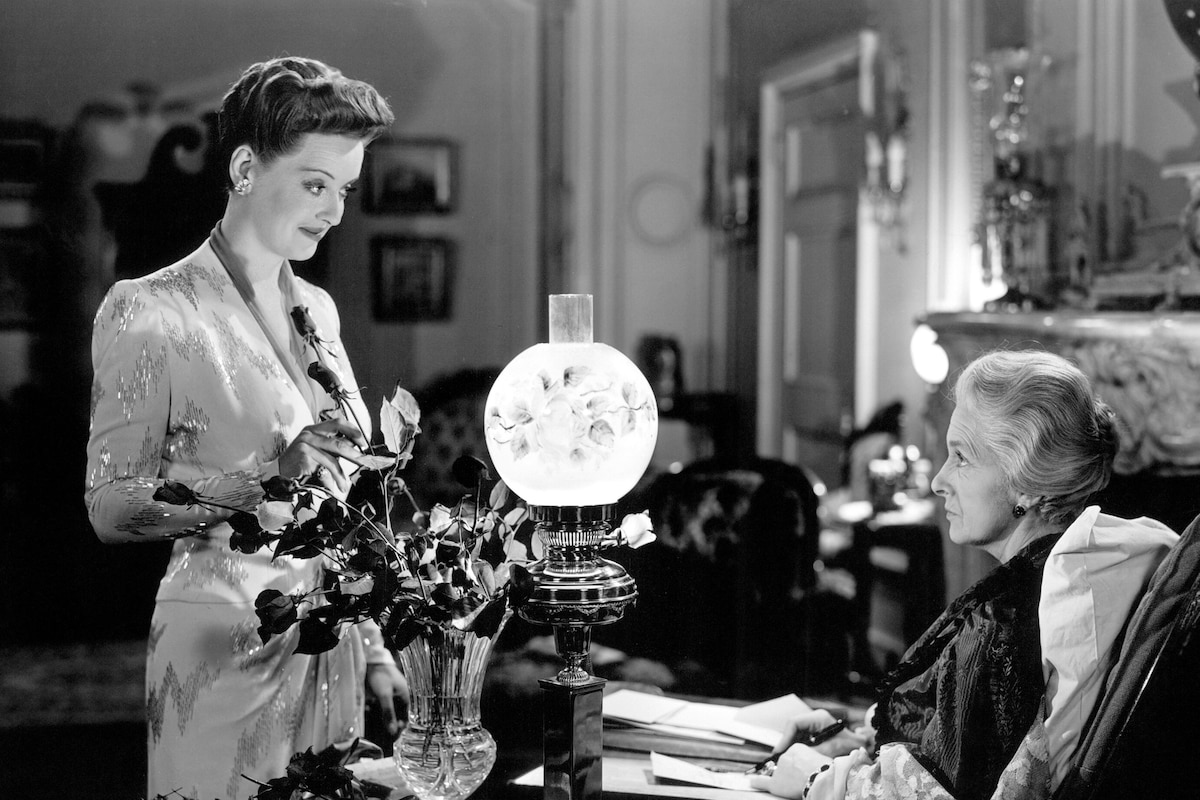
On the strength of his performance as an Allied soldier caught behind enemy lines in Night Train to Munich (1940), Paul Henreid won a screen test for the role. His European background probably helped, providing an echo of French leading man Charles Boyer in the popular Love Affair.Davis wasn't pleased with the idea of a foreign-born co-star, particularly after seeing Henreid's test. In an effort to turn him into the new George Brent, the studio had greased down his hair, put him in a silk smoking jacket and piled on the pancake. When Henreid and Davis finally met, and he told her he had hated the test, she insisted he be tested again with a more natural look. Henreid won the role and won over his leading lady. Warners' signed him for the role at just over $4,000 a week. Wallis wanted to cast Dame May Whitty as Charlotte's mother, but Rapper insisted he hire Gladys Cooper instead, even though she was too young for the role. Davis, who had seen Cooper on stage, was thrilled with the choice.
Rapper also insisted on casting Ilka Chase and Bonita Granville as Charlotte's sister-in-law and niece. When Wallis asked why, he said he thought they were the only actresses who would be believable tormenting Davis. Ironically, Davis would later say Granville was the only performer who was rude to her during the shooting.mBecause of the war situation, Charlotte Vale's cruise had to be moved from the Mediterranean to South America, which gave the film added appeal in the Latin American market. The Production Code Administration refused to approve any adaptation that clearly stated Charlotte and Jerry had an affair, since he was married. Their pristine love was one of the inspirations for Davis' final line, "Don't let's ask for the moon. We have the stars." The moon they could never have was the dream of romance. The stars were their friendship and their devotion to Jerry's daughter, Tina.
After considering Raymond Massey and Charles Coburn, Wallis asked Claude Rains to play Dr. Jaquith. The actor turned him down until the role was expanded to give him more screen time and he was paid $4,000 a week for his work. Davis was thrilled, as he was one of her favorite co-stars. Davis lobbied for Mary Anderson, one of the actresses discovered in the search for Scarlett O'Hara, to play the role of Jerry's troubled daughter Tina. Davis even tested with her, but the role was uncast when Now, Voyager went into production, eventually going to Janis Wilson.Concerned that Davis had not looked her best in her last few films, Wallis insisted that Sol Polito, one of her favorite cameramen, be pulled off another film and assigned to Now, Voyager.
After Now, Voyager, Bette Davis received letters from fans of both genders who felt their possessive mothers had ruined their lives, much as Mrs. Vale nearly ruins Charlotte's life. She also got letters from mothers admitting they had been as bad as her mother in the film.
Warner Bros. reunited the stars (Davis, Paul Henreid and Claude Rains) and the director of Now, Voyager for Deception (1946), a melodrama set in the world of classical music. Although it lacked the impact of their first film together, it performed well at the box office. For the rest of his career, Henreid's female fans would ask him to light their cigarettes as he had for Davis. When he directed her in Dead Ringer (1964), they re-staged the cigarette scene for publicity cameras. Years later, he used a photo of himself lighting two cigarettes at once on the cover of his memoirs, Ladies Man. And, when she toured with clips from her movies in the '70s, Davis always had fans offering to light her cigarettes in imitation of Henreid during the question and answer sessions following the screening.
Director: Irving Rapper
Producer: Hal B. Wallis
Screenplay: Casey Robinson, from novel by Olive Higgins Prouty
Art Direction: Robert M. Haas
Costume Design: Orry-Kelly
Cinematography: Sol Polito
Editing: Warren Low
Original Music: Max Steiner
Principal Cast: Bette Davis (Charlotte Vale), Paul Henreid (Jerry Durrance), Claude Rains (Dr. Jaquith), Gladys Cooper (Mrs. Henry Windle Vale), Bonita Granville (June Vale), John Loder (Elliot Livingston), Ilka Chase (Lisa Vale), Lee Patrick ("Deb" McIntyre), Franklin Pangborn (Mr. Thompson).
BW-118m. Close captioning. Descriptive video.
by Frank Miller
Now, Voyager
by Frank Miller | March 02, 2015
SIGN UP FOR OUR NEWSLETTERS

CONNECT WITH TCM