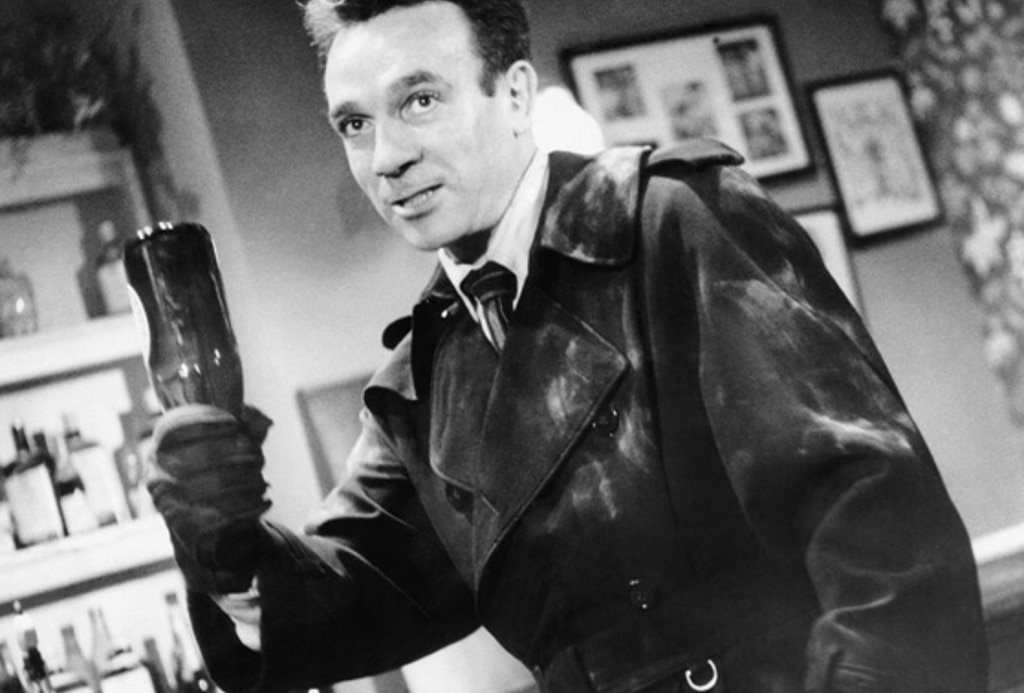
Paid to Kill (1954) plays a familiar twist on the Double Indemnity plot: an ambitious businessman with a knack for ruffling feathers with his tactics faces a scandalous crisis when an expensive deal goes belly up. He doesn't see a way out so he blackmails a desperate gunman to murder him (because his wife would be out the insurance policy if his death was ruled a suicide). Only when fortune favors him once again and he changes his mind, there's no way to call off the assignment: the would-be assassin has disappeared and may have outsourced the hit. He has to track the man down before one of the attempts on his life succeeds. The original British title of the film was Five Days, which was the deadline he gave his assassin.
This was one of the low-budget programmers that Hammer Films cranked out before it became famous for their gothic horror revivals of classic movie monsters and horror stories. Like so many of those earlier films, it's a thriller with a twist and it runs just under 75 minutes. It was a formula that Hammer had perfected, at least as a successful business plan. A quota law in Britain required that theaters play a minimum number of British productions. By importing American actors whose stardom was on the wane and could be hired inexpensively, Hammer could also export these production to the U.S. to play as second features through American distribution partner Lippert.
For Paid to Kill, the American headliner was Dane Clark, the New York-born actor and Actor's Studio member who found success playing "Joe Average" parts in Hollywood through the forties. By the 1950s, as studio parts dried up stateside, he moved out of respectable studio production to work on TV, in independent films, and in European productions, such as Gunman in the Streets (1950). Paid to Kill was his second film for Hammer and they made use of his knack for intense, tortured characters to play a hotshot American dealmaker running a British firm. His brash, competitive business manner alienates the more conservative members of his board of directors while his workaholic drive keeps him away from home, much to the frustration of his British wife (Thea Gregory). Cecile Chevreau plays his secretary Joan, a loyal gal Friday who pines for her boss, but he's so smitten with his wife that he never gives Joan a second glance, and Canadian actor Paul Carpenter plays his childhood friend, now a pathetic ne'er do well gambler, drunk, and petty thief.
It was directed by Montgomery Tully, a journeyman filmmaker who worked steadily in the British film industry, mostly in the realm of low-budget crime-dramas and thrillers from the 1940s through the late 1960s. Tully does his best to hide the budgetary constraints but he's at his best when taking the action out of the studio, or at least out of the office and apartment sets. In one nocturnal scene on a street, he turns an ordinary alley into dark, dangerous trap with slashes of light and an onrushing truck. Screenwriter Paul Tabori scripted a number of earlier Hammer films, including the low budget science fiction thrillers Four-Sided Triangle (1953) and Spaceways (1953), both directed by Hammer's star director Terence Fisher.
A more notable presence is assistant director Jimmy Sangster, who had worked his way up through the studio and put his production apprenticeship to good use. Paid to Kill was his last film as an assistant director. His first screenplay was produced by Hammer in 1955 and he quickly made his name as Hammer's top screenwriter after scripting the studio's breakthrough horror hits The Curse of Frankenstein (1957), Horror of Dracula (1958), and The Mummy (1959), highlights in a very busy career as a writer and later as a director for Hammer.
Sources:
The Hammer Story: The Authorised History of Hammer Films, Marcus Hearn and Alan Barnes. Titan Books, 2007.
Hammer: House of Horror: Behind the Screams, Howard Maxford. Overlook Press, 1996.
IMDb
by Sean Axmaker
Paid to Kill
by Sean Axmaker | February 28, 2015
SIGN UP FOR OUR NEWSLETTERS

CONNECT WITH TCM