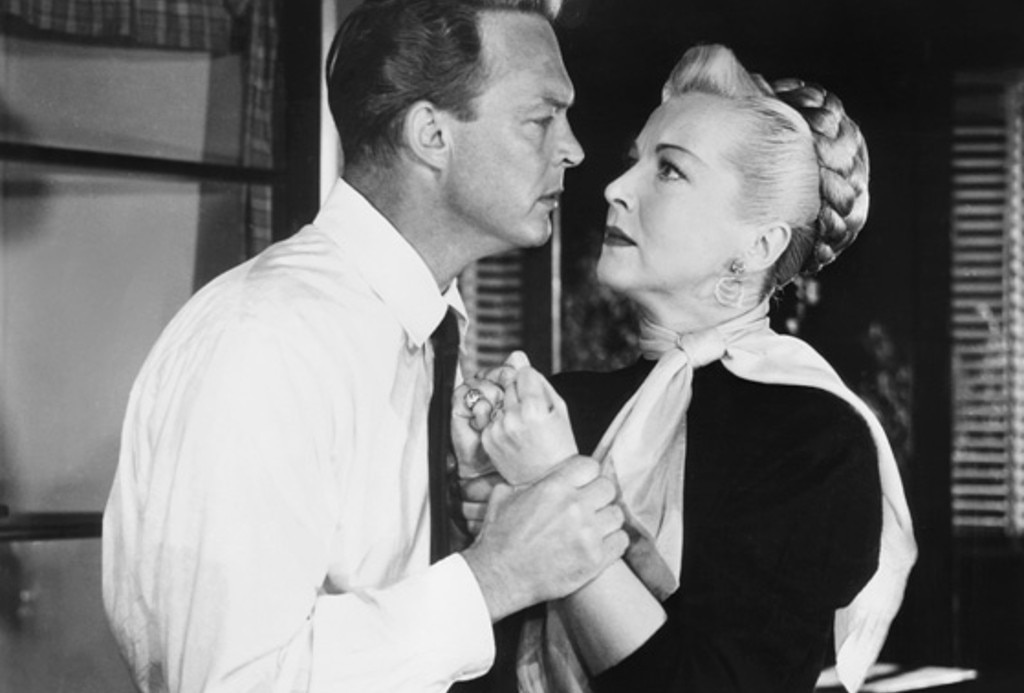
Film noir reached its tentacles beyond the United States. In England, Hammer Studios turned out several British examples of the style, often -- as in Heat Wave (1954) -- importing American actors via the studio's partnership with Hollywood's Lippert Pictures. The idea was that the actors would help the films attract audiences stateside when Lippert distributed them there through United Artists. In this case, Alex Nicol and Hillary Brooke -- usually supporting actors -- play the lead roles in a tale of murder and jealousy that has narrative shades of The Postman Always Rings Twice and Double Indemnity.
Nicol plays an American writer who rents a lakeside cottage in England in an attempt to cure his writer's block. He befriends an unhappily married couple living across the lake, played by Hillary Brooke and Sidney James, and, falling under Brooke's spell (as many a noir sap before him), gets mixed up in her scheme to kill her husband before the husband can remove her from his will. Adding a further noir feel, the film is told in flashback as Nicol relates his yarn to an initially unseen listener.
Directing the film from his own script, which in turn was based on his own novel, was Ken Hughes. Then 32, Hughes was a rising force in British cinema, having directed eight films in the past two years and written the scripts for all but the first. Years later, he'd direct his two best-remembered movies: Chitty Chitty Bang Bang (1968) and Cromwell (1970).
Heat Wave was based on Hughes' novel High Wray, which he later said was heavily inspired by the style of Raymond Chandler, his favorite author. "My agent sent the novel around," Hughes recalled, "and a copy got to Hammer Films' Tony Hinds. They liked it; and when they discovered I was also 'Ken Hughes the director,' the deal was set. So I wrote the screenplay, too."
Production took place in August 1953 at Hammer's own Bray Studios, as well as on location in England's lake district. Hughes remembered Bray as being too small to handle major sets or backlot construction: "The stages were small, but, with a bit of ingenuity, they worked. All confined theater stages and studios force you to use your imagination. The rich appearance of Hammer Films was due to the ingenuity and skill of its art directors who had to work within the confines. So, more money was available for dressing, decor, and furnishings."
Indeed, the final result, entitled The House Across the Lake for its British release in the summer of 1954 before being re-titled for America, was praised for its strong atmosphere. Today it's considered to be one of Hammer's best film-noir-style thrillers, with the feel of a B film made in Hollywood. Certainly Hillary Brooke makes for a solid femme fatale, attractive and sinister. (As the posters declared: "Her blood runs hot... but her heart is cold.")
Among her many credits, Brooke had appeared in two Sherlock Holmes films and was known for playing Lou Costello's girlfriend many times on the Abbott and Costello TV show. Soon she'd have a supporting role in Hitchcock's The Man Who knew Too Much (1956). Alex Nicol was also a reliable supporting actor, especially in westerns and war movies, but he had also just completed another "Hammer noir" in England: The Black Glove (aka Face the Music) (1954).
By Jeremy Arnold
SOURCES:
Tom Johnson and Deborah Del Vecchio, Hammer Films: An Exhaustive Filmography
Wayne Kinsey, Hammer Films: A Life in Pictures
Heat Wave
by Jeremy Arnold | February 28, 2015
SIGN UP FOR OUR NEWSLETTERS

CONNECT WITH TCM