With the release of Brief Encounter in 1945, David Lean became
the preeminent British director of his generation. But the critical and popular
success of that bittersweet postwar romance (it won the Grand Prize at the Cannes
Film Festival and garnered three Oscar® nominations) was overshadowed by
an even greater achievement, his film adaptation of Charles Dickens's Great
Expectations (1946). The latter secured his reputation on an international
scale and received five Oscar® nominations, winning statuettes for Best
Art Direction and Best Cinematography. What to do for an encore?
Instead of moving in a new direction, Lean surprised everyone by agreeing to do
another Charles Dickens adaptation - Oliver Twist (1948). "There
was considerable disappointment," wrote film critic and historian Gerald Pratley,
"on the part of many of his admirers that at a time when Italian neo-realist
directors were shooting films about post-war problems, Lean should choose to remain
in the past and make a second film from Dickens." (source, David Lean:
A Biography by Kevin Brownlow)
There was another prejudice against Oliver Twist that centered
on Dickens's depiction of Fagin, the Jewish ringleader of a band of beggar boys.
Accusations of anti-Semitism made the novel a risky venture as a film since it would
be closely scrutinized by movie censorship boards. It was also accused of having
a negative influence on younger viewers with its depictions of thievery and violence.
In fact, the 1922 silent version starring Lon Chaney was actually attacked in its day by British
critics for encouraging hooliganism among teenagers and minors.
Lean pushed ahead anyway stating his real reason for wanting to make the film.
"I tried throughout the writing and filming of both Great Expectations
and Oliver Twist to recapture my impressions on first reading
the two stories. I imagined Great Expectations as a fairy tale,
just not quite true, and Oliver Twist as a grimly realistic study
of what poverty was like at the time...Dickens's dialogue is perfect for the screen,
and almost all of it was taken straight from the book. Occasionally, an incident
has been altered to suit the demands of the cinema. In some cases, the actual sequence
of events has been interchanged to make for a better balance and dramatic value.
Technically I would say that Oliver Twist was more difficult
to adapt for the screen than Great Expectations. The main problem
was that of making fantastic, larger than life characters fit into a starkly real
setting." (source, The Cinema of David Lean by Gerald Pratley)
Stark is certainly the word to describe the grim trajectory of Oliver Twist.
A young boy, raised in a workhouse for orphans, is punished for insubordination
by being farmed out as an apprentice to an undertaker. After much abuse, he escapes
and falls in with a gang of street urchins who pick pockets on the streets of London.
The wayward youths are presided over by a trio of corrupt adults, the brutal Bill
Sikes, his mistress Nancy and Fagin, the criminal mastermind behind the boys' thefts. Oliver is quickly assimilated into the group but on his first foray into the teeming streets
he is accused of trying to steal a man's wallet. Instead of being carted away by
the police he is taken in by his intended victim who tries to educate and reform
him. In a test of trust, Oliver is sent by his benefactor on an errand into the
city where he is apprehended and coerced back into his old gang with calamitous
results.
Lean was able to encompass the novel's sprawling narrative and period detail
into a cohesive screenplay co-scripted with Stanley Haynes (Lean's production manager
on Major Barbara, 1941). Considering Lean's slow, fastidious production
process, Oliver Twist was written in one month - a record for
the director. Yet the script still needed a dramatic opening scene since the beginning
of Dickens' book was too cerebral to film: "...And in this workhouse was born
on a day and date which I need not trouble myself to repeat, in as much as it can
be of no possible consequence to the reader, in this stage of the business at all
events, the item of mortality whose name is prefixed to the head of this chapter."
It was Lean's wife at the time, actress Kay Walsh (who plays the ill-fated Nancy
in Oliver Twist), who came up with a solution and it became one
of the most famous opening scenes in the history of cinema. A pregnant woman in
labor is struggling to cross the moors in a violent rainstorm. With lightning, thunder, rain
and high winds raging around her, she makes her way towards a light in the distance.
Racked with pain, she reaches her destination and rings the entrance bell with her
last ounce of strength. The camera pans up to the sign PARISH WORKHOUSE and we hear the crying of a baby marking Oliver Twist's entrance into the world. When Lean first
viewed the sequence, designed by cinematographer Guy Green and art director John
Bryan, he stated, "We're going to have to retake this. It's too romantic. I
want more edginess and more storm." The final result, a magnificent fusion
of black and white cinematography and lighting effects, inspired Ernest R. Dickerson
(Spike Lee's cinematographer on Do the Right Thing [1989], Malcolm X [1992] and others) to become a filmmaker.
Casting for Oliver Twist was a slow, painstaking process with
careful consideration being given to every part. Robert Newton, cast in the role
of the murderous Bill Sikes, was an early favorite even though Robert Donat badly
wanted the part. Donat was anxious to escape being typecast as a sensitive idealist
after similar roles in films such as The Citadel (1938), Goodbye,
Mr. Chips (1939) and The Winslow Boy (1948) but Newton's
more sinister physical presence was ideal despite his reputation for being a disruptive
drunk. Some insurance companies would not even cover him and Lean's distributor,
Rank, wanted to boycott him but the director persisted, having worked with Newton
previously on Major Barbara. Future sex symbol Diana Dors has
one of her first memorable film roles in Oliver Twist as Charlotte,
the servant of the undertaker Sowerberry, and Kay Walsh, who knew many actors from
her stage and film work, suggested Anthony Newley as the Artful Dodger. Newley would
later become a major London stage star who equaled his success on the Broadway stage
(Stop the World I Want to Get Off) and in movies (The
Small World of Sammy Lee [1963], Dr. Dolittle [1967]) and was frequently
in gossip columns because of his marriage to Joan Collins (1963-1970).
Alec Guinness, who was at the beginning of his movie career, campaigned
heavily for the part of Fagin. Even though he had worked for Lean previously in
Great Expectations, the director couldn't picture him in the
role until Guinness convinced him to conduct a screen test. "He came on looking
not far removed from what he looks like in the film," Lean remarked. "Of
course I was bowled over by it and he got the part without another word." (source,David
Lean: A Biography by Kevin Brownlow) Working with make-up artist Stuart
Freeborn, Guinness based his appearance on illustrations in the Dickens novel by
George Cruikshank which accented the character's wrinkles, baggy eyes, loose hair, bushy eyebrows
and beaked nose.
The biggest difficulty in casting proved to be the title role. In his search to
find the perfect Oliver, Lean held an open audition at Victoria Palace in which
he received some fifteen hundred applications and interviewed all but eighty of
them. Not one matched the image he had in mind for Oliver but in a stroke of luck,
agent Ted Lloyd spotted the ideal candidate - John Howard Davies - at the home of
an associate. The son of a film critic for the Express, Davies
had no previous movie or stage experience but was a natural before the cameras.
The young novice was only eight at the time and child labor laws prohibited children
under the age of thirteen from working in film studios but Lean managed to get around
the restriction. Davies recalled that Lean "was unfailingly nice, unfailingly courteous.
He used various devices on me. When I felt inhibited about doing something, he would
often shoot the rehearsal. He wasn't silly enough not to do the take. But I pretty
soon cottoned on to this because my hearing was even better than his, with his large
ears, and I could detect the sound of a Mitchell turning over." (source, David
Lean: A Biography by Kevin Brownlow)
The actual filming of Oliver Twist proceeded smoothly though
several scenes presented their own unique challenges. One was the introduction of
Bill Sikes who appears in a doorway just as a tossed mug of beer lands in his direction
- the trick was to keep the beer mug in focus as it sails through the air. Another
was Nancy's death scene which involved a bull terrier's panicked reaction to her
murder - his frenzied scratching at the door was provoked by a stuffed cat held
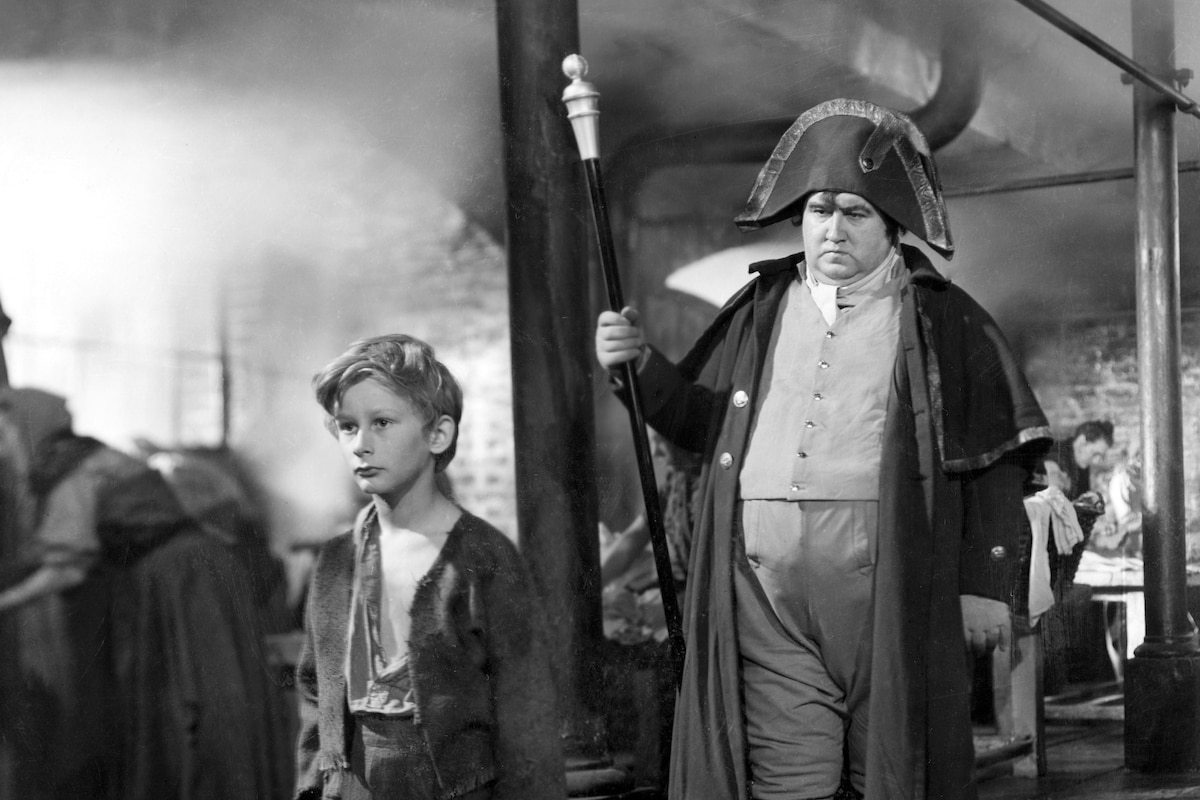
off-camera by a crew member. Cinematographer Guy Green also noted that the art direction
presented some problems. "John Bryan made it bloody difficult, too, although
his sets were wonderful to photograph. He had Francis Sullivan as the Beadle going
along a tunnel, and it was impossible to light it. So I gave Sullivan a lamp to
carry with a light inside it which shone out in to the tunnel, and that was it... Oliver was about grim, dirty interiors and I used a lot of diffused light, something which has become fashionable now with colour. I tried to get the effect of light coming through small dirty windows, and it had a kind of richness of its own."
When Oliver Twist was finally released in Great Britain, it didn't
receive the high acclaim that Great Expectations enjoyed. Some
critics accused Lean of softening the characters of Fagin, Sikes and Bumble in comparison to their deeds and actions in the book but the main complaint came from Zionists who felt that Fagin was being presented as an exaggerated Jewish stereotype, the
same charge that was leveled against Julius Streicher's Der Stermer,
a notorious Nazi propaganda film. The controversy increased when the film was submitted for a U.S. release and was denied a seal of approval from Joseph Breen's Production Code office. Breen had strongly stressed in an earlier memo the "advisability
of omitting from the portrayal of Fagin any elements or inference that would be
offensive to any specific racial group or religion." United Artists eventually
released Oliver Twist in 1951 with twelve minutes of footage
excised and it wasn't until 1970 that the uncut version of Lean's film finally aired
in the U.S. in a film tribute to Lean at the Museum of Modern Art.
Despite protests from pressure groups in America, Oliver Twist
was well received by the critics with Bosley Crowther of the New York Times
leading the charge: "a superb piece of motion picture art and, beyond doubt,
one of the finest screen translations of a literary classic ever made...it is this
extraordinary canvas, this vast picture of the poverty and greed which oppressed
nineteenth-century England, that has been magnificently reproduced in this film."
Unlike Great Expectations, Oliver Twist was
completely shut out of the Oscar® race but it did win the Golden Lion at the Venice
Film Festival and was nominated for Best Picture at England's BAFTA awards ceremony.
Of all the various film adaptations of Dickens's novel including the 1922 silent
version, the musical Oliver! (1968), a 1974 animated version
and Roman Polanski's new rendition, Lean's interpretation is still closest in spirit to the original story.
Producer: Ronald Neame, Anthony Havelock-Allan
Director: David Lean
Screenplay: Charles Dickens (novel), Stanley Haynes, David Lean
Cinematography: Guy Green
Film Editing: Jack Harris
Art Direction: T. Hopewell Ash, Claude Momsay
Music: Arnold Bax, Guy Warrack
Cast: Robert Newton (Bill Sikes), Alec Guinness (Fagin), Kay Walsh (Nancy), Francis
L. Sullivan (Mr. Bumble), John Howard Davies (Oliver Twist), Henry Stephenson (Mr.
Brownlow).
BW-105m.
by Jeff Stafford
Oliver Twist (1948) - Oliver Twist
by Jeff Stafford | October 21, 2005
SIGN UP FOR OUR NEWSLETTERS

CONNECT WITH TCM