When Robert Flaherty unveiled his groundbreaking documentary, Nanook of the North (1922), he not only established the basic vocabulary of documentaries, but also started a trend toward real-life, man vs. nature epics. The most devastating of these pictures would have to be Grass, a harrowing record of human bravery and endurance that, after all these years, is still an astonishing thing to see.
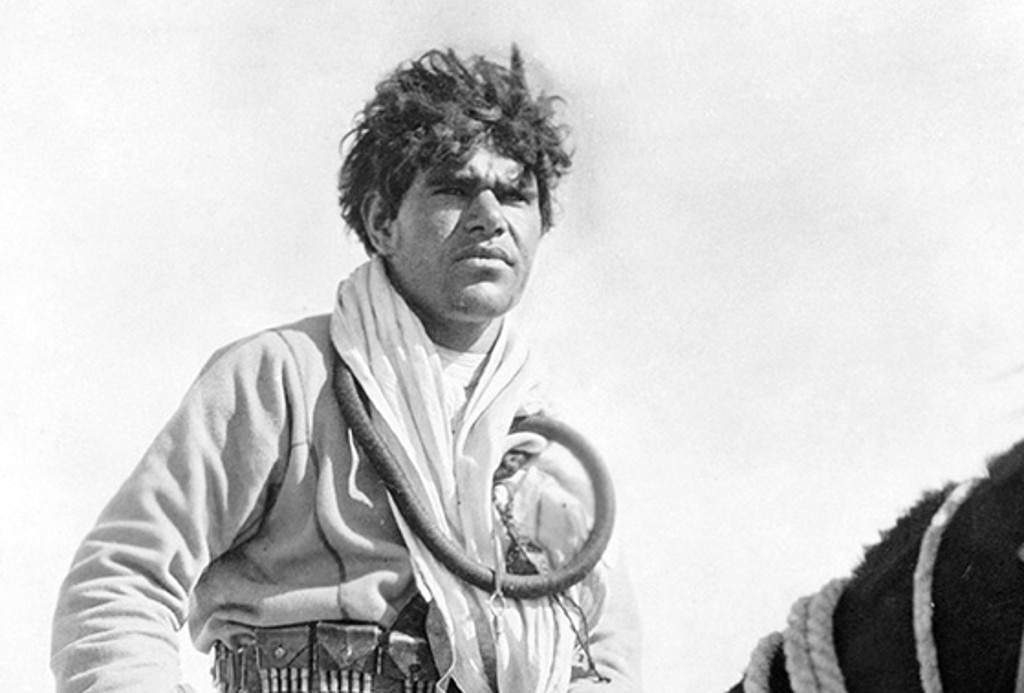
Grass's directors, Merian C. Cooper and Ernest B. Schoedsack, and their patron, Marguerite Harrison, set out to make a film about a nomadic Asian tribe. The only problem was that they knew little about nomadic Asian tribes and even less about where to find one. After a false start and a lengthy journey, they eventually came into contact with the Bakhtiari in what is now known as western Iran. The Bakhtiari proved to be extraordinarily courageous, fascinating people, and the fledgling directors ended up with some of the more remarkable footage in motion picture history.
Each summer, the Bakhtiari would journey, with their livestock in tow, to pasture grounds in the highlands. What this meant was that 50,000 people and 500,000 animals (that's not a misprint) would trudge across a 12,000-foot mountain range in the snow, ford a river, and climb a sheer mountain face! Their journey was literally a matter of life or death, and it's all caught on film. Stunning moments abound, but you won't soon forget thousands of people swimming across a raging river on inflated goat skins, with their livestock tied up and sprawled across makeshift rafts!
Grass may be slightly rickety in its construction, and some of the subtitles verge on the inane, but much of what you'll see is truly beyond belief.
As Richard Griffith noted in a 1925 Museum of Modern Art bulletin on Grass, Cooper and Schoedsack, formed a partnership based on ³a mutual interest in the strange, the dangerous, and the unknown.² Schoedsack, who started out as a camera operator for Mack Sennett, made his name by shooting amazing World War I battle footage, during which he put himself very much in the line of fire. In 1919, still looking to fight, he journeyed to Poland where he met up with Cooper, a kindred spirit who was formerly a pilot in the French military, but by then was a lieutenant-colonel in the Russo-Polish War. After the war, Cooper convinced Schoedsack to join him in making Grass.
Harrison, an ex-journalist and spy (!) who had reportedly saved Cooper's life during the Russian Revolution agreed to help finance Grass, but only if she could participate in its production. So, after writing a check for $5,000, she took the trip of a lifetime. Harrison serves as a sort of stand-in for the audience, appearing in many shots along with the nomads.
To call Harrison, Cooper, and Schoedsack gutsy would be a vast understatement. These filmmakers could have been killed while trying to secure their footage, and many of the people they were photographing actually did lose their lives.
Somewhat surprisingly, given their intense personalities, Cooper and Schoedsack had a sense of humor about their exploits. The first fictional film that they made together was a little picture called King Kong (1933), which, of course, is about a gang of camera-toting adventurers who get more than they bargained for in an exotic location. That's right- King Kong is semi-autobiographical! After the traumas they shared with the Bakhtiari while making Grass, Kong would have been a cakewalk even if the gorilla were real.
Producer: Merian C. Cooper, Ernest B. Schoedsack
Directors: Merian C. Cooper, Ernest B. Schoedsack
Screenplay: Richard Carver, Terry Ramsaye
Cinematography: Merian C. Cooper, Marguerite Harrison, Ernest B. Schoedsack
Film Editing: Richard Carver, Terry Ramsaye
Cast: Merian C. Cooper, Ernest B. Schoedsack, Marguerite Harrison, Haidar Khan, Lufta.
BW-71m.
by Paul Tatara
Grass
by Paul Tatara | October 21, 2005
SIGN UP FOR OUR NEWSLETTERS

CONNECT WITH TCM