French director Agnes Varda's deceptively idyllic third feature, Le Bonheur (Happiness), ignited a firestorm of controversy and catapulted Varda to international acclaim and notoriety when it was released in 1965. Varda, who has been called the "Grandmother of the French New Wave" because her first feature, La Pointe Courte (1954) used production methods and storytelling techniques that anticipated those of the Nouvelle Vague, had followed that film with the critically-acclaimed Cleo from 5 to 7 (1962). She had also made several well-regarded documentaries.
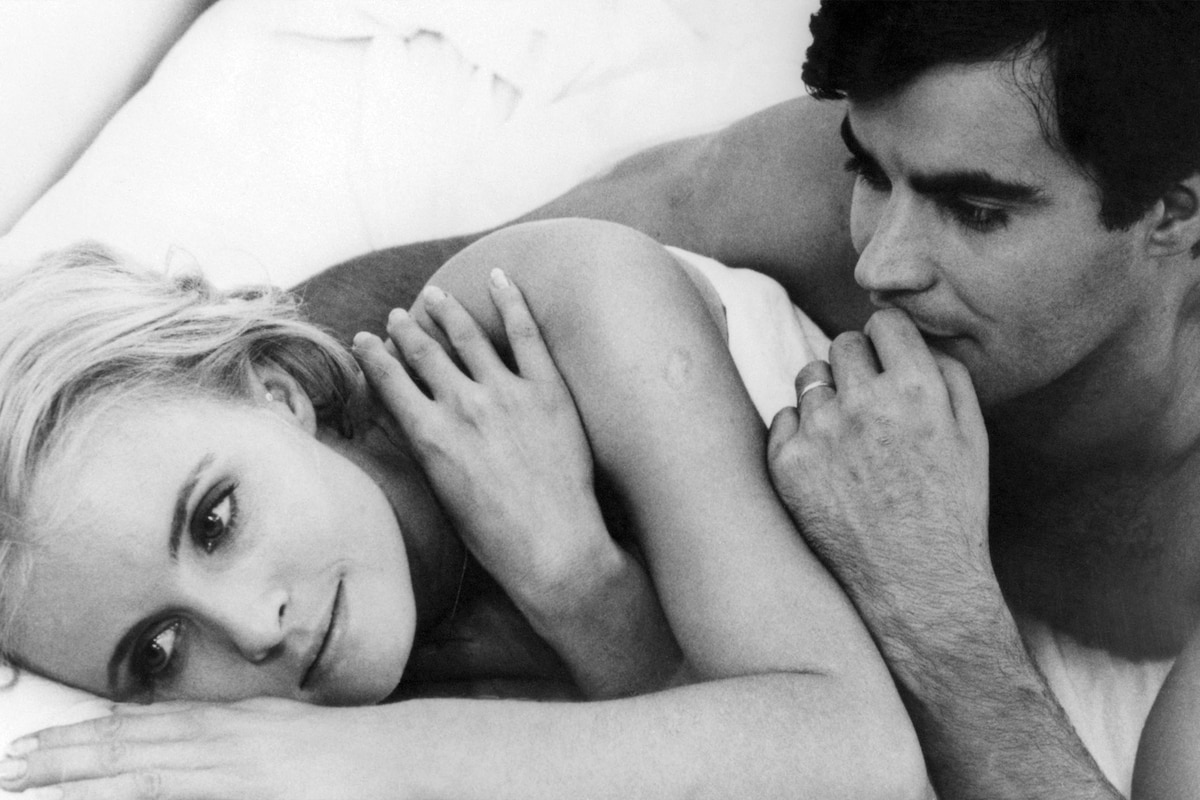
Le Bonheur on the surface appears to tell a fairly straightforward story. Francois, a carpenter living in a suburban village, is blissfully married to lovely blonde Therese, and they have two well-behaved young children. When Francois meets Emilie and begins an affair with her, his happiness only increases. "Happiness works by addition," he tells Emilie. Noticing his joyfulness during one of the family's country outings, his wife questions him about it. He tells her about Emilie, explaining that the relationship is no threat to their family, that he has more than enough happiness to satisfy everyone. Therese appears to accept the situation, but a cloud comes over the family's seemingly perfect existence.
"I don't think I've ever worked so quickly. I wrote it in exactly three days," Varda later recalled. "I wrote the film fast and shot it fast, like the vivid brightness of our short-lived summers." The film's visual design was inspired by the light-splashed colors and images of the Impressionist painters, starting with the iconic closeup of a sunflower that opens the film. She even includes a scene in which Jean Renoir's 1959 film, Dejeuner Sur L'Herbe, which is both a satire and a tribute to the Manet painting of the same name, plays on a television. At the same time, Varda noted that "Impressionist paintings emanate such melancholy, though they depict scenes of everyday happiness." She describes her vision for the film: "I imagined a summer peach with its perfect colors, and inside there is a worm."
Jean-Claude Drouot -- then the star of a "Robin Hood"-like French television series, Thierry La Fronde -- and his real-life wife Claire played Francois and Therese in Le Bonheur, with their own children playing the movie couple's children. Reminiscing about the film at the time of its restoration in 2006, Drouot, who had been married to Claire since 1960, said "I believe the film actually helped us as a couple, as a family. One makes the choice of denying oneself."
In interviews, Varda has said that she set out to understand "What is the meaning of happiness, this need for happiness, this aptitude for happiness? What is this unnamable and slightly monstrous thing?" But she has steadfastly refused to explain the film, allowing viewers to put their own interpretations on it. Many critics at the time found it disturbing at best, and amoral at worst. A.H. Weiler's review in the New York Times was typical: "At once joyful and moving but crucially immature, disturbing and tragic.... a seeming idyll sheathed in irony, [it] is obvious and tender, irresponsible and shocking and continuously provocative.... blithely flouts moral values and Hollywood conventions but, nevertheless, constantly captivates the eye and mind, if not the heart."
Le Bonheur became a succes de scandale all over the world, playing for nine months in Argentina and a year in Japan. The film cemented Varda's reputation as an important filmmaker of wide-ranging interests, equally adept at narrative film and documentary, and she remained active well into her eighties. Nevertheless, she has never achieved the kind of fame and acclaim that many of her New Wave colleagues enjoyed.
Over the years the confusion that critics expressed about Le Bonheur persists. Does Varda seem to be supporting Francois's claim that he can provide perfect happiness to both women? Or is the film a commentary about the impossibility of happiness? Made in a pre-feminist era, is it a feminist film or an anti-feminist one? Film scholar T. Jefferson Kline, in his introduction to a collection of Varda's interviews, thinks that "her film is intended to provoke a series of moral and psychological questions rather than tell a satisfying 'moral' story. It is perhaps this tendency that has best characterized Varda's cinema and may be the reason she has never reached a larger 'popular' audience."
Director: Agnes Varda
Producer: Mag Bodard
Screenplay: Agnes Varda
Cinematography: Claude Beausoleil, Jean Rabier
Editor: Janine Verneau
Costume Design: Claude Francois
Production Design: Hubert Monloup
Music: Jean-Michel Defaye
Principal Cast: Jean-Claude Drouot (Francois Chevalier), Claire Drouot (Therese Chevalier), Olivier Drouot (Pierrot Chevalier), Sandrine Drouot (Gisou Chevalier), Marie-France Boyer (Emilie Savignard), Marc Eyraud (Francois's brother)
79 minutes
by Margarita Landazuri
Le Bonheur
by Margarita Landazuri | February 19, 2015
SIGN UP FOR OUR NEWSLETTERS

CONNECT WITH TCM