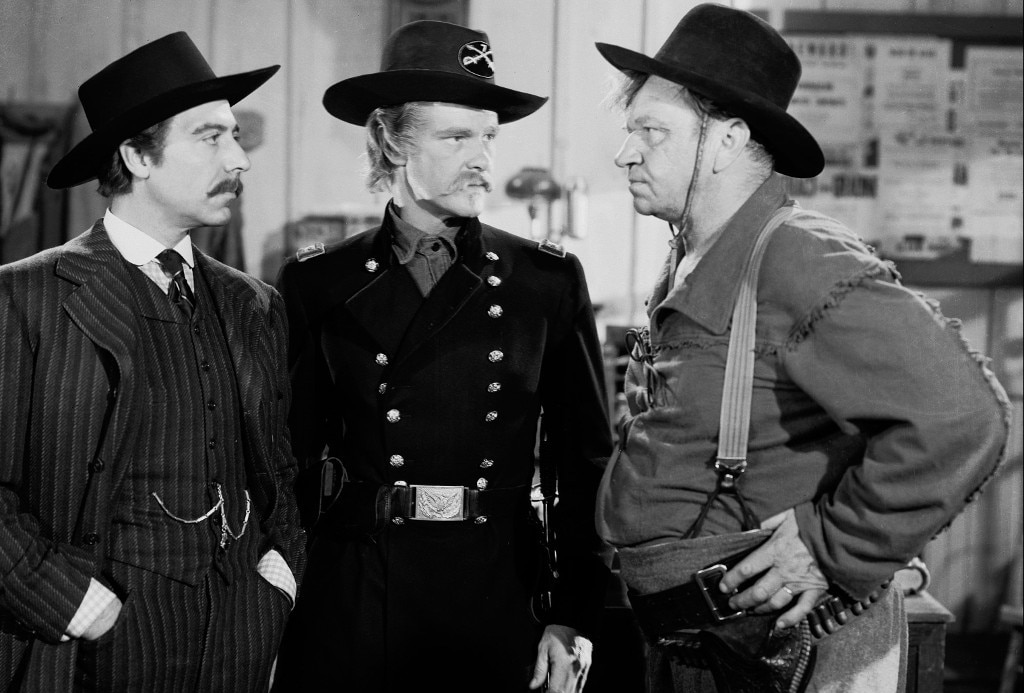
Bandit Wallace Beery and Mexican sidekick Leo Carrillo attempt to rob a train carrying General Custer and the cavalry in Wyoming (1940), a situation which quickly escalates into a comic nightmare for the outlaws. With the feds in pursuit Beery takes refuge at ranch owned by Ann Rutherford. There he befriends the local blacksmith (Marjorie Main) and is drawn into a dispute with a greedy developer (Joseph Calleia). The cavalry eventually rides to the rescue and helps bring down Calleia, while Beery finds himself an ideal partner in Marjorie Main in this amiable oater by director Richard Thorpe, a veteran of no less than fifty silent westerns,
Beery was, by 1940, a Hollywood veteran with hit movies like The Champ (1931) and Viva Villa! (1934) under his belt. But Marjorie Main was a relative newcomer. She'd visited Hollywood and made a few scattered film appearances (Her screen debut was in A House Divided, 1931). But it wasn't until 1937, and a reprisal of her stage role in the film adaptation of Dead End (1937), that Main had much big screen success. Main was born Mary Tomlinson in 1890 in Acton, Indiana. With the reluctant support of her preacher father, she attended dramatic school and eventually joined a local stock company where she changed her name to avoid embarrassing the family. As the story has it, she chose Marjorie Main because it was easy to remember. Main made her Broadway debut in 1916, where she worked, among others, with W.C. Fields. Her memorable portrayal of a dead gangster's mother in Dead End translated well to the big screen opposite Humphrey Bogart, and brought Main to Hollywood permanently.
Of course Beery's most successful pairing to date had been with the late Marie Dressler in such movies as Tugboat Annie and Dinner at Eight (both 1933). As the promotional tag line for Wyoming suggested - "1940's Min and Bill" (an early talkie starring Beery and Dressler) - the studio had been looking for another saucy female to butt heads with Beery. And the chemistry worked, beyond anyone's expectation. The pair proved such a crowd pleaser that MGM signed Main to a seven year contract and teamed Beery with her in five more films: Barnacle Bill (1941), The Bugle Sounds (1941), Jackass Mail (1942), Rationing (1944) and Bad Bascomb (1946).
But it's for a series of films without Beery that Marjorie Main is best remembered. It all started in 1947, when she appeared with Claudette Colbert and Fred MacMurray as neighbor Ma Kettle in The Egg and I. The role won Main her only Oscar nomination as Best Supporting Actress and kicked off another nine Ma and Pa Kettle movies, most of which co-starred Percy Kilbride. Each of the Kettle movies was filmed in less than 30 days and cost under $500,000. But in all, the series took in $35 million.
Main never really took to the glitz of Tinseltown. She lived in a rented apartment, did her own housework and reportedly took the bus to the studio. In later years, she did own a car (though still preferred to ride a bicycle) and several houses, where she had no servants except for a gardener who helped her in the yard. Main knew her strengths, and once remarked about her acting, "character actors are best, I believe, when they portray characters that give them a chance to draw on their own experiences, backgrounds and observations. Imagine me trying to play a society woman." She was as down to earth as her characters and her plain-speaking Wyoming blacksmith named Mehitabel was no exception.
Producer: Milton H. Bren
Director: Richard Thorpe
Screenplay: Hugo Butler, Jack Jevne
Art Direction: Cedric Gibbons
Cinematography: Clyde De Vinna
Editing: Robert J. Kern
Music: David Snell
Cast: Wallace Beery (Reb Harkness), Leo Carrillo (Pete Marillo), Ann Rutherford (Lucy Kincaid), Lee Bowman (Sgt. Connelly), Joseph Calleia (John Buckley), Bobs Watson (Jimmy Kincaid), Marjorie Main (Mehitabel), Henry Travers (Sheriff), Addison Richards (Kincaid), Paul Kelly (General Custer).
BW-89m.
By Stephanie Thames
Wyoming
by Stephanie Thames | October 30, 2002
SIGN UP FOR OUR NEWSLETTERS

CONNECT WITH TCM