Part one of Peter Jackson's Lord of the Rings trilogy, The Fellowship of the Rings, was released worldwide in time for the 2001 Christmas holidays, barely three months after the terrorist attacks of 9-11 and the subsequent uptake in global fear and paranoia. Though Jackson's expansive and expensive adaptation - filmed in one fell swoop in the filmmaker's native New Zealand between October 1999 and October 2000 (with pick-up footage added over the course of the next two years) -- would likely have been a hit in its own right, moviegoers throughout the western world were able in one sitting to lose themselves in an extravaganza of epic high fantasy while channeling their anger and fears into a compelling, vengeance-fueled adventure pitting absolute good against unalloyed evil. The Fellowship of the Ring was an instant hit, grossing better than $300 million in the United States and nearly $900 million worldwide. Rather than success driving the franchise, the parceling out of parts two and three came down to clockwork. With the first installment remaining in movie theaters for eight solid months, Jackson, his producers, and New Line Cinema had the benefit of nearly a year of post-production time before offering up the second. The Two Towers, had its premiere early in December 2002. (To speed post-production, Jackson hired different editors for each film; while John Gilbert had cut Fellowship, Jackson relied on Mike Horton for The Two Towers, leaving the third film, The Return of the King, to Jabez Olssen.) The Two Towers was another instant success, reaping a worldwide gross of $926 million.
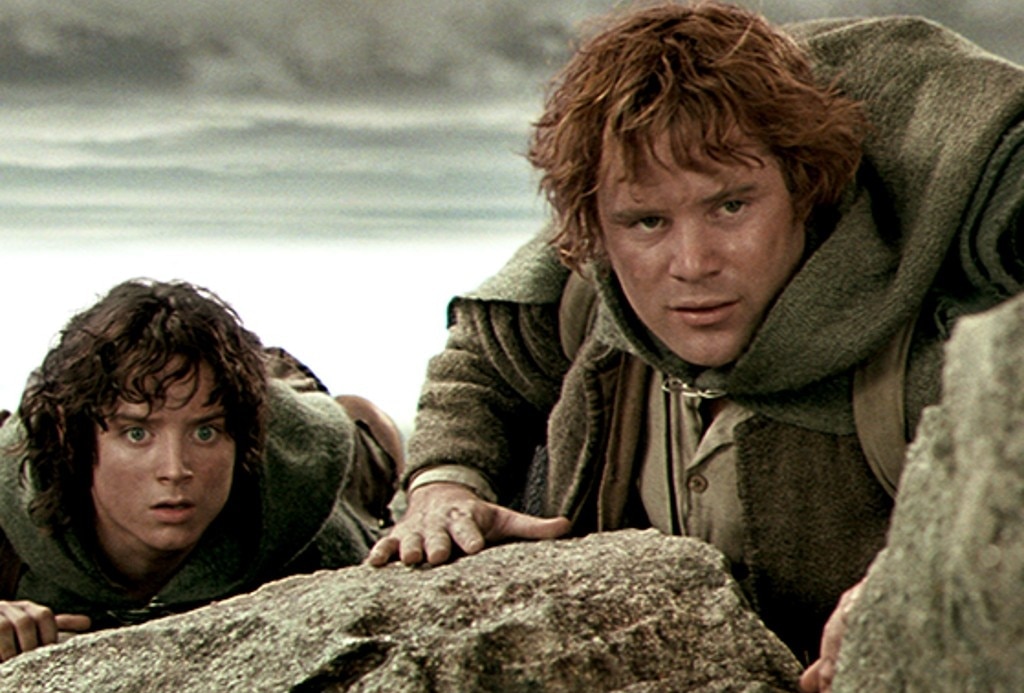
Thanks to source novelist J. R. R. Tolkein, The Two Towers did not suffer the sophomore doldrums of many a sequel spun from a desire for profit but enjoyed equally high production values and benefited from unprecedented feats of film production - not the least of which was the first cinematic use of many area of rural New Zealand, which substituted persuasively for Tolkein's Middle Earth. During production of the trilogy, Jackson and his crew ran through 1,100 miles of film (the Battle of Helms Deep alone was edited down from 20 hours of footage), 19,000 costumes (created by 40 seamstresses), 2,000 weapons, 1,000 suits of armor, 10,000 facial prosthetics, and 1,800 hobbit feet. (Feeding a veritable army of actors, extras, and crew, craft services went big, serving up nearly 1,500 eggs for breakfast each day.) As The Fellowship of the Ring yielded to The Two Towers, Jackson's cast had bonded into a veritable band of brothers. As in war, injury only solidified the ranks, with actors Ian McKellen, Viggo Mortensen, Sean Astin, Orlando Bloom, Bernard Hill, Billy Boyd, Liv Tyler, and others pushing through the pain for the greater good. A number of these incidents made it to the finished film, as when Mortensen broke two toes when his character was required to kick an empty enemy helmet in a moment of rage. Practical joking also fed the bonhomie. Having lost the tip of one finger in his youth, actor John Rhys-Davies was fitted with a prosthetic digit to play the dwarf warrior Gimli but convinced Jackson (with the addition of cosmetic blood cadged from the crew) that he had severed the end of that finger while shooting a scene.
Contracted originally to provide only a voice for the character of Gollum (whom Jackson had intended to create whole cloth out of CGI), actor Andy Serkis wound up acting the role physically, with his movements overlaid in postproduction by computer generated "motion capture," which fleshed out the unpalatable corporeality of the slimy, devolved hobbit. A prominent character in Tolkein's original novel The Hobbit and there on the page in The Fellowship of the Ring, Gollum had reduced screen time in Jackson's first film, emerging as a true player in The Two Towers. (In interviews conducted during post-production, Serkis claimed to have patterned Gollum's distinctive throat sounds after the noises made by his own cat while dislodging a hairball.) Serkis' performance was an instant audience favorite, earning the actor a place on Empire magazine's list of "100 Greatest Movie Villains of All Time." With The Two Towers, Serkis established himself as the premiere motion capture performer, providing the physical (and aural) foundations for the simian protagonists of Jackson's 2005 King Kong remake and the Planet of the Apes reboots Rise of the Planet of the Apes (2011) and Dawn of the Planet of the Apes (2013). Taking the enterprise a step further, Serkis co-founded in 2011 the Ealing-based Imaginarium Studios, a digital production facility with an aim towards a state-of-the-art adaptation of George Orwell's Animal Farm.
Scoring The Lord of the Rings trilogy was Canadian composer Howard Shore, best known for his many collaborations with countryman David Cronenberg. (The Two Towers star Viggo Mortensen would himself collaborate with Cronenberg on several films over the course of the next few years, among them A History of Violence and Eastern Promises.) Shore was one of four Academy Award recipients out of The Fellowship of the Ring's thirteen nominated categories; he would win a second Oscar for his work on the trilogy's final leg, The Return of the King (2004), yet his compositions on The Two Towers went unrecognized by the Academy of Motion Picture Arts and Sciences. In fact, Shore's score, which repeated themes heard in the first film, was at first adjudged as ineligible for competition due to the semi-recycled nature of the cues - a judgment that was swiftly reversed due to pressure from within the industry. The Two Towers was nominated for six Academy Awards (among them, Best Picture), of which it won two technical Oscars, for editing and visual effects. The international success of The Two Towers proved that The Fellowship of the Ring was no fluke, ensuring good business for the concluding chapter and enshrining The Lord of the Rings trilogy in the rarified mythological air of the George Lucas Star Wars films. As filming of The Lord of the Rings progressed in New Zealand, Lucas was shooting Attack of the Clones, the second installment of his second Star Wars trilogy, at Fox Studios in Sydney, Australia; making villainous appearances in both films is former movie Dracula Christopher Lee, the only member of Peter Jackson's production team who had ever met J. R. R. Tolkein.
By Richard Harland Smith
Sources:
Peter Jackson: A Filmmaker's Journey by Brian Sibley (Harper Collins, 2006)
The Lord of the Rings: The Making of the Movie Trilogy by Brian Sibley (Houghton-Mifflin, Harcourt, 2002)
The Lord of the Rings: The Two Towers
by Richard Harland Smith | February 09, 2015
SIGN UP FOR OUR NEWSLETTERS

CONNECT WITH TCM