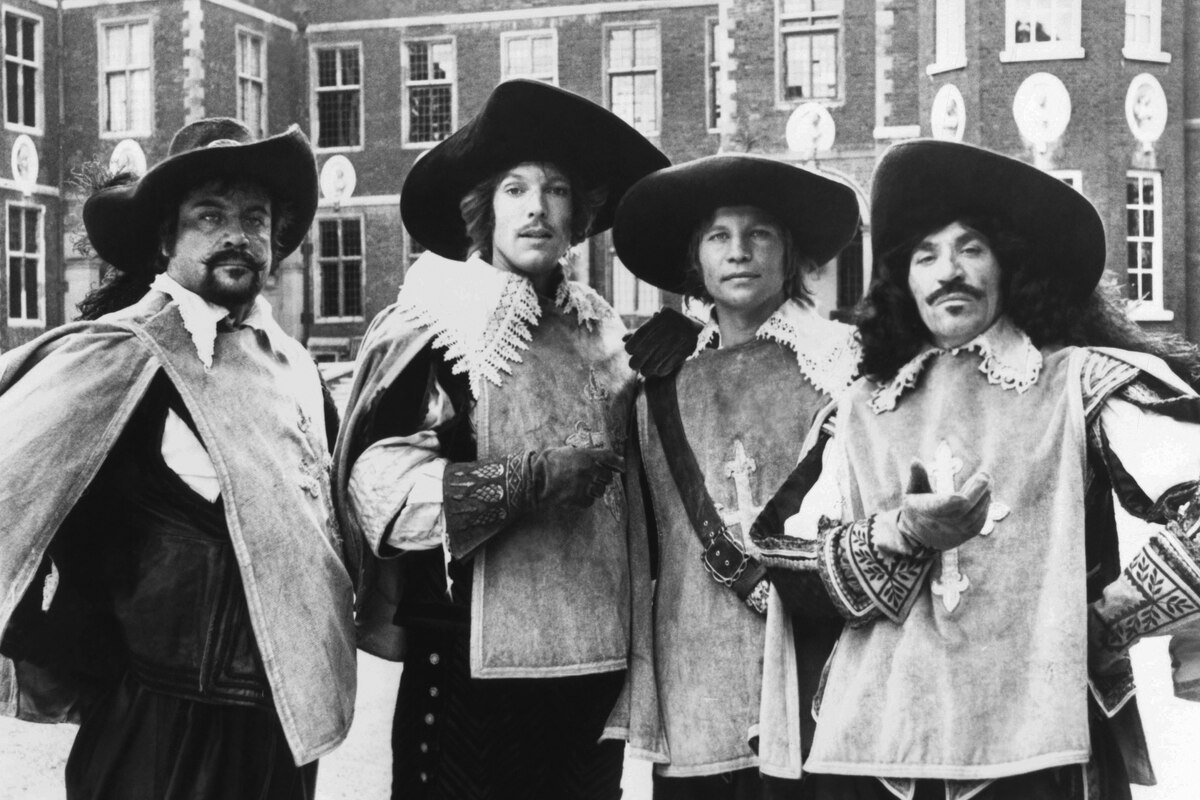
This 1974 sequel to The Three Musketeers (1973) achieved something rare in Oscar® history. It scored a nomination (for Yvonne Blake and Ron Talsky's costume design) even though the original film had been entirely overlooked by the Academy®. Perhaps it took voters an extra year to process director Richard Lester's heady mix of swashbuckling action, slapstick comedy and 17th century grandeur. Or possibly they were offended by the film's rather unorthodox release pattern.
Lester was looking for a comeback when the Salkinds, father Alexander and sons Michael and Ilya, approached him about directing the 16th big-screen version of Alexandre Dumas' classic novel about three members of the royal guard, their new colleague D'Artagnan, and the vicious plots of Cardinal Richelieu and Milady de Winter. Lester had scored major hits by putting The Beatles on screen in A Hard Day's Night (1964) and Help! (1965), but later missteps had killed his career momentum. At the time, he had not made a film since the off-beat science-fiction comedy The Bed Sitting Room (1969) four years earlier.
Originally, the Salkinds had hired Tony Richardson, the Oscar®-winning director of Tom Jones (1963), to helm the film, but they parted ways over artistic differences. Since they also hoped to cast The Beatles in the four male leads, Lester seemed the logical choice to replace Richardson. That casting idea fell by the wayside, however, when they decided the rock group's personalities would overshadow the plot and characters. Instead, they assembled an all-name cast headed by Michael York as D'Artagnan, Faye Dunaway as Milady, Raquel Welch as Constance, Geraldine Chaplin as Queen Anne, Richard Chamberlain as Aramis, Oliver Reed as Athos, Christopher Lee as Rochefort and Jean-Pierre Cassel as Louis XIII. They offered Charlton Heston one of the musketeer roles but, feeling they were subsidiary to York's role, he opted instead for a cameo appearance as Cardinal Richelieu.
After 20 weeks of shooting in Spain, the Salkinds realized they had enough material for two films, so that's what they released, sending out The Three Musketeers in 1973, with The Four Musketeers scheduled to appear a year later. This did not sit well with the cast, who promptly sued to be paid for making a second picture. They won, but the courts did not award them as much as they would have made for another film. Because of the case, however, the Screen Actors Guild began adding what they call the "Salkind clause" to all film contracts, stipulating exactly how many films are being made.
Both films were major hits and received strong reviews, with special notice going to Welch for her surprisingly effective comic performance. At the time she was only thought of as a sexy set dressing in a series of mostly forgettable films. The Three Musketeers won Welch a Golden Globe for Best Actress in a Musical or Comedy while also being named Best Comedy in the London Evening Standard Film Awards. The sequel copped a second London Evening Standard Award.
In 1989 Lester reunited with York, Reed, Frank Finlay, Chaplin, Roy Kinnear, Lee and Chamberlain for a sequel, The Return of the Musketeers, loosely based on Dumas' Twenty Years Later. Cassel also appeared in the film, but in a new role, as Cyrano de Bergerac. At least in the sequel he got to use his own voice. With the large number of British and American actors playing leads in the earlier films, his voice was dubbed by British actor Richard Briers. York would return to play D'Artagnan in a 2004 television movie, The Lady Musketeer, with Susie Amy as his daughter and Gerard Depardieu as Cardinal Mazarin.
Producer: Alexander Salkind, Ilya Salkind, Michael Salkind
Director: Richard Lester
Screenplay: George MacDonald Fraser
Based on the novel by Alexandre Dumas
Cinematography: David Watkin
Score: Lalo Schifrin
Cast: Oliver Reed (Athos), Raquel Welch (Constance de Bonancieux), Richard Chamberlain (Aramis), Michael York (D'Artagnan), Frank Finlay (Porthos), Christopher Lee (Rochefort), Geraldine Chaplin (Queen Anne of Austria), Jean-Pierre Cassel (Louis XIII), Faye Dunaway (Milady), Roy Kinnear (Planchet), Michael Gothard (Felton), Simon Ward (Duke of Buckingham), Charlton Heston (Cardinal Richelieu), Sybil Danning (Eugenie)
By Frank Miller
The Four Musketeers
by Frank Miller | February 09, 2015
SIGN UP FOR OUR NEWSLETTERS

CONNECT WITH TCM