The film version of the John Kander/Fred Ebb musical Chicago (2002), winner of six Academy Awards including Best Picture, had a long and fascinating history on its way to the screen.
It all began with two sensational real-life murder trials in the Windy City in 1924. Both Beulah May Annan and Belva Gaertner were married women tried for murdering their lovers and acquitted, even though evidence pointed to guilt in each case. The attendant publicity turned the two women into notorious Jazz Age celebrities. Maurine Dallas Watkins, a reporter for the Chicago Tribune, covered the notorious trials and their aftermath in a series of sensational columns that inspired her to write the play Chicago. The show made it to Broadway in the 1926-27 season and was chosen by influential critic Burns Mantle as one of the season's Top Ten plays. Watkins would write other plays and eventually become a successful Hollywood screenwriter.
In Watkins' play, Annan became the character Roxie Hart, and Gaertner (who attended the play's opening in Chicago in 1927) was Velma Kelly. The story elements that would become so familiar in the Kander and Ebb musical were already in place in Watkins' original script, beginning with the setup described by the playwright as "A man, a woman, liquor and a gun." The smooth-talking defense lawyer (Billy Flynn in the play) and the media attention that he helped fan into a frenzy were also taken from life. The fictional character of Flynn was considered to be a composite of two actual lawyers, William Scott Stewart and W.W. O'Brien.
Thomas H. Pauly, whose 1997 book Chicago includes not only Watkins' play but her original columns, comments that the play "offers a bracing reminder that lurid crimes were as aggressively commercialized 70 years ago as they are today. Her comic depiction of a woman groping towards liberation and the future foregrounds pressures women still face, but it is downright uncanny in its anticipation of today's news-as-entertainment culture."
The first film version of Chicago was a silent produced by Cecil B. DeMille and directed by Frank Urson, with Phyllis Haver as Roxie Hart, Julia Faye as Velma Kelly, Victor Varconi as Roxie's husband Amos and Robert Edeson as Billy Flynn. Reports of the day had it that DeMille himself directed much of the film (including 11 days of retakes), but theater owner Sid Grauman convinced him that he shouldn't take directorial credit for this story of "loose living" so soon after directing The King of Kings (1927), a film about Christ. This version of Chicago was unavailable for many years but has been restored and seen again in recent times, including on DVD and at a sellout screening in San Francisco in 2006. Reviewing the restored film on Cineaste.com, critic Thomas Doherty called it "the real deal: a shimmering Jazz Age window into the Jazz Age."
Chicago was remade as "Roxie Hart" in 1942, with direction by William A. Wellman and Ginger Rogers in the title role. The emphasis in this case was on comedy, and Roxie is innocent of murder in this version since it's her no-good husband who shoots the guy and lets her take the blame. Adolphe Menjou plays Billy Flynn, and others in the cast include Phil Silvers, William Frawley and Spring Byington. Roxie has jailhouse rivals as in the musical, but none are as formidable as the musical's Velma Kelly.
For some years director/choreographer Bob Fosse and his wife, dancer/singer/actress Gwen Verdon, had wanted to adapt Chicago as a stage musical, and they acquired the rights from author Watkins' estate in 1969. Fosse enlisted the aid of tunesmiths John Kander and Fred Ebb, and together they visualized and constructed the show as a series of vaudeville turns. Each major character would perform in the style of a headliner of the era: Roxie as Helen Morgan, Velma as Texas Guinan, Billy as Ted Lewis, and the prison matron Mama Morton as Sophie Tucker. Standout songs in the Kander/Ebb score include "All That Jazz," "Razzle Dazzle," "My Own Best Friend," "Me and My Baby," "Cell Block Tango," "Mr. Cellophane" and "Nowadays."
The original Broadway production of Chicago, with Fosse directing and choreographing, opened in 1975 at New York's 46th Street Theatre and ran for 936 performances. Verdon was cast as Roxie, with Chita Rivera as Velma, Jerry Orbach as Billy, Mary McCarty as Mama Morton and Barney Martin as Amos. A production in London's West End would follow in 1979 and run for 600 performances. The Broadway edition, judged by some critics to be overly cynical and critical of American culture, was overshadowed by the opening of Michael Bennett's A Chorus Line, which dominated at the box office and the Tony Awards.
Ironically, a re-imagined and streamlined 1996 Broadway revival of Chicago became a huge hit with critics and audiences, arriving during an era in which audiences were more jaded, and social phenomena including the O.J. Simpson trial had made the idea of accused-criminal-as-celebrity more acceptable. The revival continues its run today after having set several records including recovering its initial costs faster than any other musical in history; longest-running musical revival; and more Tony Awards (six) than any other Broadway revival. (South Pacific would break that record with seven wins in 2008.) Among the Chicago Tony wins were those for Best Revival, Best Musical Actress (Bebe Neuwirth as Velma), Best Musical Actor (James Naughton as Billy), Best Direction of a Musical (Walter Bobbie) and Best Choreography (Ann Reinking). Fosse had failed to win the last two awards for the original, but Reinking acknowledged that her choreography for the revival was "in the style of Bob Fosse."
The revised version of Chicago also proved a big winner in London, where it opened in 1997 and played for almost 15 years. Like the Broadway revival, it pulled many well-known celebrities into its cast during the lengthy run. The musical has had 10 major tours in the U.S. alone, with numerous international touring companies. There have been several cast recordings including those from the New York and London productions as well as those featuring Austrian and Dutch casts.
There had been talk of a movie version of Chicago since Liza Minnelli had filled in for an ailing Gwen Verdon in the role of Roxie for six weeks during the Broadway run. By 1977 Minnelli was saying publicly that Chicago would be her next film, with Martin Scorsese or Milos Forman as her preferred director. (Bob Fosse, who had scored such a success as Minnelli's director in 1972's Cabaret, was on record that, after the failure of his 1969 movie of Sweet Charity, he preferred not to direct film versions of musicals he had staged on Broadway.) Goldie Hawn was mentioned as Minnelli's costar, and speculation about this pairing intensified after the two appeared together in the 1980 CBS-TV special Goldie & Liza Together and performed a full-out version of "All That Jazz" as their finale. But nothing materialized for the Hawn/Minnelli combo.
In 1979 Chicago inspired another movie when Bob Fosse made All That Jazz, a fictionalized account of his struggles in bringing the musical to the Broadway stage, which culminated in his suffering a near-fatal heart attack. Fred Ebb has said that, later in life, Fosse reconsidered taking on Chicago as a film project and was at work on a concept when he died of another heart attack in 1987.
Nicholas Hytner and Wendy Wasserstein wrote a screenplay for the proposed film musical, as did Larry Gelbart. But Mirimax, which owned the movie rights, was dissatisfied with every attempt to combine the vaudeville approach of the stage production with the more realistic demands of film. Enter Rob Marshall, then best known as director of an Emmy Award-winning television adaptation of the Broadway musical Annie. Marshall had the idea of presenting the musical numbers of Chicago in a stylized way as they might be imagined in the mind of the character Roxie, and filming the rest of the action in a grittier, more down-to-earth manner. Studio executives bought the concept, and Oscar-winning screenwriter Bill Condon (1998's Gods and Monsters) wrote a new script.
By now, Madonna and Charlize Theron had been mentioned as possible female stars of a screen version, and possibilities for the role of Billy included John Travolta, Kevin Spacey, John Cusack, Steve Martin and Hugh Jackman.
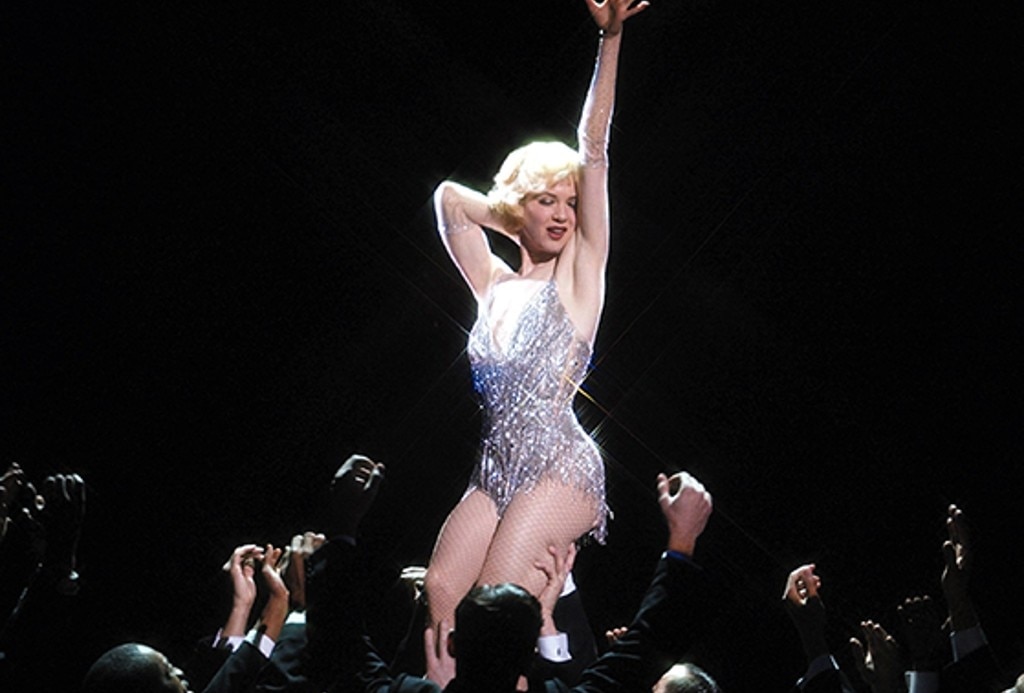
When the film was finally cast, performers not primarily known for work in musicals were chosen as its stars, including Renée Zellweger as Roxie, Catherine Zeta-Jones as Velma, Richard Gere as Billy and John C. Reilly as Amos. Queen Latifah, cast as Mama Morton, was a well-established singer of hip-hop, jazz and blues standards as well as an actress. Also in the cast are Christine Baranski, Taye Diggs, Lucy Liu and, in a cameo as a prostitute, the musical's original Velma, Chita Rivera. The revelation of the group is Zeta-Jones. Drawing upon her musical-comedy roots as a young hoofer in Wales and England, she delivers a sizzling performance that won her an Oscar as Best Supporting Actress (although she is top-billed in the credits).
In addition to the Best Picture award (the first musical winner since 1968's Oliver! in that category), other Oscars went to John Myhre and Gordon Sim for Art Direction; Colleen Atwood for Costume Design; Martin Walsh for Film Editing; and Michael Minkler, Dominick Tavella and David Lee for Sound Mixing. Additional nominations went to Zellweger as Best Actress, Reilly as Supporting Actor, Latifah as Supporting Actress, Marshall as Director, Condon for Adapted Screenplay, Dion Beebe for Cinematography and John Kander and Fred Ebb for Best Original Song - "I Move On," a new tune sung over the end credits by Zeta-Jones and Zellweger. The successful soundtrack album for Chicago, which reached No. 2 on Billboard charts, won a 2004 Grammy Award for Best Compilation Album.
Chicago earned a slew of other awards, much critical acclaim and impressive box-office receipts, becoming at that time the highest-grossing live-action film musical with earnings of $306 million worldwide. Its success is considered partly responsible for paving the way for subsequent Broadway-to-Hollywood musical adaptations including Marshall's recent Into the Woods (2014).
By Roger Fristoe
Chicago
by Roger Fristoe | February 05, 2015
SIGN UP FOR OUR NEWSLETTERS

CONNECT WITH TCM