Producer Edward Small and writer Alexandre Dumas were well acquainted. No, they weren't peers but Small did carve out quite a successful career using the works of Dumas as a rights-free entry into a movie series with a built-in audience. Small made The Count of Monte Cristo (1934), The Man in the Iron Mask (1939), and The Son of Monte Cristo (1940) and when all of those proved popular, he dipped into the rich Dumas well again and came up with The Corsican Brothers in 1941. He even had the good sense to cast Douglas Fairbanks, Jr., son of the most famous swashbuckler Hollywood has ever known (that would be Doug Sr.) and it proved as commercially successful as the others, if not, perhaps, as critically so.
The story of The Corsican Brothers begins in Corsica, of course, before the two are even born, when we learn their mother is about to give birth to them. The Count and Countess Franchi are proud to announce the imminent birth of their first child while their sworn enemies, the Colonnas, headed by the great Akim Tamiroff, are plotting to kill the whole family and seize power. After Dr. Paoli (H.B. Warner) informs the Count that the Countess gave birth to Siamese twins (no one calls them conjoined twins in this movie, as should probably be expected), the Count insists they be surgically separated, even if it kills them. Better they die than have to live joined, the father reasons, although the doctor thinks it's a mistake. Before the surgery can be performed, the Colonnas attack and kill the Count and Countess but not before the doctor can escape with the twins.
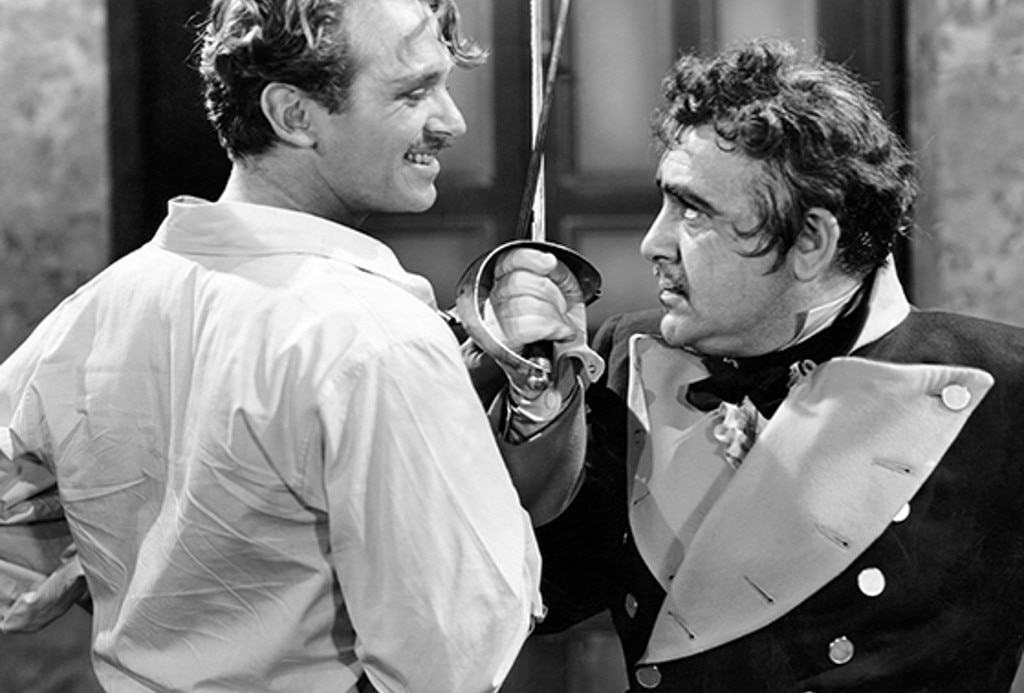
Eventually, the doctor is able to separate the two and the brothers, Lucien and Mario, both played by Fairbanks, Jr., are raised separately, neither knowing of the other's existence. But Lucien suspects it or, better said, senses it. As they grow up, Lucien feels what Mario feels. When Mario is physically injured, Lucien feels the pain. This sixth sense is finally confirmed when, on their 21st birthday, the doctor reunites the two and tells them who they really are. The two brothers vow revenge on the Colonnas clan.
Doing a movie with one actor playing two characters that interact is never easy but on a low budget, it can be especially difficult. The optical work has its problems but those problems mainly come from poor planning and bad decisions rather than low budget. For example, during the scene where the two brothers face each other as they are introduced, each with his hand on the Franchi family history bible, the effect looks good until the doctor and Mario overlap, with both men's hats becoming transparent, since the doctor is in the original shot with Lucien and Mario is in the second shot overlaid. A little better planning on their placement and this wouldn't have happened. Meanwhile, the bad decision comes with having Mario reach forward and touch Lucien's hand. When the arm goes out, clearly from someone else being masked in the Mario shot, it clearly comes off as a disembodied arm. Take out the transparent hats and the disembodied arm, and the effect would have worked seamlessly, because Fairbanks does a good job of playing both characters differently enough that special effects aren't necessary to convince the audience. It's a rare instance where the lower budget alternative, just having them stand on opposite sides of the screen, is much better than going for a clever effect. Better still are the shots where the two brothers are seen from medium distance or over the shoulder, at which point a double can be used and quite effectively. In this case, that double was the legendary Peter Cushing.
The Corsican Brothers works in spite of the low budget for a few reasons. One, it's simply a good, rousing swashbuckler, something Edward Small knew how to put together by combining the right actors with the right director. Two, Douglas Fairbanks, Jr., while never reaching the heights of fame and celebrity as his father, was still good enough and charming enough to carry a movie like this on his shoulders and pull it off. And three, Akim Tamiroff, period (he's also reasons four through ten). Tamiroff made his name in the thirties with movies like The General Died at Dawn (1936) and The Buccaneer (1938), and by 1941 was in full command of his craft. He could have fun with a role like this and did. Bosley Crowther even singled him out in his New York Times review to say that while Fairbanks played his role with a bit too much "solemnity," Tamiroff played it with "thorough comprehension of its fancy-dress phoniness." In other words, he hammed it up, as well he should. Subtlety is rarely a virtue in a swashbuckler and The Corsican Brothers is no exception. And when it follows its low budget heart and forgets the clever optical tricks, it's at its enjoyable best.
By Greg Ferrara
The Corsican Brothers (1941)
by Greg Ferrara | February 05, 2015
SIGN UP FOR OUR NEWSLETTERS

CONNECT WITH TCM