"There are no clean getaways," reads the original poster for the Coen Brothers film No Country for Old Men. It's a fitting introduction and epitaph to the film, faithfully adapted from the novel by Cormac McCarthy. The project did not originate with Joel and Ethan Coen, who were working on bringing James Dickey's novel "To the White Sea" to the screen when their financing fell through. Scott Rudin, who optioned "No Country" before publication, thought that the Coens would have an affinity for the dark themes and unexpected turns of the story, a combination getaway tale, chase thriller, and detective story with three main characters who pursue one another but never share a scene together. "We're naturally attracted to subverting genre," Joel explained to Los Angeles Times critic Kenneth Turan. "We liked the fact that the bad guys never really meet the good guys, that McCarthy did not follow through on formula expectations." It was, simply put, a perfect match of story and storyteller.
Set in West Texas in 1980, when the drug wars were crossing the border and leaving a trail of violence, the story concerns Llewelyn Moss, a cowboy who returns from a poaching trip with a fortune in drug money, a pitiless killer named Anton Chigurh, who sets out to recover the money and the thief, and Sheriff Bell, a dedicated lawman with a laconic manner and the best intentions. The Coens wrote a remarkably faithful adaptation, making minor changes but preserving the tone, structure, and story. "The story is very much about how unforgiving and capricious the world can be," summed up Ethan Coen in an interview with IGN.
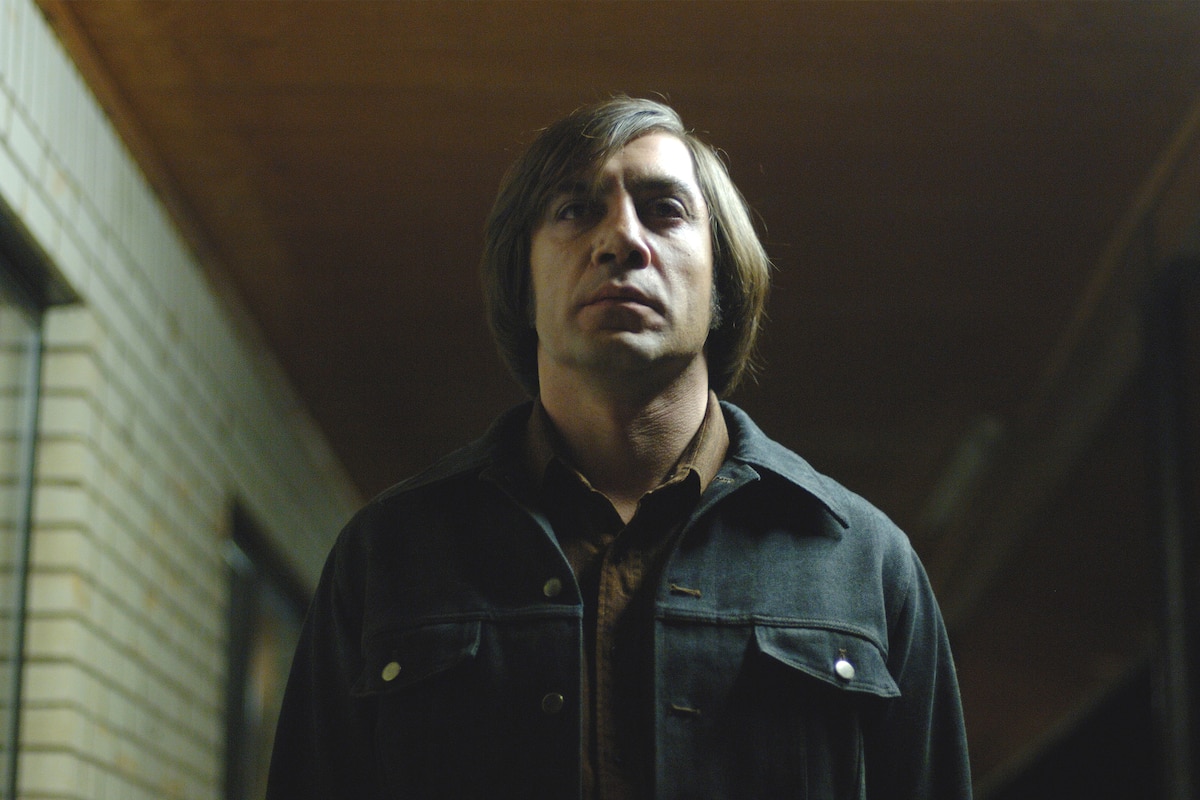
Anton Chigurh and Sheriff Bell were the first roles cast. The Coens had always wanted to work with Javier Bardem and the character of Chigurh, whose description in the novel is purposely left vague, seemed to be a perfect opportunity. As Joel describes it, "one of the things that you do get in the book is the sense that he's the one character that's not sort of 'of the region' -- that there's something exotic or maybe foreign about him." Bardem brought an indeterminate accent and an unnerving stillness to the role but the most striking dimension may be his haircut. "We saw that hair in a photograph of a guy in a bar in a Texas border town in 1979, and we just copied it," explained Joel. As Bardem told the Los Angeles Times, "You don't have to act the haircut; the haircut is acting by itself ... so you don't have to act weird if you have that weird haircut."
Tommy Lee Jones, who was born in Texas not far from where the film was set, was a natural for the role of Sheriff Bell. In Ethan's words, "There's a short list of people who could play that part at the basic level of the qualities you need: age, screen presence and the need to really inhabit that region and that landscape." Jones also had an affinity with the material. The Three Burials of Melquiades Estrada (2005), a film that Jones co-wrote and directed, explored similar themes as No Country and he had previously worked on an unproduced screenplay adaptation of McCarthy's novel "Blood Meridian." "Cormac is our best living prose stylist... and he's also a friend," he told me in a 2007 interview. "I think the Coen Brothers did a very fine job of representing Cormac's work on the screen."
The Coens found that the most difficult role to cast was Llewelyn, which went to Josh Brolin, an actor with a fairly lengthy resume (he made his debut in the 1985 adventure The Goonies and has worked steadily since) but had not broken through as a star. "We needed the same combination we had with Tommy: someone with equal weight who could authentically be part of that landscape," described Joel. "Those two things together ... we were surprised how difficult it was, and we weren't happy until he walked in." Filling in key supporting roles are Woody Harrelson as bounty hunter Carson Wells and Kelly Macdonald as Llewelyn's wife Carla Jean.
The Coens were no stranger to bloodshed in their films--their debut Blood Simple (1984) says as much in the title and Miller's Crossing (1990) was a gangster film with plenty of gunplay--but No Country for Old Men is, by Joel Coen's own admission, "by far the most violent thing we've ever made." Chigurh has an unconventional weapon of choice and isn't one to leave witnesses behind. In an early scene, he escapes arrest by killing a police officer with the man's own handcuffs. To make the murder suitably grisly and violent, the special effects crew created body armor for the "victim" that protected him from stomach to neck and piped fake blood to spurt out of a gory neck wound. Special make-up effects artist Christien Tinsley created bloated corpses to depict the victims of a shoot-out left to bake in the Texas desert. "They've put violence on screen before, lots of it, but not like this," described Kenneth Turan in his review for NPR. "No Country for Old Men doesn't celebrate or smile at violence; it despairs of it."
"It's the closest we'll come to an action movie," remarked Ethan in a 2007 interview. The Coens' reputation is largely built on visual inventiveness and narrative cleverness but this is a different method of filmmaking, a model of simple, strong, evocative storytelling pared down to the bone. There is little dialogue and the performers express character as much in their body language and physical performance as in their words. In Joel's words, "It's about physical activity in order to achieve a purpose, which honestly we've always been fascinated by." Roger Deakins, who shot all the Coens' films since Barton Fink (1991), delivers simple and stark images and gives the desert a desolate, isolated quality that sometimes feels like it's a lawless frontier.
The Coens did not meet Cormac McCarthy before taking on the project or during the adaptation process but much of the film was shot in New Mexico, near the author's home, and he came to the set to observe the shooting. "He didn't yell at us," quipped Ethan to Charlie Rose. "We were actually sitting in a movie theater/screening room with him when he saw it... and I heard him chuckle a couple of times, so I took that as a seal of approval, I don't know, maybe presumptuously."
Joel and Ethan Coen earned their first Academy Award for their original screenplay for Fargo (1996). No Country for Old Men earned them a full set of trophies. It was nominated for seven Academy Awards and won four, including Best Picture (which the Coens shared with Scott Rudin), Best Director and Best Adapted Screenplay (which they shared between themselves), and Javier Bardem for Best Supporting Actor. The Coens were also honored with awards from the Director's Guild of America and the Screen Writers Guild, Roger Deakins picked up awards from BAFTA and the British Society of Cinematographers for his work, the Screen Actors Guild honored Bardem and the ensemble as a whole with awards, and the film dominated critics' awards and year-end best lists.
No Country for Old Men is filled with richly-drawn characters, vivid yet stark images that appear to have been carved directly into the screen itself, and an enthralling story that builds merciless momentum as events spin out of the control of everyone but the filmmakers, whose methodical deliberateness tracks every detail of the story. The Coens don't offer that comforting sense of cosmic justice or poetic irony that most crime movies provide. Their world is neither compassionate nor cruel, simply indifferent and unforgiving, a fatal game of chance where a random encounter or the flip of a coin can mean the difference between life and death.
Sources:
The Making of No Country for Old Men, documentary directed by Kevin Gill. Miramax, 2008.
Working With the Coens, documentary directed by Kevin Gill. Miramax, 2008.
The Diary of a Country Sheriff, documentary directed by Kevin Gill. Miramax, 2008.
Charlie Rose. PBS, Nov. 16, 2007.
"Coens' Brutal Brilliance Again on Display," Kenneth Turan. Los Angeles Times, May 18, 2007.
"We've killed a lot of animals," John Patterson. The Guardian, Dec 21, 2007.
"Inteview: Joel and Ethan Coen." IGN, Nov 9, 2007.
"A Moment with Tommy Lee Jones / actor," Sean Axmaker. Seattle Post-Intelligencer, Sept 13, 2007.
By Sean Axmaker
No Country for Old Men
by Sean Axmaker | February 05, 2015
SIGN UP FOR OUR NEWSLETTERS

CONNECT WITH TCM