By the late 1980s, Meryl Streep was one of the world's most acclaimed actresses, and had won numerous awards, including two Oscars -- as best Supporting Actress for Kramer vs. Kramer (1979), and as Best Actress for Sophie's Choice (1982). She earned her eighth Academy Award nomination for A Cry in the Dark (1988), a role which again demonstrated her uncanny talent for accents.
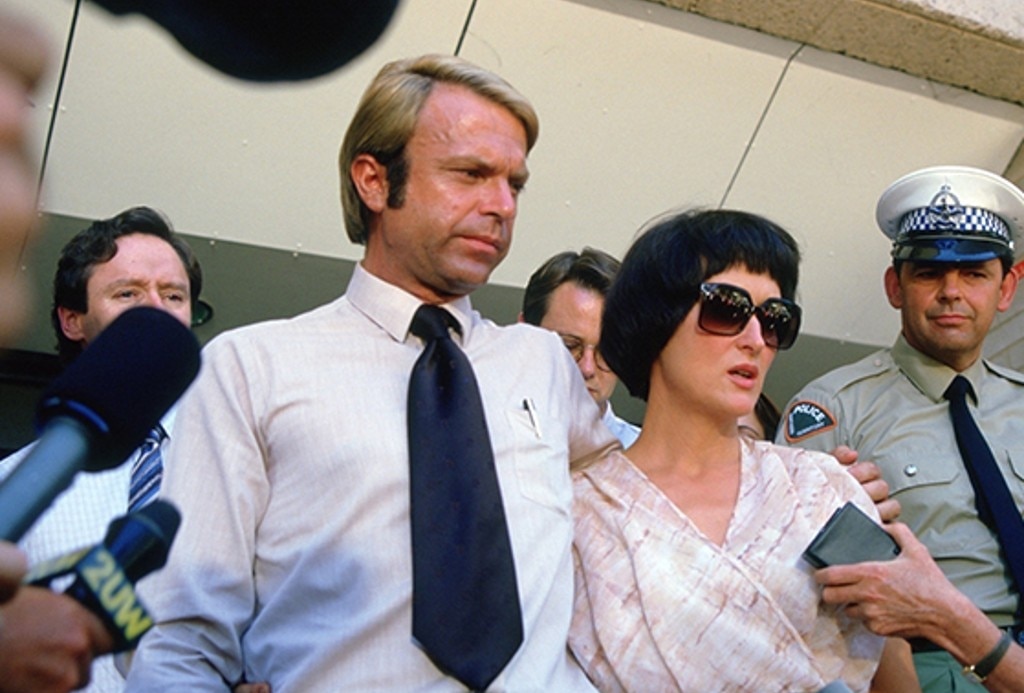
The film is based on a true story that mesmerized and polarized Australia. In 1980, Michael Chamberlain, a Seventh-Day Adventist minister, his wife Lindy are on a camping vacation near Ayers Rock in the Australian outback with their two sons and infant daughter. One evening, the family is having dinner around the campfire with other families, as baby Azaria lies sleeping nearby in a tent. They hear a cry, and when Lindy goes to check on her daughter, she sees a dingo -- a wild dog -- exiting the tent, and finds her baby missing. Some of the child's bloodstained garments are found nearby, and an inquest rules that the dingo snatched and probably killed the baby. But public opinion begins to turn against the couple, and within two years, Lindy Chamberlain is tried and convicted of murder and sentenced to life imprisonment. A few years later, new evidence clearing the couple comes to light and Lindy is set free, but the family's lives have been irrevocably damaged.
A Cry in the Dark was based on John Bryson's book, Evil Angels (the film was released under that title in Australia and New Zealand) and directed by Fred Schepisi, who had earned worldwide acclaim for his 1978 film about an Aboriginal man, The Chant of Jimmie Blacksmith. Schepisi has had a successful international career, but some of his best works are firmly rooted in Australian subjects and interests. Both the book and the film focus on how the suspicion surrounding the Chamberlains escalated due to bigotry and ignorance about their "otherness": both Chamberlains were New Zealand-born, their religion was perceived by some as a "cult," and Lindy's brusque demeanor and stubborn refusal to break down in public meant she was at least guilty, or at worst, a "witch." Throughout the film, ordinary Australians form a Greek chorus of sensation-seekers, commenting on the proceedings in workplaces, restaurants, living rooms, and outside the courtroom.
Streep worked hard on her characterization, getting the accent right (New Zealand overlaid with Australian) and refusing to soften Lindy Chamberlain's tough facade, which Streep plays as defensive of her family's privacy and determined to see justice done. As New Yorker critic Pauline Kael wrote: "Here was Lindy on TV...stoic, matter-of-fact, and bluntly impatient at the endless dumb questions. Streep has seen that Lindy's hardness saves a part of her from the quizzing and prying of journalists and lawyers -- that she needs her impersonal manner to keep herself intact....You come out moved -- even shaken -- yet not quite certain what you've been watching."
Other reviews for < B>A Cry in the Dark also praised Streep's performance. As Vincent Canby wrote in the New York Times, "Unlike most screen actresses, Miss Streep works on two levels at once. There is, on the surface, the character she is creating within the context of the script. Underneath that, there is the sometimes breathtaking pleasure of watching an actress exercise her talent as she reaches for, and achieves, the high notes." Sam Neill's performance as Michael Chamberlain also drew rave reviews. "His fall from [a] plastic-wrapped pride, his awful disintegration and self-doubt later is played wrackingly by Neill, who captures every small shift and nuance with intelligence," according to Los Angeles Times critic Sheila Benson, who called the film "a sort of epic mosaic of the national character."
Over the years, Lindy's horrified cry in the film, "the dingo's got my baby!" has become a much-ridiculed meme. It began with an episode of Seinfeld, in which a character misquotes the phrase as "dingo ate my baby," and it even became an Australian euphemism for abortion. But the horrifying experience was no joke to the Chamberlains, whose ordeal was at least partly to blame for their 1991 divorce. However, they remained united in their efforts to legally determine what happened to their infant daughter. It took until 2012 for another inquest to declare once and for all that baby Azaria was killed by a dingo, and the death certificate was amended to show that cause of death.
Meanwhile, Meryl Streep continues adding new and acclaimed portraits to her gallery of fascinating women. She won her third Oscar for playing Margaret Thatcher in 2011's The Iron Lady. As of 2015, she holds the record for the most Academy Award nominations of any actor, having been nominated 19 times, 15 as Best Actress and four as Best Supporting Actress.
Director: Fred Schepisi
Producer: Menahem Golan, Yoran Globus, Verity Lambert
Screenplay: Robert Caswell, Fred Schepisi, based on the book Evil Angels by John Bryson
Cinematography: Ian Baker
Editor: Jill Bilcock
Costume Design: Bruce Finlayson
Production Design: Wendy Dickson, George Liddle
Music: Bruce Smeaton
Principal Cast: Meryl Streep (Lindy Chamberlain), Sam Neill (Michael Chamberlain), Bruce Myles (Ian Barker, Q.C.), Neil Fitzpatrick (John Phillips, Q.C.), Charles "Bud" Tingwell (Justice James Muirhead), Maurie Fields (Justice Denis Barritt), Nick Tate (Detective Graeme Charlwood), Lewis Fitz-Gerald (Stuart Tipple)
121 minutes
by Margarita Landazuri
A Cry in the Dark
by Margarita Landazuri | February 03, 2015
SIGN UP FOR OUR NEWSLETTERS

CONNECT WITH TCM