Hammer Film Productions' One Million Years, B.C. (1966), a remake of the Hal Roach dinosaur classic One Million B.C. (1940), was a significant gamble for a company whose stock-in-trade was mid-budget Gothic horror films (Curse of Frankenstein, Horror of Dracula), psychological thrillers (Scream of Fear, Paranoiac) in the Psycho (1960) mode, and the occasional combat drama (Yesterday's Enemy, The Steele Bayonet); beneficiary of Hammer's largest budget to date (the $600,000 shooting costs were split between the Bray-based outfit and American distributors Warners-Seven Arts), the prehistoric adventure was an enormous hit, thanks in no small part to an iconic turn by Raquel Welch (in a career-making performance as a cavegirl beset by tribal unrest and a mama pterodactyl with hungry beaks to feed) and the stop-motion wizardry of animator Ray Harryhausen. Never known to quit while they were ahead, Hammer executives pressed for a likeminded follow-up, leaving production in the capable hands of Aida Young, who had just graduated from thankless behind-the-scenes scutwork to full-on producer status. Looking to give When Dinosaurs Ruled the Earth (1970) a distinctive voice, Young called upon science fiction novelist J. G. Ballard. Young tasked Ballard to cook up a suitable treatment, its tone not too far afield of his postapocalyptic novel The Drowned World, whose publication in 1962 had established the Shepperton-based scribe as a key figure in the 60s science fiction new wave.
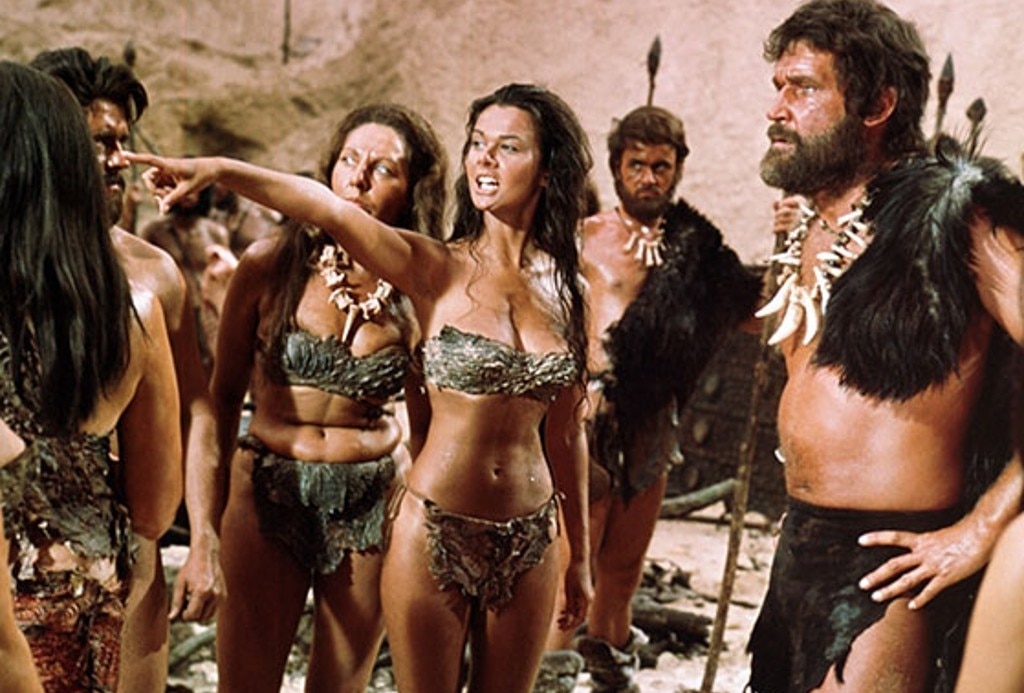
As if unable to take seriously Hammer's game plan of a prehistoric plain inhabited by both dinosaurs and primitive men, Ballard turned in a darkly satiric treatment that had its own fun with the ahistorical nonsense. His take on the subject was, not surprisingly, rejected by Hammer, who then trucked in writer-director Val Guest (who had led the company to glory in 1955 with The Quatermass Xperiment) to devise something a bit more on-message. Worse luck for Hammer, Raquel Welch was disinclined to step back into her iconic One Million Years, B.C. loincloth (having moved on in the interim to leading lady assignments opposite Frank Sinatra, Dean Martin, and James Stewart) while Ray Harryhausen was unavailable, laboring as he was with exquisite patience on the Spanish location of the cowboys vs. dinosaurs romp Valley of the Gwangi (1969). In place of Welch, Aida Young turned to former Playboy playmate Angela Dorian; born Victoria Vetri in San Francisco to Italian immigrants, Vetri had been a youthful hopeful for the title role in Stanley Kubrick's Lolita (1962) before setting into eye candy roles on episodic television (Batman, , Star Trek) and in the occasional feature film (as Mia Farrow's Satanic predecessor in Rosemary's Baby). Having officially returned to her birth name for professional purposes, Vetri refused to have her natural auburn locks lightened to play a primitive woman earmarked by her tribe for sacrifice, and was fitted instead with a blonde wig.
In Harryhausen's stead, Hammer retained the services of Jim Danforth, another American animator/stop-motion specialist whose career had begun under the mentorship of Gumby creator Art Clokey. Danforth had his earned his first feature film credits (The Time Machine, Jack the Giant Killer) before he was old enough to vote and was nominated for an Academy Award at age 25 for his visual effects for The 7 Faces of Dr. Lao (1964). Hammer was so keen to have Danforth on board that they maintained they would not commission a screenplay for When Dinosaurs Ruled the Earth until he had committed to the project; yet, after Danforth signed on, he felt squeezed out of the creative loop, unable to contribute screenplay ideas or to advise Hammer of grave errors they were making in preproduction. Relations grew hostile after the start of principal photography on the Canary Islands in October 1968, as Danforth informed his bosses that matte paintings and sets would have to be redone to accommodate his animated dinosaurs and that whole sections of the Guest screenplay would have to be binned unless the company was willing to cough up more time and money. Contracted for the term of one year, Danforth beavered away on When Dinosaurs Ruled the Earth for eighteen months, completing his effects in February 1970. Despite the behind-the-curtain setbacks, the film opened to good press and good business. Perhaps not surprisingly, it was Danforth's contributions that drew hosannas from the trades. Released in the United States in March 1971, When Dinosaurs Ruled the Earth earned Danforth his second Academy Award nomination (for special visual effects) and brought Hammer its one and only close encounter with Oscar gold.
By Richard Harland Smith
Sources:
So You Want to Be in Pictures: From Will Hay to Hammer Horror and James Bond, by Val Guest (Reynolds & Hearn, Ltd., 2001)
Hammer Films: An Exhaustive Filmography by Tom Johnson and Deborah Del Vecchio (McFarland and Company, Inc., 1996
Miracles of Life: From Shanghai to Shepperton, An Autobiography by J. G. Ballard (W. W. Norton & Company, 2013)
When Dinosaurs Ruled the Earth
by Richard Harland Smith | January 21, 2015
SIGN UP FOR OUR NEWSLETTERS

CONNECT WITH TCM