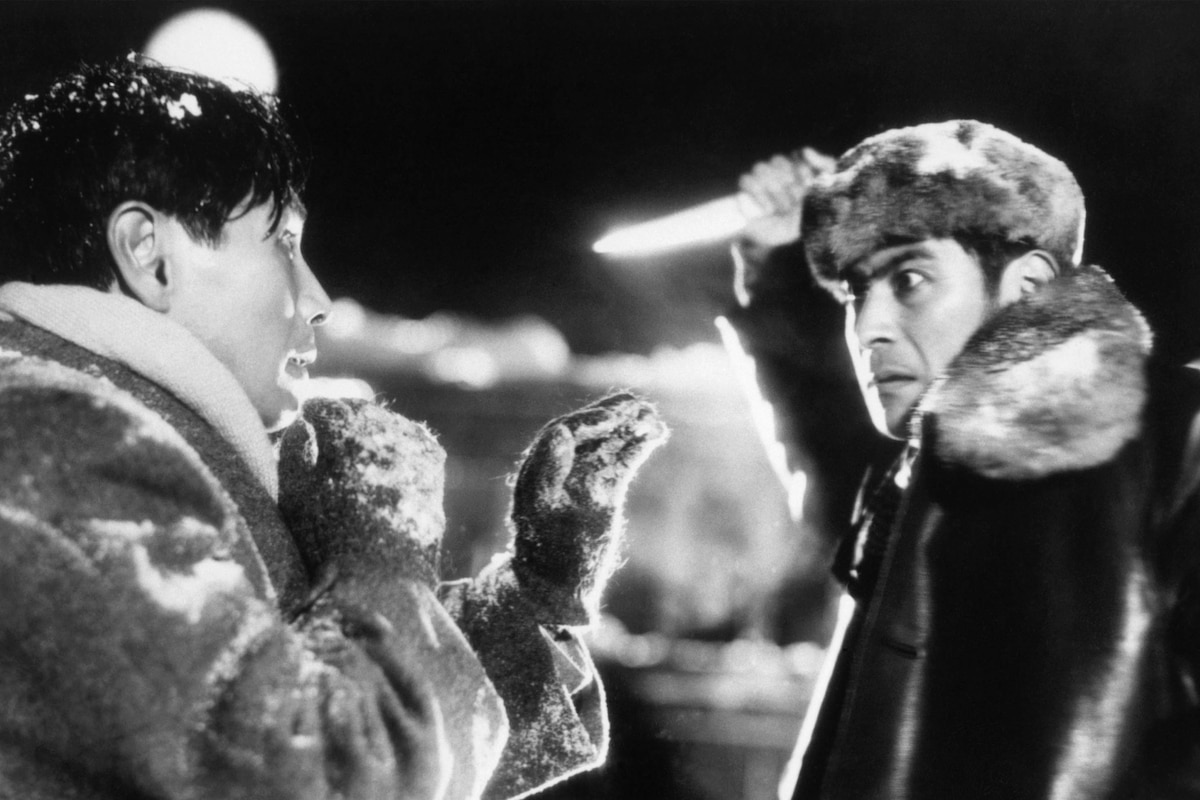
Though filmmaker Akira Kurosawa is now respected for a number of successful adaptations of international literature into Japanese cinema, the concept was still new when he made Hakuchi in 1951. This transposition of Fyodor Dostoyevsky's The Idiot to postwar Japan is often overlooked, which is understandable considering it was sandwiched between two of the director's most famous films, Rashomon (1950) and Ikiru (1952).
Critics at the time were less than receptive to this film despite the fact that Dostoyevsky was cited as Kurosawa's favorite author, and the film actually follows the source novel with admirable fidelity. This film could also be seen as a template for Kurosawa's more grandiose literary films to come, including a pair of epic Shakespeare projects (Throne of Blood in 1957 and Ran in 1985), Maxim Gorky's The Lower Depths (1957), and even a superlative version of an Ed McBain crime novel with High and Low in 1963.
While this may be the most famous rendition of the Dostoyevsky novel, it was far from the only one. The first adaptation actually appeared in 1921 from Carl Froelich as a German silent under the title Irrende Seelen (or Wandering Souls), while filmmaker Sergei Eistenstein filmed a version that was scuttled through the interference of Joseph Stalin. Sound versions were later made in France (Georges Lampin's L'idiot in 1946), India (Mani Kaul's Idiot in 1992), and even a feature-length expansion of the final chapter, Andrzej Wajda's 1994 film, Nastasja. The book has also made several surprising appearances in pop culture, with its status as one of David Bowie's favorites in turn inspiring the title of Iggy Pop's 1977 album, The Idiot. Additional references have also turned up everywhere from Mel Brooks's The Producers to Andrzej Zulawski's meta analysis, L'amour Braque.
Published in full in 1869, Dostoyevsky's novel is often read as a Christ parable (thanks in no small part to the bearded appearance and beatific nature of its main character, Prince Myshkin) and initially appeared one year earlier as a serial in The Russian Messenger, which had earlier published the first two parts of Crime and Punishment. Kurosawa himself found the author's world daunting and oppressive at times, noting that his "novels are, well, like subjecting the human spirit to a scientific experiment. The people are put into an extreme situation, a pure situation, and then he watches what happens to them... All the same, it was a marvelous experience for me." In fact, Kurosawa later referred to his other films Drunken Angel and Ikiru as being Dostoyevsky-inspired as well.
In this case the titular idiot is Kinji Kameda, played by Masayuki Mori, a naïve and epileptic war veteran who comes home to the icy town of Hokkaido. There his guileless nature sets off a romantic triangle and other dramatic developments leading to a tragic finale.
Hakuchi marked Kurosawa's second film at the Shochiku studio (following Scandal), and the filmmaker "certainly never put so much labor into a film and has spoken at length about it" according to Donald Richie's The Films of Akira Kurosawa. Unfortunately the studio (which is still best known for its melodramatic, flamboyant action films and outrageous sci-fi and horror offerings) was less than receptive to Kurosawa's original 265-minute cut, intended to be released in two parts. The final cut was drastically shortened to 166 minutes against Kurosawa's wishes, angering the director so much he left the studio and did not return until Rhapsody in August in 1991. Unfortunately the original mammoth-length version is now lost despite extensive recovery efforts.
By Nathaniel Thompson
Hakuchi
by Nathaniel Thompson | December 22, 2014
SIGN UP FOR OUR NEWSLETTERS

CONNECT WITH TCM