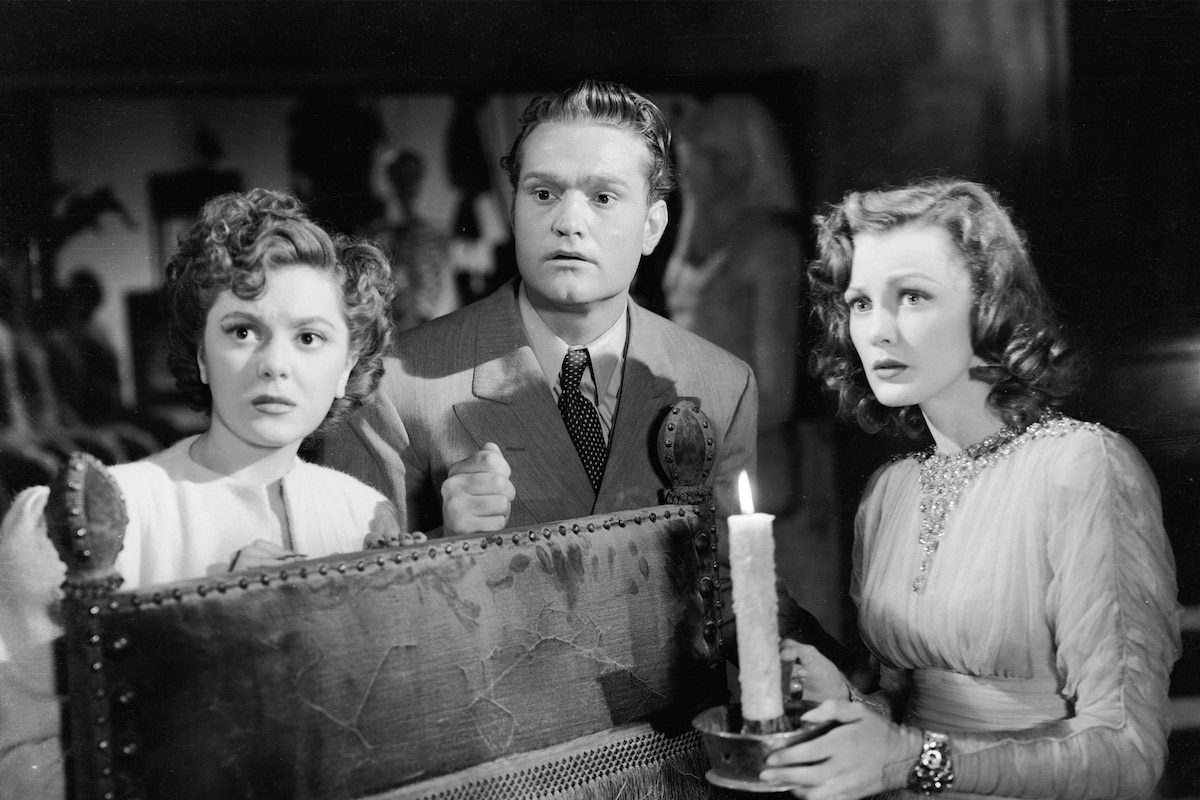
Though the studio was not known for its comedies, Metro-Goldwyn-Mayer put in an early bid on Richard "Red" Skelton, a vaudeville and nightclub performer turned radio comic who was making a name for himself in 1938. Metro plugged the rubber-faced comedian into a handful of films, most often as comic relief, among them Frank Borzage's Flight Command (1940) and two entries in the studio's long-running Dr. Kildare series of hospital dramas starring Lew Ayres. Skelton so impressed the front office with his sixth-billed turn in the show business musical comedy Lady Be Good (1941) that the decision was made to bump him up to star player, beginning with the old dark house spoof Whistling in the Dark (1941). Though production of horror films in Hollywood had ceased after 1936 (the genre was yet another victim of the spoilsport Production Code), the major studios began working Gothic thrillers back into their production schedules by 1939. Paramount had scored big by plugging funnyman Bob Hope into their 1939 remake of The Cat and the Canary and its follow-up, The Ghost Breakers (1940) and by following suit MGM was merely playing the percentages. Sticking close to the template stamped by Hope, Whistling in the Dark dropped Skeleton's radio mystery host, an expert in murder methods, into the clutches of cult leader/con man Conrad Veidt and confined its action, for the most part, to a spooky old house.
In lining up a vehicle for Skelton, MGM dusted off an old property, a successful Broadway play of the same name written by Laurence Gross and Edward Childs Carpenter that the studio had brought to the big screen for the first time in 1933. Reprising the roles they had created onstage, Ernest Truex played the protagonist (a mystery writer rather than a radio personality) in the earlier film and Edward Arnold the villain, with direction entrusted to Elliott Nugent - who would, six years later, helm Paramount's The Cat and the Canary. Reworked by Robert MacGunigle, Harry Clork, and Albert Mannheimer, Whistling in the Dark was tailored to fit Skelton's comic aptitude; like Hope, Skelton's shtick was that of a cowardly hero whose manifest inadequacies add up, in the eleventh hour and against all odds, into a win for the good guys. Production began in June 1941 and wrapped four weeks later, with the film's west coast premiere set for August. Backing Skelton's play were Ann Rutherford (as the love interest), comic dolt Rags Ragland and, buried way down in the cast list, Eve Arden. (Skelton and Arden had made their film debuts in Having Wonderful Time in 1938.) The combination of chills and chortles pleased Metro and moviegoers alike and two follow-ups were ordered: Whistling in Dixie (1942) and Whistling in Brooklyn (1943), all of which reunited the now-proven comedy team of Skelton, Rutherford, and Ragland.
Though Skelton would make thirty-odd features as an MGM contract player, his true medium would prove to be in the burgeoning medium of television. Built into his MGM contract (a codicil his home studio would come to regret as the silver screen lost audiences to the cathode tube) was an opportunity for Skelton to flex his talents in radio (which he did as the star of his own show from 1941 until 1953) and TV. Making his small screen debut on NBC in 1951, Skelton moved The Red Skelton Show to CBS, where the program remained on the air (in one form or another) from 1953 until 1970; the variety show's final season was broadcast once again by NBC before Skelton's signoff in August 1971. Skelton's Whistling in the Dark castmate Eve Arden would also enjoy a long association with television, as the star of the long-running CBS comedy Our Miss Brooks (1952-1956), as well as The Eve Arden Show (1957-1958), The Mothers-In-Law (1967-1969), and as a frequent guest on The Red Skelton Hour.
By Richard Harland Smith
Sources:
Mystery Movie Series of the 1940s by Ron Backer (McFarland & Company, Inc., 2010)
Red Skelton: The Man Behind the Mask by Wes Gehring (Indiana Historical Society, 2013)
Whistling in the Dark
by Richard Harland Smith | October 23, 2014
SIGN UP FOR OUR NEWSLETTERS

CONNECT WITH TCM