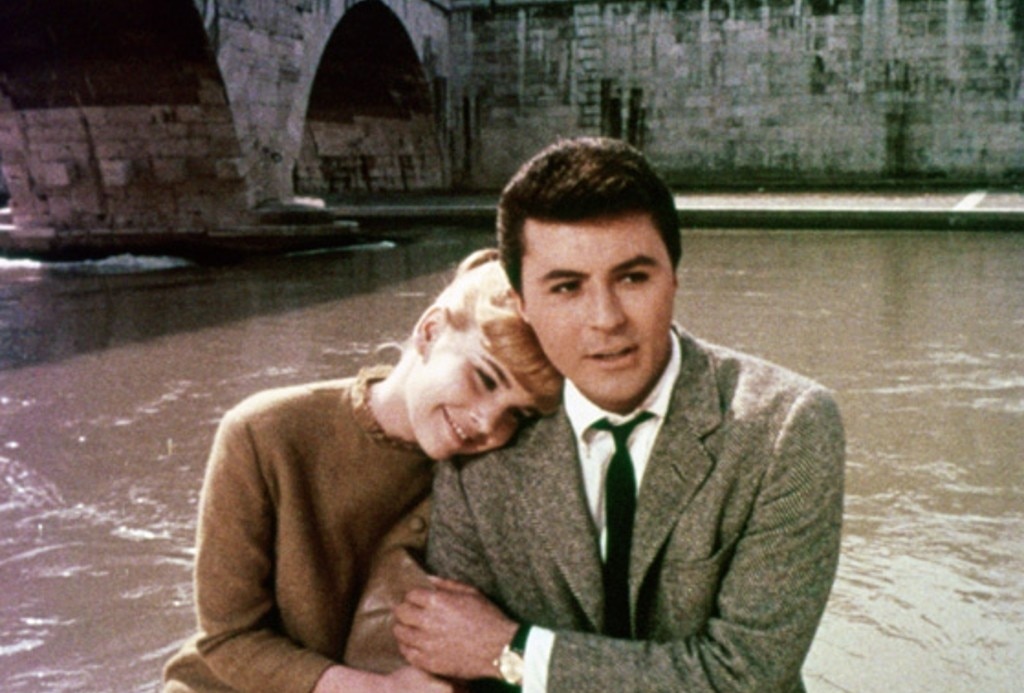
"Gidget. Gidget Goes Hawaiian. Now - she's in GAY ROMANTIC ROME!" screamed the headline in the Independent Exhibitors Film Bulletin about Gidget Goes to Rome (1963). It was the third film of the Gidget series, which had begun in 1959 with Sandra Dee in the starring role. After Dee left, Frances "Gidget" Lawrence was played by Deborah Walley in Gidget Goes Hawaiian (1961). She received mixed reactions from the critics, who were divided into pro-Sandra Dee and pro-Walley camps. The public, however, loved the film and Columbia Pictures was happy with the big box office results. They cast Walley in the next film, counting on another success with Gidget Goes to Rome. What they didn't count on was Walley getting pregnant. Enter Cindy Carol.
Carol was an 18-year-old who had appeared under her real name of Carol Sydes in films like Cape Fear (1962) and television shows like Leave it to Beaver, My Three Sons, and The New Loretta Young Show, where she was a regular for the show's only season. Columbia bleached her hair, changed her name, paid her (according to Variety) $300 a week, and she was Gidget. Also in the cast was James Darren, reprising his role as Moondoggie, Don Porter as Gidget's father, Mr. Lawrence, (a role he would also play in the television show starring Sally Field, which debuted in 1965) and Joby Baker.
Based on Frederick Kohner's 1962 novel Gidget Goes to Rome, the film has Malibu surfer girl Gidget nowhere near the beach she helped make famous. Instead, as in many films of the 1950s and 1960s, she goes to Italy. With her are her usual friends and a wacky aunt, played by Jessie Royce Landis. Gidget becomes jealous of their pretty Italian tour guide (played by Danielle De Metz) who she thinks is paying too much attention to Moondoggie. She turns to Paolo Cellini (Cesare Danova), a handsome Italian who Gidget thinks is attracted to her, but turns out to be her father's war buddy, asked to keep an eye on her.
The studio and producer Jerry Bresler planned to exploit the film by dispatching forty "field men" around the country to drum up excitement, creating high fashion shows by Italian designers in major US cities, and cementing tie-ins with Italian tourist offices and the Italian airline, Alitalia. Carol and Darren were "slated for national tours when the teenage crowd is out of school - and panting to see them."
On its release in September 1963, The New York Times critic Bosley Crowther dismissed the film as "syrupy," and merely described Cindy Carol's performance as "played with the proper pout and correct ingenuousness." Stylish clothes, famous art, and beautiful Italy weren't enough to get the teenage crowd panting or rushing to the box office to see Gidget Goes to Rome, because it was the last theatrical film in the series. This was fine with James Darren, who was a 27-year-old, twice married father and tired of playing boys. He left acting for a time, telling TV Guide that he was frustrated because he couldn't do "the things I want to do. Forget Gidget. I want a chance to do other things." He got that chance, later becoming a television director. Cindy Carol left the entertainment industry after appearing in Dear Brigitte (1965) and the television program Never Too Young.
By Lorraine LoBianco
SOURCES:
Crowther, Bosley "Gidget Goes to Rome" The New York Times 12 Sep 63
Independent Film Exhibitors Bulletin (1963)
The Internet Movie Database
Lisanti, Tom Drive-In Dream Girls: A Galaxy of B-Movie Starlets of the Sixties
Lisanti, Thomas Hollywood Surf and Beach Movies: The First Wave, 1959-1969 .
Gidget Goes to Rome
by Lorraine LoBianco | October 08, 2014
SIGN UP FOR OUR NEWSLETTERS

CONNECT WITH TCM