Biloxi Blues opened on Broadway in 1985 as the second play in Neil Simon's autobiographical trilogy that had begun with Brighton Beach Memoirs and would conclude with Broadway Bound. Brighton Beach Memoirs had been such an unqualified hit that it was still playing, six blocks away. It had also won a Tony Award for Matthew Broderick, in the role of Simon's alter ego Eugene Jerome. Broderick was now reprising the character for Biloxi Blues, another tremendous hit that ran for 524 performances and won three Tonys including Best Play.
Meanwhile, Brighton Beach Memoirs was being turned into a feature film that would be released in December 1986, with Jonathan Silverman cast in the role of Eugene because Broderick was busy with Biloxi Blues on stage. But when the time came to make a movie out of Biloxi Blues, Broderick was available to play the part, and the resulting 1988 film is widely considered the best of the bunch. (The third play in the trilogy, Broadway Bound, starred Silverman on stage and Corey Parker in a TV movie adaptation.)
Certainly a big reason for Biloxi Blues' success on screen, aside from Broderick's presence, was the involvement of acclaimed director Mike Nichols. Nichols had directed five of Neil Simon's plays on Broadway but had never directed a film version of any of them, reasoning that there would be no sense of artistic discovery for him in adapting a work he'd already mined for the stage. But he had not directed the stage version of Biloxi Blues and so took this opportunity to finally translate Neil Simon to the screen.
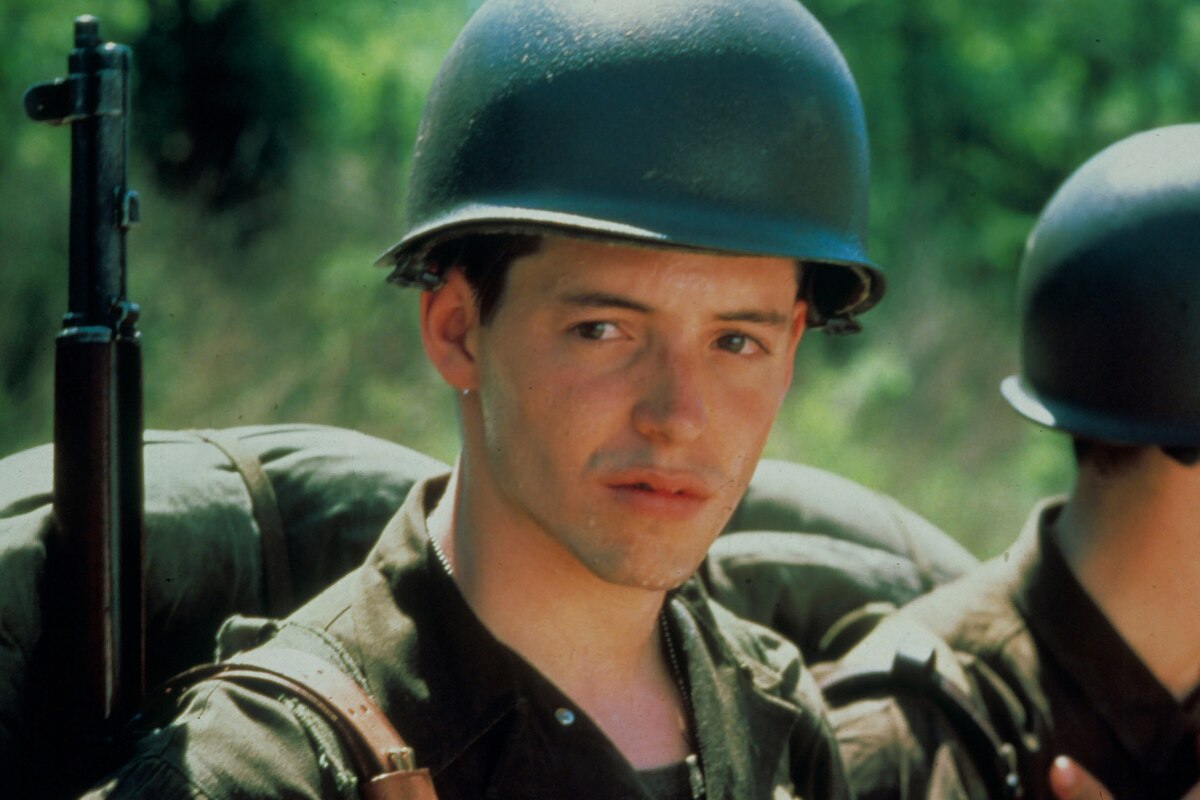
The story follows the character of Eugene as he heads from Brooklyn to an Army boot camp in Biloxi, Miss., during the waning days of World War II. Eugene is an aspiring writer, and much comedy is derived from his being totally out of place in the military. He's also a virgin, and very concerned about losing his virginity before being shipped off to potentially die in combat. As the film's advertising line proclaimed: "The army made Eugene a man. But Daisy gave him basic training!"
Daisy, played by Penelope Ann Miller (also reprising her Broadway performance), is the Catholic girl who gets Eugene's heart fluttering. And making an impression by underplaying his role is Christopher Walken as drill sergeant Merwin Toomey. "I have a nutcracker that crunches the testicles of men that take me on," Toomey proclaims. At another point, he berates his recruits: "You're not fighting men yet, but I'd put any one of you up against a Nazi cocktail waitress."
Biloxi Blues filmed on location at Fort Chaffee, Ark., and neighboring towns during the spring of 1987. The camp in the real Biloxi, Miss., was no good because it had been refurbished many times since World War II and looked too modern. But Fort Chaffee was nearly pristine, with many buildings untouched since the 1940s. Director Nichols wanted a look and style for the film that evoked the innocence and romance of Norman Rockwell, and the period's music, clothes, and popular culture all figure on screen. There's even a scene where the characters watch the Abbot and Costello service comedy Buck Privates (1941).
Nichols' cinematographer Bill Butler shot the picture in Super-35mm for greater depth of field. Interviewed by Ron Magid in 1988 for American Cinematographer magazine, Butler recalled that he gave the film "a subtly comedic look, ...an easy-to-look-at appearance that lets what happens to the characters make you laugh or cry. The look is tender, not tough... We're not trying to show people the grimy, dirty, terrible thing that war is -- it's not Vietnam."
Butler also explained how he and Nichols achieved a realistic "moving train" effect at the beginning of the film. Because they were shooting on a mock-up (so as to obtain the maximum possible performance from the actors), injecting the right amount of jiggle into the shots was key to furthering the illusion of being on a moving train. Ultimately, Nichols came up with the idea of suspending the camera on an intricate system of bungee cords. Butler laughed at the memory because this was a high-budget film on which he could have used any equipment he wanted, including complicated cranes. But for these shots, simple, low-tech bungee cords proved perfect.
Reviews were moderately positive, though many critics found the picture a bit too mild and lacking in drama. The New York Times' Vincent Canby, however, gave the film a rave, calling it "a first-rate service comedy... a very classy movie, directed and toned up by Mike Nichols so there's not an ounce of fat in it... The pleasure comes in witnessing Mr. Simon and Mr. Nichols as they discover surprises in situations that one might have thought beyond comic salvation." Canby added: "Mr. Walken gets his best role in a very long time, possibly since Pennies From Heaven... He underplays dramatically and to pointed effect; by starting so coolly, his subsequent aberrations seem all the more shocking."
By Jeremy Arnold
Biloxi Blues (1988)
by Jeremy Arnold | October 08, 2014
SIGN UP FOR OUR NEWSLETTERS

CONNECT WITH TCM