Walt Disney had a problem. Technically, he had two problems, but they were really just two sides of the same coin.
The year was 1941, and as World War II continued to rage, the man responsible for some of the most beautiful, popular, and groundbreaking animated films was facing money troubles. The war had cut off 40% of his overseas markets. His last two features, Pinnochio and Fantasia, had been box office disappointments (largely attributable to the loss of the European markets). He had other films in development, but Dumbo wouldn't be ready for close to another year, and Bambi not until the year after that. His short cartoons continued to be among the most popular in Hollywood history, but even the most popular short subject's revenues were trivial rounding errors compared to the money a feature could generate.
When other movie studios faced similar challenges like, they could churn out quickie, low-budget features for fast cash. Take some standing sets, throw some B-list actors into them and get a journeyman director to gin up something generic and familiar--it wasn't rocket science. But this was essentially outside Disney's reach. The only live action footage his studio had ever shot was the orchestra in Fantasia. He had no standing sets, and no movie stars B-list or otherwise.
Except... this wasn't entirely true.
Disney had just invested in a massive upgrade to his production facilities and opened a brand new studio in Burbank. That could be used as a set, for a behind-the-scenes tour of how Disney cartoons are made. It would be something of a feature-length commercial, of course, but Walt had been toying with that sort of idea even since the publicity for Snow White and the Seven Dwarves, and in 1954 would unveil a weekly televised commercial in the form of the Disneyland TV series. Not only would this film serve as a general advertisement for the Disney brand, but would also feature snippets of Dumbo and Bambi by way of whetting appetites for those upcoming releases.
Comedian Robert Benchley played himself, more or less, as the central character in the behind-the-scenes tour. Benchley was an absurdist comedian, New Yorker cartoonist, essayist, and Algonquin Round Table regular who had won an Academy Award for his own work in short comedies. If anyone could stand toe-to-toe with Donald Duck (or the voice of Donald Duck, Clarence Nash), it was Benchley.
To film the live-action sequences, Disney borrowed Alfred Werker and a production team from Fox. Werker was a prototypical journeyman director, fresh off directing Basil Rathbone in The Adventures of Sherlock Holmes and on his way to directing Laurel & Hardy in A-Haunting We Will Go. At the Disney studio, Werker was impressed by how the animators laid out blueprints of their planned films in the form of something called "storyboards." Inspired, he took the idea back with him to the world of live-action filmmaking.
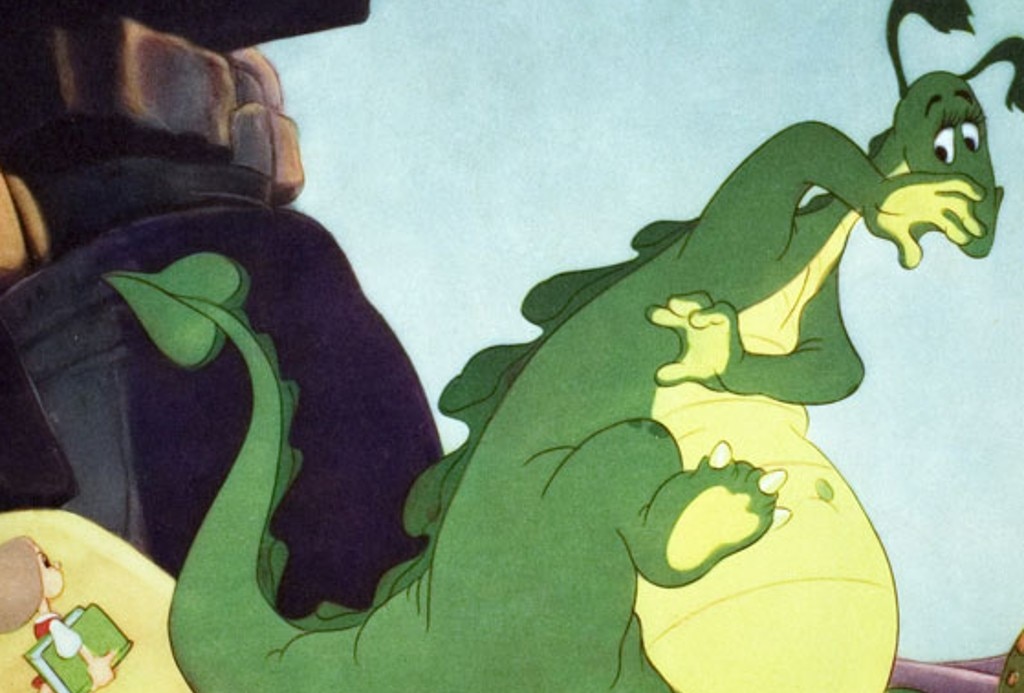
Along with Werker's live-action sequences starring Benchley, the film features three central animated sequences. The final one, which gives The Reluctant Dragon its title, is an adaptation of a nineteenth century children's book by Kenneth Grahame, with a dragon character modeled on character actor Franklin Pangborn.
Also featured is a Goofy short called How to Ride a Horse which reintroduced the Goofy character following his lackluster debut as a solo cartoon star in Goofy and Wilbur earlier in 1941. Director Jack Kinney rethought how best to use the gangly, enthusiastic bumbler and decided to cast him in a series of "educational" films in which his incompetent actions would be contrasted with the sober narration of voice artist John McLeish. As the story goes, McLeish was misled into thinking he was actually narrating a genuine educational film, and was (pleasantly) surprised to see Goofy flailing his way through the finished film. Kinney's "How to..." series of Goofy shorts continued for over a decade.
The third cartoon segment was the most revolutionary, but its effects were not entirely felt at Disney. In the Baby Weems sequence, Benchley sits with a group of Disney story artists--or, at least, some actors playing Disney story artists (one of them is Alan Ladd, a year away from his breakout role in This Gun for Hire). Ladd and the lads present their storyboards for a proposed film to Benchley--and for the next several minutes the film gives over to these sketches, minimally animated. In point of fact, this was not Disney's first experiment with what would come to be called "limited animation," with the studio having used similar techniques earlier that year in a training film for Lockheed called Four Methods of Flush Riveting. The cost-savings inherent in using highly stylized and visually arresting static images , with actual moving parts used sparingly, would soon proliferate through rival studios and ultimately to TV, where it would make such things as The Flintstones viable as a weekly series.
As an exercise in penny-pinching, The Reluctant Dragon was a masterstroke: a 72-minute advertisement for the Disney Studio as a whole, publicity for Dumbo and Bambi, a way to sell a Goofy short as a feature film, and an experiment in making animation on the cheap. Unfortunately, audiences did not agree, and generally rejected the thing as a cheat. And it was here that Disney's penny-pinching backfired catastrophically.
At the premiere of The Reluctant Dragon at the Pantages Theater, picketers marched in front of the theater entrance with extraordinarily well-drawn caricatures of Walt Disney as a fire-breathing dragon, above the slogan "The Reluctant Disney." The placards were well-drawn because they were drawn by the very artists who'd made the movie, now on strike against Uncle Walt.
There are many different ways of telling the story of Disney's labor strike, but it is not unfair to say that the artists who worked at Disney felt underpaid and unappreciated. Ever since the grueling slog of making Snow White and the Seven Dwarves, they had been working unpaid overtime to help secure popularity, profits, and awards for their boss. Although The Reluctant Dragon depicted the new Burbank Studio as a bright, whimsical campus full of shiny, happy artists, many of the actual staff thought of it as a grim sweatshop.
The new facility segregated the working units and hired supervisors to prevent the artists from mingling across departments. There was talk of installing time clocks, as if they were factory workers instead of artists. Few workers had any direct contact with Walt, and no special feeling for him personally. They were there to do their job. For years they had been giving him their weekends and nights to create his masterpieces, and now instead of the promised bonus checks they were facing waves of layoffs.
For his part, Walt felt the labor unrest was nothing short of disloyalty. He already paid better wages than most other animation outfits, and times were tough. Keeping the lights on was an increasing challenge, and the union organizers were known troublemakers who were being encouraged by some of his rivals.
On May 28, 1941, some 500 Disney staffers walked out to picket outside the studio. The strike went on for five weeks, and was only resolved in the end by federal mediators (who backed the union against Disney on every issue).
The cost to Disney was massive. When all was said and done, the Disney staff was cleaved almost in half. The artists he lost in the dispute were among his best and brightest. Some landed at MGM, others at Leon Schlesinger's shop (where Looney Tunes were born), and a few founded a new animation studio called UPA. In sum, Disney had sent his most talented people out to become his competitors. The staff that stayed was no longer a family, but a workforce he treated warily. Something ineffable had been destroyed.
The Reluctant Dragon memorializes and celebrates a moment of magic that never quite existed. It is not so much a behind-the-scenes glimpse at Walt Disney, but more of a fairy tale of that place, set in "Once Upon a Time..."
By David Kalat
Sources:
Jerry Beck, The Animated Movie Guide
Leonard Maltin, Of Mice and Magic
Richard Schickel, The Disney Version
Charles Solomon, The Disney That Never Was
Frank Thomas and Ollie Johnston, Disney Animation: The Illusion of Life
The Reluctant Dragon (1941)
by David Kalat | October 03, 2014
SIGN UP FOR OUR NEWSLETTERS

CONNECT WITH TCM