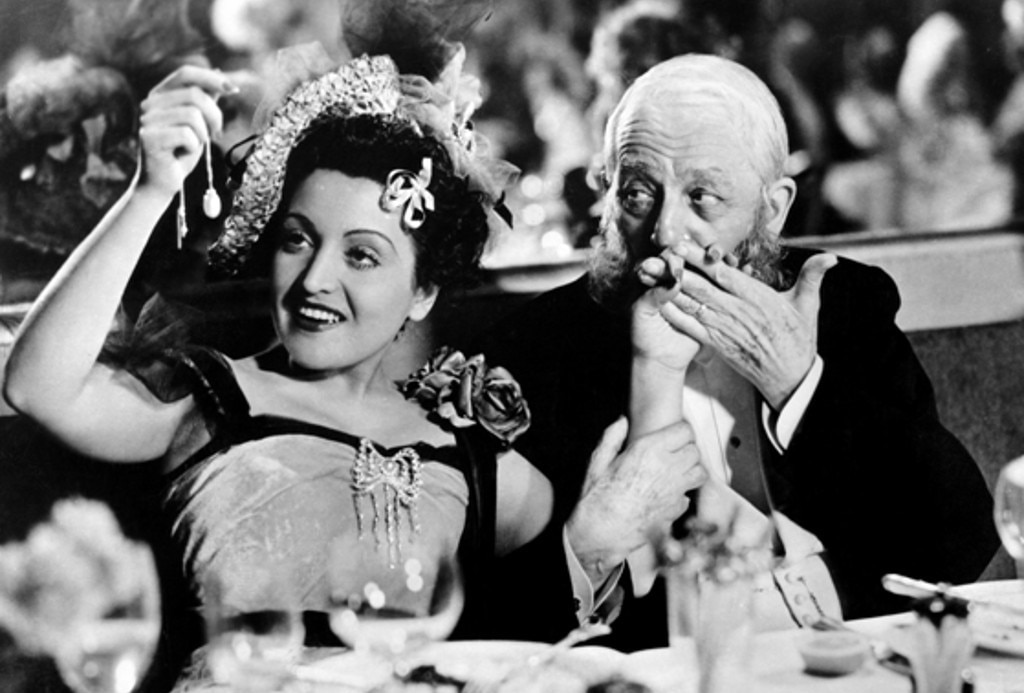
Released in 1937, the quasi-anthology The Pearls of the Crown (Les perles de la couronne) is the seventh narrative featured directed by Russian-born French filmmaker Sacha Guitry. Born Alexandre-Georges Guitry to an acting family, he first rose to fame as a playwright and often appeared on the stage in his own work.
Extremely prolific and able to shoot some films in only a matter of a few days, Guitry infused his famous wit in this film into a semi-historical template filled with lighthearted, inventive touches. In fact, Guitry himself assumes four roles - narrator Jean Martin, François I, Barras, and Napoleon III - for the chronicle of seven pearls, three of which have mysteriously disappeared after the others wind up on the crown of England. The origin of the gems as gifts to a young Catherine de Medici by Pope Clement VII turns into a springboard for four hundred years and hundreds of characters' worth of twists and turns including other familiar figures like Henry VIII and Mary, Queen of Scots.
Devoid of a central protagonist, the film instead works as a kind of picaresque journey through world history; in fact, it was originally intended to be shot in multiple languages, with its native French alternating with English and Italian. Unlike his previous films, this one had no basis in any of his plays and offers up a wide, cinematic canvas for him to explore unlike his most famous prior film, The Story of a Cheat (1936).
Among the many roles, two standouts for fans of French are found in the Abyssinia segment featuring Marcel Dalio, a veteran of productions like Jean Renoir's The Rules of the Game (1939) who went to Hollywood to appear in films like To Have and Have Not (1944) and Sabrina (1954), and Arletty, the iconic star of such films as Children of Paradise (1945) and Les Visiteurs du Soir (1942). However, none of their other features quite matched the tropical, politically incorrect spectacle on display here.
Released to great acclaim in the United States in 1938 by Lenauer International Films, the film was slightly trimmed of some of its more bawdy dialogue in order to receive a Production Seal with an MPAA certification awarded in July of that year. The film was a success in its native country as well and is often cited as a forerunner to Max Ophüls's The Earrings of Madame de... (1953), which also follows the ironic path of jewels but over a much shorter span of time.
As it turned out, fate would turn out to have a few surprises in store for Guitry as well when France was occupied by German forces during World War II. Rumors of collaboration turned into an accusation that took a toll on his health in a detention camp and destroyed his fourth marriage. Ultimately he was cleared of charges, but the resurrection of his career took some time with his reputation only fully restored in later years. It's a tale too wild to imagine even in a film as fanciful as this one.
By Nathaniel Thompson
The Pearls of the Crown (1937)
by Nathaniel Thompson | October 03, 2014
SIGN UP FOR OUR NEWSLETTERS

CONNECT WITH TCM