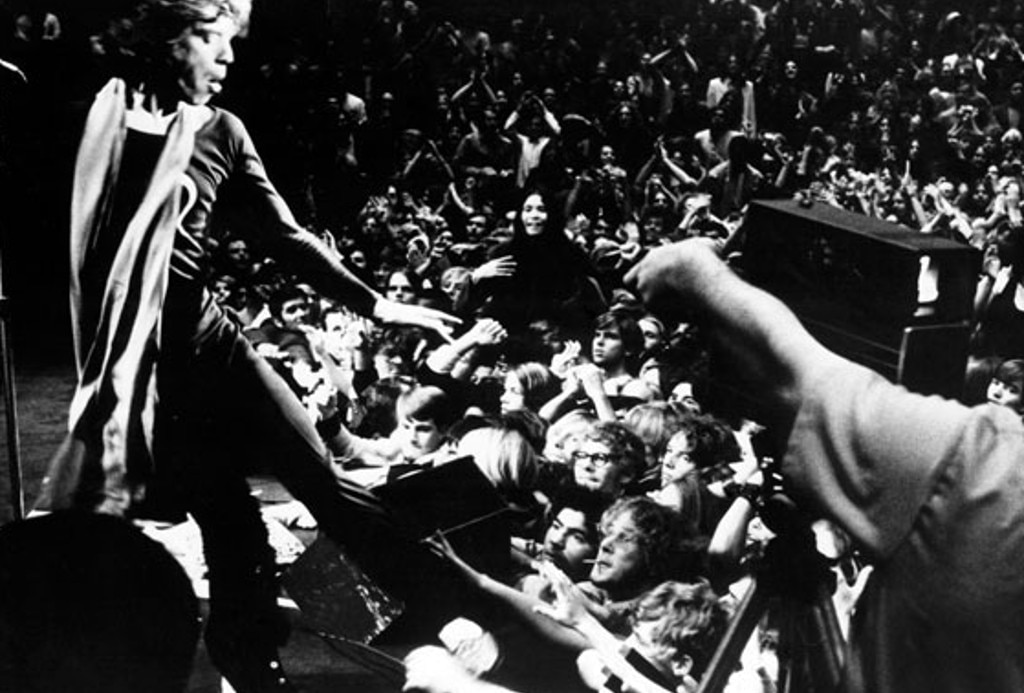
The fickle nature of documentary production has caused some drastic changes in course for more than a few filmmakers over the years, with the random nature of real life often causing a shift in subject matter entirely during production. Perhaps no film illustrates this more vividly than Gimme Shelter (1970), which began as a visual document of the Rolling Stones' American tour for its self-termed apocalyptic 1969 album, Let It Bleed.
A visceral reaction to the violence and turmoil of the Vietnam War and race riots that had turned newscasts into real-life horror programs, the album and the song "Gimme Shelter" were ominous enough without the real-life tragedy that brought the tour to a horrific end at the notorious Altamont Free Concert, which was held on December 6, 1969 at the Altamont Speedway in Northern California. With beer-bribed Hells Angels barricading the stage and an unruly crowd high on various substances, the event quickly escalated into violence and vandalism even before the Stones arrived on stage. At the end of the day-long event (which also included performances by acts like Jefferson Airplane, Santana, and Crosby, Stills, Nash & Young), a pistol-wielding youth named Meredith Hunter was stabbed to death by one of the Angels, Alan Passaro, while attempting to charge the stage. The incident was caught on film and became the defining moment of the documentary while also symbolically closing the door on the peace and love generation.
However, the film begins in happier times earlier in the tour with a performance at Madison Square Garden and preparations for the live album Get Yer Ya-Ya's Out, helmed by directors Albert and David Maysles and Charlotte Zwerin. Also among the film's cameramen at different points were Martin Scorsese (who had just worked as an assistant director on Woodstock) and George Lucas (whose footage was not used for the final cut). The Maysles Brothers were no strangers to the world of rock music, having made a 1964 short documentary about The Beatles (What's Happening! The Beatles in the USA) but were better known for their now-classic 1968 documentary feature with Zwerin, Salesman. As a team they continued working until David's death in 1987 with their most famous achievement arguably being the 1975 documentary Grey Gardens, a vivid portrait of the lives of the two Edie Beales in upstate New York.
The Maysles films form a crucial component of what was termed the Direct Cinema movement, which was devoted to capturing the organic process of real events without creative distortion. That edict required the use of easily portable cameras and, by necessity, an often loose and improvised shooting style that evolved in tandem with the similarly unpolished look of North American experimental cinema of the era. The United States branch of the movement is usually traced to Drew Associates, a creative company founded by Life magazine reporter Robert Drew who also recruited other soon to be influential documentarians like D.A. Pennebaker and Richard Leacock.
What makes Gimme Shelter a unique case is the fact that the unscripted events which became the film's major claim to fame also form a reaction from the participants interviewed after the fact. The capturing of the death on film raises a number of issues dealt with by Direct Cinema, as the details witnessed in two seconds of celluloid become the catalyst for a number of different readings and sociological changes. Even today the film remains a vital title among film courses and is often cited as one of the most important documentaries of all time, with essays and pop culture references still trying to sort it all out. In his essay for the film's Criterion release (one of several commissioned for that set), journalist and author Michael Lydon summed it up especially well: "As one who was there, I most want Gimme Shelter's new viewers to know how deeply the disturbing drama of this film sprang from the disturbing drama of the times. Nostalgic journalism has made the sixties an innocent time of love, peace, and flowers, but living through the decade didn't feel like that to me. Becoming a hippie was fun but at the same time a scary, soul-wrenching process. Altamont was one of many dark and dangerous bummers I, and seemingly everyone else, stumbled into as we reached for new ideals and possibilities."
By Nathaniel Thompson
Gimme Shelter
by Nathaniel Thompson | October 03, 2014
SIGN UP FOR OUR NEWSLETTERS

CONNECT WITH TCM