A seasoned vet of the waning days of music-hall vaudeville by the time he was 30 and had made his way to Hollywood (in 1934), Bob Hope spent very little time in the lower ranks before becoming a full-on star. There was something simply bewitching about him then, a mixture of wide-eyed guilelessness, quick-tongued sarcasm, and a bumbling honesty about his own cowardice and stupidity, that made him addictive. When he was still young, the persona was still unjaundiced and effortlessly entertaining. He was never not an American institution; he averaged three movies a year in the decades before television, and at the start finished a total of seven between his first feature, The Big Broadcast of 1938 (1938), and 1939's The Cat and the Canary, by which time he was a major star.
You can't say he didn't earn it - there was nobody quite like Hope in Hollywood, a savvy hipster wracked by his own insecurities and the bully-beaten knowledge of how little use the world has for him. Naturally, his yin matched perfectly with Bing Crosby's supercool yang, but Hope in his heyday (before he became just a TV-culture set of schtick one-liners) could zip through nearly any scenario, working it with his fast eyes and mouth, and always make his co-stars, even Martha Raye and Dorothy Lamour, seem deft and in the moment. The Cat and the Canary was in many ways a perfect fit for Hope - a classic, semi-self-mocking thriller-mystery chestnut into which Hope could cower and quip to his heart's content, giving his personality nervous juice while allowing his wit to update what would've otherwise been an antique.
The results are exactly what you'd foresee, complete with an early Jack Benny joke - and also very different from the classic original production, from 1927. The first true trapped-in-a-haunted-mansion-on-a-rainy-night-to-read-the-will story John Willard's 1922 play always had a modicum of winking irony to it, but the silent version directed by German Expressionist-emigre Paul Leni, as hokey as it may be, emphasizes the Gothic atmospherics and musty architecture, making it a lovely, nightened place to visit, especially on Halloween. (It's also perfectly suited for, and seductive to, children.) Naturally, it was quickly remade as a talkie, as 1930's The Cat Creeps, but the modern era was already proving too sophisticated for its gambits and 19th-century conventions. When Hope became huge, Paramount saw a way to make the mothballed property new again, as a madly old-fashioned thriller plot that Hope, portraying essentially a show-biz version of himself, is thrust into and recognizes for the menacing but familiar hokum that it is. Much like the characters in Scream (1996), almost six decades later, Hope's Wally Campbell bounces through Willard's scenario as if he'd seen it, and acted in it, a hundred times before, and knows more or less exactly what will happen.
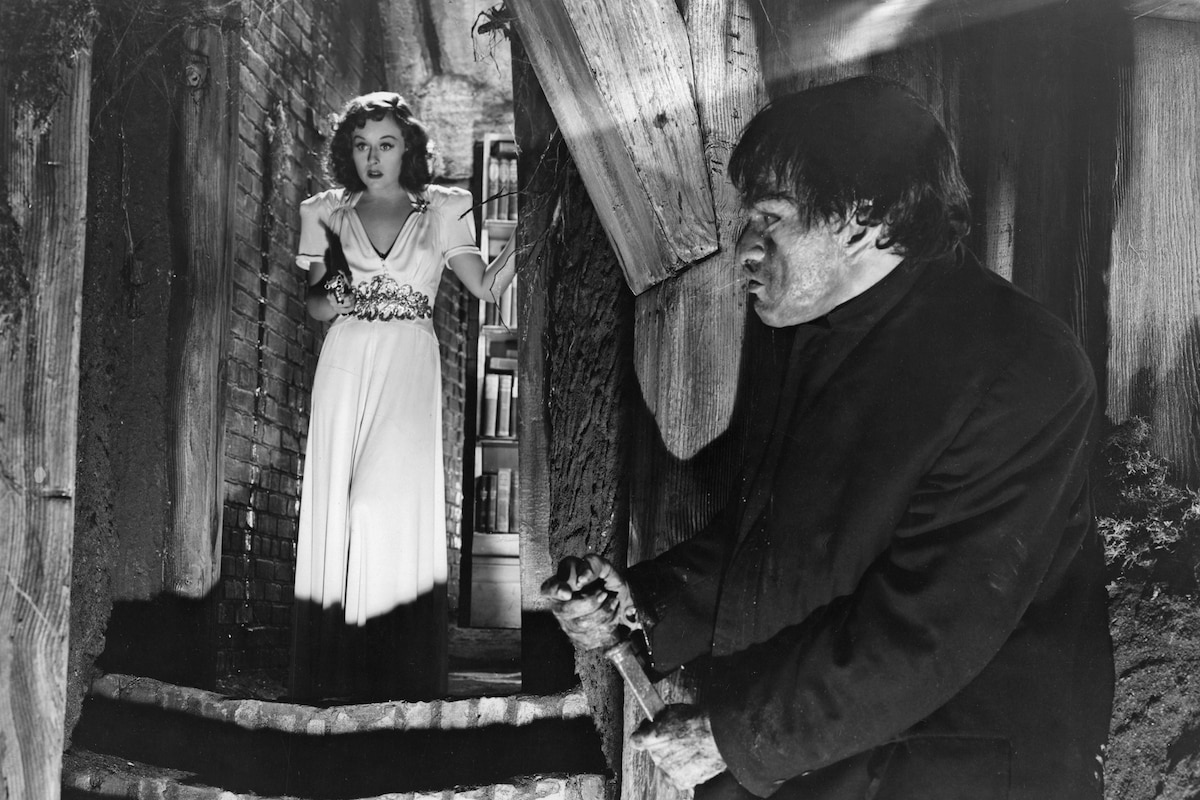
Not that Wally is emboldened or aided in any way by this knowledge, of course. Directed by Elliot Nugent and adapted by Walter Deleon and Lynn Sterling, all three experienced veterans of the Hope studio unit, The Cat and the Canary became one of the first old-dark-house comedies, marking the way for a popular subgenre subsequently exploited by other Hope films, Abbott & Costello, Kay Kyser and the Bowery Boys. (Of course, Laurel & Hardy, with 1930's The Laurel-Hardy Murder Case, and the Little Rascals, with 1938's Hide and Shriek, were pure-bred comedy precedents.) Willard's spooky mansion has been transplanted into the Louisiana bayou, accessible only by dingy, but otherwise the plot remains the same: a pack of contentious cousins summoned for the reading of the will, an officious and doomed lawyer (named Crosby, in every version), a budding romance, news of a psychotic mental patient loose outside, disappearances and bodies and the specter of a killer manifesting and then disappearing from a network of hidden passageways...
The cast around Hope, often receiving his acidic one-liners with open disdain, are a varied lot, with horsefaced pretty boy Douglass Montgomery being the direst, and George Zucco, as the suspicious lawyer, maintaining such an air of world-weary acumen that you half-wish the film wasn't a comedy at all, but the grimly serious Gothic melodrama Zucco seems to think he's in. Hope shares the spotlight with Paulette Goddard, who as the stalked heiress is as bright as a new penny but whose dazzling comic capacities are more or less unutilized. It's all up to Hope, and he's more than up to both sniveling-chicken farce and leading-man gravity, to a degree he wasn't later, as he aged and became "Bob Hope" and hardly ever a character you could happily follow through a genre film's storyline.
It's a confection, this movie, all of 72 minutes long and as effortless buoyant as a carnival balloon. Photographed by the estimable silversmith Charles Lang, the movie doesn't really have a single DNA strand of creepiness or menace to it; the scenario's Gothic tension has been completely sublimated by studio gloss and comic irreverence. And so it was for 1939 audiences, for whom the dread delivered by horror films earlier in the decade had been overshadowed by real international concerns elsewhere, and economic devastation at home.
By Michael Atkinson
The Cat and the Canary (1939)
by Michael Atkinson | October 03, 2014
SIGN UP FOR OUR NEWSLETTERS

CONNECT WITH TCM