Josef von Sternberg is best remembered for his seven-film partnership with Marlene Dietrich, which stretched from The Blue Angel in 1930 to The Devil Is a Woman in 1935. But the director's two-film collaboration with Emil Jannings was also pivotal to the acclaim he enjoyed in the late 1920s and early 1930s, the only period when his career really thrived. Sternberg's first picture with Jannings was The Last Command (1928), and his success in working with the temperamental star was what prompted the invitation to direct him again in The Blue Angel for Germany's renowned UFA studio. The latter film's lasting fame has overshadowed Sternberg's earlier achievements, but his Hollywood films of the silent era--most notably The Last Command, Underworld (1927), and The Docks of New York (1928) - are much too entertaining to be forgotten.
The Last Command is distinguished on many counts. Jannings's performance in it (and in another picture, Victor Fleming's 1927 drama The Way of All Flesh) brought him the very first Academy Award for Best Actor - although the canine star Rin Tin Tin received more votes for the honor, only to be disqualified by Academy officials (who valued dignity over arithmetic) for not being human. The Last Command also earned screenwriter Lajos Biró the Academy Award for Best Original Story. Prizes aside, The Last Command is a splendid instance of Hollywood dealing directly with its own nature and practices, and dealing indirectly with Old World cultural legacies that helped shape the American film industry.
Jannings plays Sergius Alexander, a former Russian aristocrat whose glory days came crashing down in 1917 along with the czarist government. After a narrow escape from the Bolsheviks he made his way to America and ended up in Los Angeles, where he scrapes by as a studio extra, making $7.50 a day when he's working. The story begins when Russian-American movie director Lev Andreyev (William Powell, sophisticated as always) sees Sergius's photo in a casting file and chooses the melancholy old man to play a Russian general in a historical drama he's about to shoot.
But more is going on than meets the eye. In the kind of uproarious coincidence you only find in movies, Lev has recognized Sergius from bygone times. Back in the day, it turns out, Lev was a young firebrand in the revolutionary struggle and Sergius was an imperial bully who took pleasure in toying with his foes, one of whom was Lev, who's still angry after all these years. Preparing for his role in the dressing room, Sergius gazes into a makeup mirror and sees himself in a czarist getup like the one he used to wear. At this point another actor complains about a nervous tic Sergius has, and Sergius explains that the twitch - a constant shaking of the head -is the result of an awful shock he once experienced.
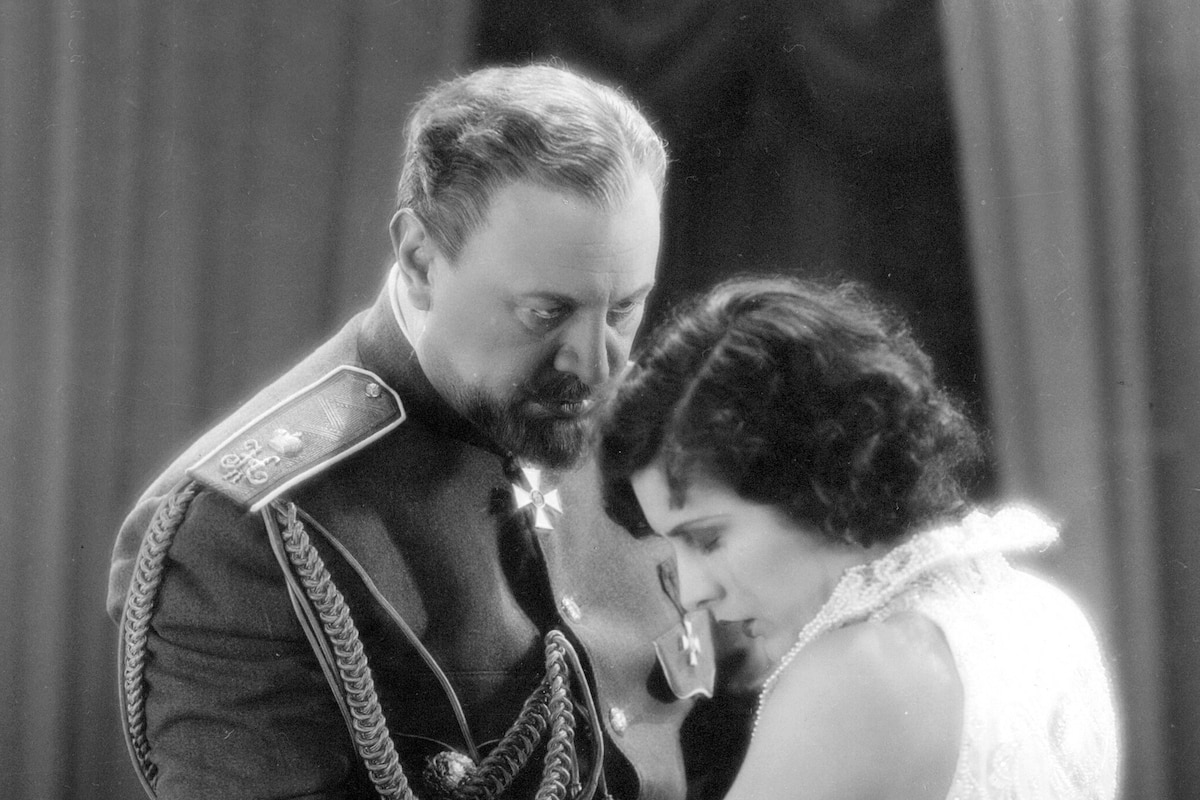
A long flashback then ensues. We see Sergius flaunting his imperial power, beating and jailing the revolutionary Lev, and falling in love with Lev's beautiful companion, Natalie Dabrova (Evelyn Brent), who's known to insiders as "the most dangerous revolutionist" of them all. Natalie reciprocates Sergius's love, and when Bolsheviks attack him during a train journey she helps him get away. But she dies in a crash moments later, leaving him lost and alone in a frozen, hostile land. And now we return to modern-day Hollywood, where Lev is maneuvering Sergius into playing a bogus version of his former self, thus taking revenge for the indignities he suffered at the arrogant general's hands.
In the powerful conclusion of The Last Command, feeble old Sergius performs his bit part in Lev's movie, rallying disheartened troops and responding to an upstart's defiant taunt - "You've given your last command!" - with the same furious blow he inflicted on Lev so many years ago. And then he succumbs completely to madness; forgetting that he's only acting in a film, he hallucinates a fierce battle with antagonists on every side. This extraordinary scene takes place on a studio soundstage that Sternberg endows with a stylized, almost abstract design; it's less an actual place than a movie set of the mind, thronged with phantom revolutionaries from the old actor's delirious brain. In an abrupt (and unconvincing) turnaround when old Sergius breathes his last, Lev finally softens to the old man, declaring that he was not merely a great actor but "a great man" as well.
According to a 1929 newspaper report, the story of The Last Command was inspired by an encounter between filmmaker Ernst Lubitsch, who had directed Jannings in several pictures going back to 1917, and an erstwhile Russian general he had known years earlier, now hiring himself out as a movie extra for $7.50 a day. The Last Command may itself have influenced Billy Wilder's classic Sunset Blvd. (1950), in which Erich von Stroheim-whose name encouraged the young Josef Sternberg to add a "von" to his moniker in the middle 1920s-plays a once-celebrated filmmaker reduced to serving as butler and gofer for a faded Hollywood star.
Jannings was a towering star when he teamed with Sternberg - even today his performances for F.W. Murnau in The Last Laugh (1924) and Faust (1926) are celebrated and studied everywhere - and although the actor was difficult to handle, Sternberg generally brought out his most expressive qualities. His most fully realized scenes as Sergius almost reach the heights he scaled as the love-wracked professor of The Blue Angel, although in both pictures he pours on a bit too much suffering-soul sauce for my taste.
Soon after his Sternberg films, Jannings's career was undermined in Hollywood by the arrival of talkies, which didn't take kindly to his heavy German accent; and back in Germany he acted prominently in Nazi propaganda films, which doomed his prospects in the postwar years. Sternberg's career declined for different reasons, including the fact that he was too obsessive an artist to flourish in Tinseltown over the long haul. In all his finest films, he concerned himself less with niceties of acting than with nuances of light, shadow, and décor, and The Last Command deserves high praise in those departments, especially during its climax on Sergius's delusional battlefield. Look beyond the film's anguish and occasional bathos, moreover, and you'll see a sharp-eyed satire of Hollywood politics, crafted by a director whose creative personality contained more than a trace of mischief.
Director: Josef von Sternberg
Producers: Jesse L. Lasky, Adolph Zukor
Screenplay: Lajos Biró, story; John F. Goodrich, writer; Herman J. Mankiewicz, titles
Cinematographer: Bert Glennon
Film Editing: William Shea
Art Direction: Hans Dreier
With: Emil Jannings (Sergius Alexander), Evelyn Brent (Natalie Dabrova), William Powell (Lev Andreyev), Jack Raymond (Assistant Director), Nicholas Soussanin (Adjutant), Michael Visaroff (Serge), Fritz Feld (Revolutionist)
BW-88m.
by David Sterritt
The Last Command (1928)
by David Sterritt | October 03, 2014
SIGN UP FOR OUR NEWSLETTERS

CONNECT WITH TCM