Universal Studios was the undisputed trendsetter in the horror movie cycle of the 1930s, though most other studios tried their hand at the genre in the wake of the success of such films as Dracula (1931) and Frankenstein (1931). Paramount Pictures, for example, indulged in some elaborate monster make-ups and pre-code scenes of torture in Island of Lost Souls (1933), while Warner Bros. released a pair of two-strip Technicolor shockers starring Lionel Atwill and Fay Wray, Doctor X (1932) and Mystery of the Wax Museum (1933). Small independent Hollywood studios were also turning out their own horror offerings. While many of these didn't grasp the appeal of Universal's style and featured watered-down mystery elements instead of bona fide supernatural shock, some poverty row films more than rose to the occasion; Halperin Productions' White Zombie (1932) is one example, as is Majestic Pictures' The Vampire Bat (1933).
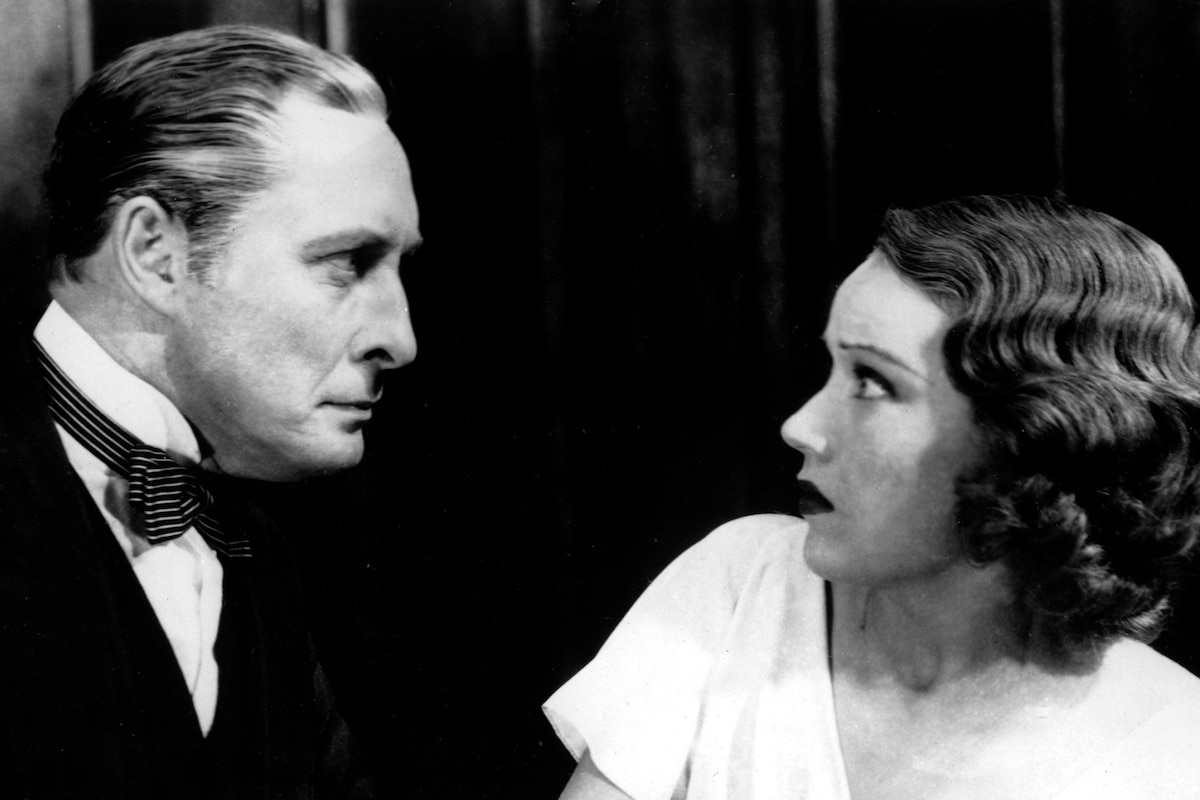
The Vampire Bat is set in the fictitious European village of Klineschloss, where many residents have been killed - their bodies drained of blood and puncture wounds found on their necks. The Burgermeister (Lionel Belmore), as well as most of the townspeople, fear that the killings mark the return of an outbreak of vampirism; their historical writings tell of an epidemic of death accompanied by giant bats visiting the town in 1643. Police inspector Karl Brettschneider (Melvyn Douglas) doesn't believe the vampire myth, but he is keeping a watchful eye on the town loon, Herman Gleib (Dwight Frye). Herman, you see, is very fond of bats and even takes to carrying them around in his jacket pockets. The town doctor, Otto Von Niemann (Lionel Atwill) is kept busy examining all of the bodies that are piling up around the village. His lovely assistant Ruth (Fay Wray) is also romantically involved with Inspector Brettschneider.
The Vampire Bat is an entertaining mélange of several familiar horror elements: vampirism, hypnotism, and the creation of artificial life. It has lush visuals and the look of a bigger budget movie for good reason - the producers shot much of the film on standing sets from the Universal Studios lot. As George E. Turner and Michael Price point out in their book Forgotten Horrors: Early Chillers from Poverty Row, "The town is the familiar Village Frankenstein, the von Niemann home is The Old Dark House (from James Whale's 1932 film of that name), furnished in part from the manse in the 1927 The Cat and the Canary, and the morgue is the cavernous wine cellar of Castle Frankenstein. A torchlit chase resembles the pursuit of The Monster in Frankenstein, although it was filmed at Bronson Canyon instead of among Universal's man-made cliffs. Even the cast includes Universal veterans - Lionel Atwill, Melvyn Douglas, Dwight Frye, and Lionel Belmore - and scripter Edward T. Lowe was scenarist of Universal's The Hunchback of Notre Dame (1923)." In addition, The Vampire Bat reunites the Atwill and Wray team of the Warner Bros. Technicolor chillers.
In spite of all of the apparent borrowing, The Vampire Bat feels wildly original, the story veering from murder mystery to horror chiller to science fiction with ease. The pre-code shocks are also effective; not only are we shown puncture wounds on the necks of the dead, we are treated to some surprisingly graphic dialogue as the Burgermeister describes them: "Two wounds on the neck, right at the jugular vein...pierced and spread apart just as if two fang-like teeth had bitten through the flesh and right into the vein. And in every case, a blood clot - eight inches from the victim's neck. The mark of the feast - the Devil's signature."
The players in The Vampire Bat elevate the romantic and comedy relief scenes that often tend to bog down other 1930s horror pictures. Maude Eburne as Wray's hypochondriac aunt figures in one sequence that manages to be simultaneously creepy and amusing while it advances the plot. Dull-witted Herman shows up in Gussie's garden and distracts her with a rat, steals her food, then gives her a nice soft bat. She faints and is awakened, not by Herman, but by a slobbering Great Dane, causing Gussie to believe that the vampire can take the form of a dog as well as a bat! The wonderfully sardonic Melvyn Douglas makes for a believable leading man, and the presence of Fay Wray as his romantic interest adds weight to the relationship. Wray is not given as much to do in this film as in her other movies with Atwill, and unfortunately she does not have the chance to display her screaming skills; for the scenes in which she would have good reason to scream, she is bound and gagged. Of course, she would make up for this oversight later in the year, when she appeared in her signature role as Ann Darrow in King Kong (1933).
Dwight Frye's Herman is another in that character actor's list of eccentrics - the type of role that has long endeared him to aficionados of early horror movies. He makes the most of his bizarre halting dialogue, usually in defense of his beloved bats: "Bats no do - they soft, like cats - they not bite Herman." Herman Gleib may be even more manic than Frye's better-known roles as Renfield in Dracula and Fritz in Frankenstein.
The colorful Lionel Atwill easily jumped from leading mystery roles at major studios (Paramount's Murders in the Zoo - 1933, Universal's Secret of the Blue Room - 1933), to supporting roles in A-list films like Captain Blood (1935) and Boom Town (1940). Atwill was also apt to pop up in leading roles for minor studios (Monogram's The Sphinx - 1933, Republic's serial Captain America - 1944). His unforgettable turn as the one-armed Inspector Krogh in Son of Frankenstein (1939) assured that he would appear in every subsequent film in that series, as well as in other Universal shockers, such as Man Made Monster (1941).
Director Frank Strayer and his photographer Ira H. Morgan collaborate on nicely atmospheric establishing shots, with plenty of bat-like swoops of the camera up and down village exteriors. Strayer had a career stretching from the silent era to the early 1950s, all of it spent directing second features and B-movies. By the late 1930s he had graduated from independent outfits like Majestic and Invincible to the majors - Columbia Pictures, to be exact, where he helmed the majority of the Blondie series of films based on Chic Young's comic strip.
For years The Vampire Bat could only be viewed in battered prints and transfers, with washed-out images that signaled that they were dupe prints several generations from the original. Some reissue prints even had jarringly mismatched continuity, as scenes were intercut with brief shots from unidentified silent pictures. In one sequence, for example, we see a man dressed in period Napoleonic garb approach the doorway of a stone house, and we are not supposed to notice that it does not match the following shot in which Atwill, wearing completely different clothing, enters his front door. Fortunately, in 2017 the UCLA Film & Television Archive made new preservation prints and a digital master of The Vampire Bat, using the best available material from the 1933 original. The improvement in both sound and picture is startling; even a brief but effective bit of hand-coloring was restored to the torch-carrying mob scene. Seen in this revealing version, The Vampire Bat can rightly take its place among the select group of essential examples of early-1930s horror.
Producer: Phil Goldstone
Director: Frank Strayer
Screenplay: Edward T. Lowe
Cinematography: Ira H. Morgan
Film Editing: Otis Garrett
Art Direction: Daniel Hall
Sound: Dick Tyler, Sr.
Cast: Lionel Atwill (Dr. Otto von Niemann), Fay Wray (Ruth Bertin), Melvyn Douglas (Karl Brettschneider), Maude Eburne (Gussie Schnappmann), George E. Stone (Kringen), Dwight Frye (Herman Gleib), Robert Frazer (Emil Borst), Lionel Belmore (Burgermeister Gustave Schoen).
BW-74m.
by John M. Miller
The Vampire Bat
by John M. Miller | September 23, 2005
SIGN UP FOR OUR NEWSLETTERS

CONNECT WITH TCM