Tess (1979), Roman Polanski's film adaptation of Thomas Hardy's 1890 novel Tess of the D'Urbervilles, has in 2014 received a sublime Blu-Ray and DVD release from Criterion. Restored by Pathe under the direct supervision of Polanski himself, the movie looks and sounds magnificent. At first glance, the lushly beautiful Tess is a seemingly unusual work for Polanski, whose films we tend to associate with horror and sex, but this was actually a highly personal project for the master filmmaker. It was his first picture after fleeing the United States in 1977, and also a project that his wife, Sharon Tate, had suggested he make as a vehicle for herself -- just before she was murdered by the Manson gang in 1969. Polanski read the novel after her death and realized it was indeed right up his alley, and he dedicated the eventual film to her with an on-screen inscription.
Hardy's tale, to which the film is very faithful, is about a poor English girl, Tess, whose father learns he is a distant descendant of a once prominent, rich family, the D'Urbervilles. He sends Tess to the home of a remaining D'Urberville to find employment (or at least a handout), but Tess winds up being seduced by the ne'er-do-well Alec D'Urberville (Leigh Lawson), who becomes obsessed with her. Fleeing Alec, she eventually finds work at a dairy farm and starts a passionate relationship with a young farmer named Angel Clare (Peter Firth). But in this society, the revelation of the sins of her past, even if they were not her fault, could doom Tess to shame, ostracism and worse. Ultimately, Tess is about a woman struggling to make her way in the world, looking for happiness, or at least survival, but finding that a judgmental society, timing and even luck are all working against her.
Polanski explores this theme vividly, sympathetically and cinematically. Costumes, speech and physical mannerisms of the actors all convince the audience of the time period and of the distinctions among the social classes, and the film's pictorial beauty does much to stress the contrasting cruelty of some of the characters. The movie is not "pretty" for prettiness' sake. Most important, one really feels the isolation of Tess throughout the film, which is at once sprawling and intimate. The plot itself, while important, feels less vital here than the depiction of Tess' emotional experience of the world she is forced to inhabit, and as a result, the long running time feels entirely appropriate and never tedious.
Tess was shot entirely in France, mostly on locations in Normandy and Brittany, because Polanski worried that if he traveled to England he would be extradited to the United States. Polanski later wrote, "To tell the story at all, it was essential to find the proper setting, a twentieth-century equivalent of Hardy's nineteenth-century Dorset. The only way to convey the rhythm of his epic was to use that setting as an integral part of the film, signaling the passage of time and the change in Tess herself by means of a visible, almost palpable change in seasons. Once our rural locations were chosen, we would have to film throughout the year from early spring, through high summer, to the depths of winter." With such a shooting strategy, filming wound up lasting nine months over 80 separate locations, and Tess became, at $12 million, the most expensive film ever made in France to that point. Freak weather and labor strikes only added to the overall time and expense.
If Tess is atypical of Polanski, it's in the way that The Age of Innocence (1993) is atypical of director Martin Scorsese. But in fact, both films are completely emblematic of their directors' concerns and are indeed suffused with violence. It's just that the violence is emotional, an undercurrent beneath a pristine surface -- exactly like the societies the films depict.
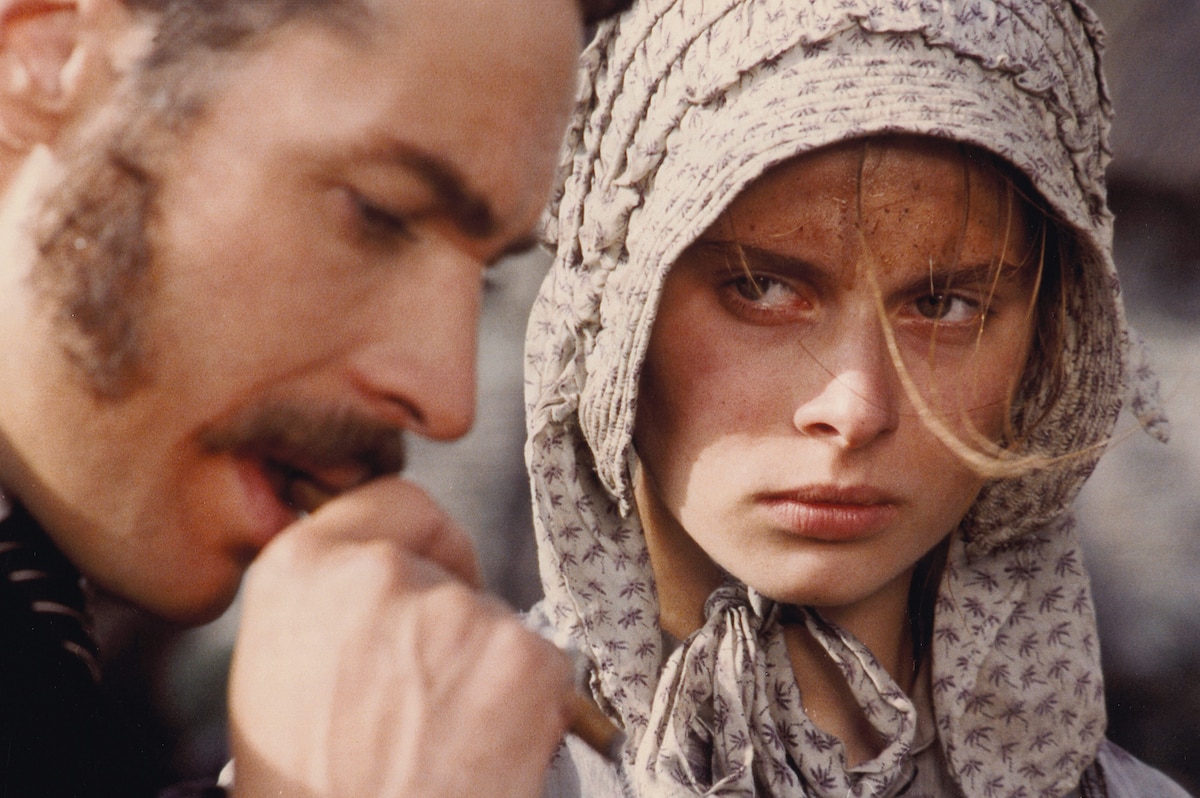
That being said, it's hard to shake some of Tess's most exquisitely beautiful imagery, such as the lovely natural light of an outdoor dance, or the riders and dogs on a fox hunt who appear out of a sublime mist, or the face of Nastassia Kinski, who is heart-stoppingly gorgeous (a quality, incidentally, that is vital to the story). Cinematographer Geoffrey Unsworth, who had shot such films as Becket (1964) and Cabaret (1972), died a few weeks into production and was replaced by Ghislain Cloquet, who sadly would himself pass away two years later. They shared the Oscar for Best Cinematography. The film also won for Best Art Direction and Best Costume Design and was nominated for Best Picture, Best Director and Best Original Score.
Criterion's dual-format release contains one Blu-ray disc and two DVDs, with both formats containing the film and identical extras. And there are plenty, starting with three short documentaries about the film's making (originally included in Columbia's 2004 DVD release), directed by Laurent Bouzereau and totaling 73 minutes in length. Bouzereau expertly interviews key players like Polanski, producers Claude Berri and Timothy Burrill, co-writer John Brownjohn, actors Nastassia Kinski and Leigh Lawson, set decorator Pierre Guffroy, costume designer Anthony Powell, hair and makeup artists, the crew electrician, the assistant editor and others. The artists discuss fascinating details of production, like the challenge of getting the "strawberry seduction" scene between Kinski and Lawson just right (which astonishingly was shot on a rainy day despite looking on-screen like the height of warm summer), the creation of the Stonehenge set outside of Paris, and the design of the costumes to be authentic and truly expressive of character -- beautiful without being decorative. Powell is fascinating as he discusses his approach, and also about the little splotch of blood he put on the hem of Tess' dress at a key point in the story, which Polanski shot for maximum impact.
Burrill recalls that on location the filmmakers were only able to see the rushes days after shooting, rather than the next day, and not always under the best conditions. But gradually, he says, "we started to see what was happening, the magic that was coming off the screen, and the extraordinary professionalism of Nastassia.... I don't think there was ever one day when she fluffed a line. She was word-perfect, always."
Second is a 52-minute documentary from 2006 by Daniel Ablin and Serge July entitled Once Upon a Time... Tess. This is also interesting, but it covers much of the same material as the Bouzereau pieces, with many of the same interviewees telling the same stories. It's also not as smoothly edited. But unlike the Bouzereau film, it includes composer Philippe Sarde, and delves more into Polanski's pre-Tess life and career. It also recounts the difficulties in Tess's post-production, particularly concerning the running time. Francis Coppola was brought in by producer Claude Berri to trim the film, which was deemed overlong, but Polanski hated the result, leading to a falling-out between Berri and Polanski and between Polanski and Sarde. Polanski himself eventually trimmed the film by about 20 minutes, resulting in the current running time of 171 minutes.
Third, there's a 1979 episode of the French TV program Cine Regards, running 48 minutes, that looks at the making of Tess and interviews Polanski during the film's production. The interviews with Polanski are revealing, but the real strengths of the piece are the long, uninterrupted slices of life on the set as Polanski directs and thinks through scenes, conducting his orchestra of crewmembers. These sequences go on long enough to make us feel as if we are there.
Fourth is a 1979 episode of the British TV program The South Bank Show, 50 minutes in length, in which host Melvyn Bragg interviews Polanski. And Criterion rounds things out with the film's trailer as well as a handsome printed booklet containing a fine essay by Colin MacCabe and crisp, colorful photos from the film, almost all of which feature the entrancing Nastassia Kinski. It's a beautiful package and motion picture, all very highly recommended.
By Jeremy Arnold
Tess on Blu-ray
by Jeremy Arnold | September 25, 2014
SIGN UP FOR OUR NEWSLETTERS

CONNECT WITH TCM