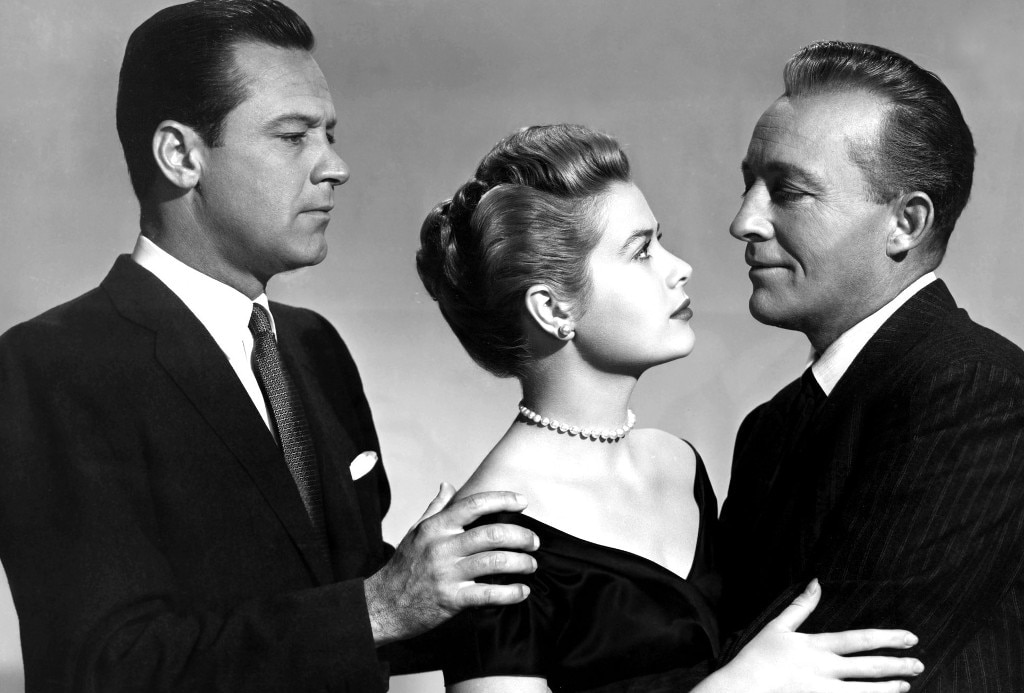
"Crosby Acts in Country Girl" was the title of film critic Bosley Crowther's review of The Country Girl for The New York Times on December 16, 1954. Although Crosby had already appeared in 60 films, and won the Best Actor Oscar® ten years before for Going My Way Crowther firmly placed his emphasis on the word "acts".
"Clifford Odets' poignant drama of a broken-down actor, his loyal wife and a misunderstanding stage director in The Country Girl has been put on the screen with solid impact -- and with Bing Crosby in the actor role. This latter piece of offbeat casting is the most striking thing about the film...For, with all the uncompromising candor of George Seaton's adaptation of the play and with all the intense, perceptive acting of Grace Kelly and William Holden in the other roles, it is truly Mr. Crosby's appearance and performance as the has-been thespian who fights and is helped back to stardom that hits the audience right between the eyes...Although the heroic character is inevitably the wife, who fights for her weak and sodden husband with the last store of energy in her weary frame, it is he -- the degraded husband -- who is the focus of attention here. And the force and credibility of the drama depends upon how he is played. That is why it is Mr. Crosby who merits particular praise, for he not only has essayed the character but also performs it with unsuspected power...he plays the broken actor frankly and honestly, goes down to the depths of degradation without a bat of his bleary eyes and then brings the poor guy back to triumph in a chest-thumping musical show with a maximum of painful resolution and sheer credibility. There is no doubt that Mr. Crosby deserves all the kudos he will get."
Some of the kudos must go to director George Seaton who not only had to coax Crosby into playing the role, but to literally let his hair down: "Come the first day of shooting and at nine-thirty there was no Crosby; ten o'clock, no Crosby; ten thirty and still no Crosby. At eleven I had a call from Wally Westmore - who was head of the make-up department - and he said, 'You'd better come up here, I think you've got big trouble on your hands!'" When Seaton arrived he found that Crosby was wearing an old toupee that he had worn nearly twenty years before. "When I walked in, there sat Bing with his College Humor [1933] wig on! The wavy one he'd worn in all those early films, and he was very defiant. He said, 'I've just decided that this is what I'm going to wear in this picture'".
"I reminded him that we'd already agreed he had to play the character and that he couldn't play College Humor all over again. He said, 'Well, I've got my audience to think of. I don't want to look like an old man on the screen'. I said, 'You won't - you'll look your age - but there's nothing wrong with that, you're playing a character part'...I said, 'Bing, let's be honest, you're frightened' and he almost started to cry and said, 'I can't do it.' I said, 'Please have faith in me, I'm frightened too, so let's be frightened together.' We threw our arms around each other and walked on to the set and from then on there was no problem at all."
It was no secret that Crosby, like many other actors in Hollywood, wore a toupee. Jack Oakie, who appeared with Crosby in College Humor and several other pictures in the early 1930's, dubbed Crosby "the Robot of Romance" because the makeup department had to go to great lengths to enhance Crosby's sex appeal. In addition to the toupee, they fitted Crosby with a corset to make him svelte and used spirit gum to glue his protruding ears closer to his head. Later, when Crosby became more established in films, he ditched the spirit gum and said "Let 'em flap!"
In his own December 1954 New York Times article, Bing Scans His Elgin, Crosby admitted that he had reservations about playing someone so different from his established screen persona. "I suppose it's pretty apparent to anyone who goes to the movies much that through a career of sixty-odd pictures I have played one character -- Bing Crosby. The background changed some, but not very much. The songs were other songs and the people I worked with generally were different people, but I played the same fellow. Really, there seemed to be no great reason to do otherwise. But when [Producer] Bill Perlberg and George Seaton came to me with the Country Girl proposal, I knew the old routine wasn't going to do. Frank Elgin, my part, was a wholly different guy, and I must say I had some serious qualms about my ability to play the role accurately. It was surely something that I had never tried to do before. In fact, I told Seaton two or three times I didn't think I could cut it. I even suggested on several occasions some fellows I thought would be infinitely better choices, but George was firm. I think really he just wanted to see if I had guts enough to try. He told me if I carried it off I'd have done something of which I could really be proud."
For co-stars, Crosby had Grace Kelly, whom he had briefly dated, and William Holden (who was having an on-again, off-again affair with Kelly at the time). According to various accounts, Crosby resumed his romance with Kelly during shooting and Holden stepped aside out of respect for Crosby. The romance grew serious on Crosby's side, as Kelly's sister Lizanne later recalled, "He really wanted to marry her. She called me up one night and said 'Bing has asked me to marry him'. But I don't think she was in love with him at all. Grace loved him but she was not in love . There is a difference."
Ironically, Crosby - who had the right of approval for his leading ladies - had not wanted Kelly cast as his wife when his first choice, Jennifer Jones, had to drop out of the project when she became pregnant. He thought Kelly was "too pretty" to play an unglamorous role. Kelly was upset when she heard this: "I just had to be in The Country Girl. There was a real acting part in it for me. Sometimes I had to act before, but I had beautiful clothes, or beautiful lingerie, or glamorous settings to help me. Many times I was just the feminine background for the male stars who carried the action and the story on their shoulders."
Perlberg and Seaton campaigned on Kelly's behalf and eventually Crosby relented, but the first week of filming wasn't easy. Kelly said, "It was a wonderful opportunity for me and I was very anxious, but we didn't pay much attention to one another and we really didn't get on too well during the first week we were working. After the first rushes the strain sort of came though and George Seaton said, 'Look, we're going to have to shoot this all over again.' We did - and it started to work from then on. It was a very happy picture and took only five or six weeks to make." Crosby told Perlberg and Seaton, "I'll never open my mouth to you two again. I'm sorry I had my doubts about her. She's great."
Turning the beautiful Kelly into a plain and depressed housewife was no easy task. Producer's assistant Arthur Jacobson attended the first costume tests conducted by famed designer Edith Head, "We looked at twenty-four sweaters before we settled on the one that looked dowdy enough. Edith found this drab dress, and we gave Grace some heavy spectacles and we pushed them back on her forehead. By the time the hairdresser had finished with her and we had her standing by an ironing board with a basket of washing, she looked like a different woman." Edith Head was delighted, "I didn‘t think we could do it" she told Kelly, "You look extremely depressed, Grace. I congratulate you."
Crosby threw himself into his role. "First off, I asked George [Seaton] to write me a biography of Frank Elgin. I wanted him to start right back at the cradle, to tell me about his parents, his boyhood, his friends and companions, where he went to school and how he got into show business -- everything that ever happened to Frank Elgin before we pick him up in the play. George provided me with quite a dossier on this boy, and I read it over very carefully, and I read the play over several times -- [Clifford] Odets' play -- and slowly, but very clearly, a definite personality began to emerge. As a matter of fact, I got real brave and even questioned some of the motivations in the piece. Incredibly, I was right in one or two instances, and I was instrumental in some re-tailoring of the character. Well, now that we had Elgin card-indexed, analyzed and blueprinted, the rehearsals began -- first, just George and I alone, and then with Grace Kelly and Bill Holden, and I want to tell you these rehearsals were pretty thorough. Two weeks of them, ten hours a day, and George drilling me like a top-kick. I must confess there were times when I got a little impatient. There were times when it seemed to me that he was picking lint, but I stayed in there and did like a good boy. I had rehearsed for pictures before -- you know, 'Who takes the harmony on the second chorus?' or 'Let's all make together on the 'eight bars lively and off.' But never two weeks on dialogue, characterization, reactions and bits of business -- where and how to spot a look, a nuance or an expression that would tie the whole thing together."
He was particularly careful with his drunk scene in which Elgin is in a Boston jail after binge-drinking. While Crosby was known off-screen as a heavy drinker, he achieved the realistic effect completely sober. His son, Dennis said, "I can remember that very clearly, because he made Philip [his brother] and I stay up with him the night before he did that drunk scene. He wouldn't go to sleep so we walked with him and kept him up. He usually liked to go to bed early and get up early, but that next morning his eyes were all red and he looked like he'd been drinking. I think when he wants to act, he can act."
Crosby's mother, who rarely visited his film sets, happened to be present when the scene was filmed, to the amusement of director Seaton. "Bing just looked awful. It was perfect for the scene and Mrs. Crosby brought three women friends with her who were very straight-laced. She came in and looked at Bing, who was sitting at a table exhausted and said, 'Harry!' [Crosby was born Harry Lillis Crosby] Then she walked right off the set, sure that he'd been drinking. I had to chase her down the street and assure her this was not the case, but she didn't come back."
When it was all over, Bing Crosby wrote, "Well, the picture has been cut and edited and scored and it's been shown around in several places, but I haven't seen it yet. Honestly, I'm afraid to. I don't want to see it in a cold projection room with a couple of fellows -- I want to wait until I can catch it in front of a live audience, and until I can sense what their reaction is as the picture unfolds. Maybe I won't be good in the picture -- maybe I shouldn't have taken the part, but I know that Grace Kelly and Bill Holden are good, because I worked with them day after day and they moved me on many occasions. Maybe the critics will blast me, but I won't be annoyed -- I've been impaled before. Of course, if the picture is a success and everybody likes it, then it's a beautiful parlay."
He needn't have worried. The Country Girl earned him the best reviews of his career. The film was nominated for seven Academy Awards, including Crosby for Best Actor (he lost to Marlon Brando for On the Waterfront). Grace Kelly won Best Actress in a Leading Role and George Seaton won for Best Writing, Screenplay. And it proved that Bing Crosby could, indeed, act.
Producer: William Perlberg, George Seaton
Director: George Seaton
Screenplay: George Seaton, based on the play by Clifford Odets
Cinematography: John F. Warren
Editing: Ellsworth Hoagland
Music: Victor Young
Art Direction: Roland Anderson, Hal Pereira
Cast: Bing Crosby (Frank Elgin), Grace Kelly (Georgie Elgin), William Holden (Bernie Dodd), Anthony Ross (Phil Cook), Gene Reynolds (Larry), Jacqueline Fontaine (Singer-Actress), Eddie Ryder (Ed).
BW-105m.
by Lorraine LoBianco
The Country Girl
by Lorraine LoBianco | September 23, 2005
SIGN UP FOR OUR NEWSLETTERS

CONNECT WITH TCM